
If you only have one day in Rome and want to avoid the crowds at the most famous monuments, this itinerary takes you to discover another city: that of hidden Baroque churches, quiet Renaissance palaces, and historic neighborhoods where you can still breathe an authentic atmosphere. It's a perfect route for those seeking an intense and original cultural experience, away from the usual tourist circuits. We'll start from Trastevere, but not from the main square: we'll explore less-traveled alleys, discover masterpieces like the Church of Santa Maria della Scala and Palazzo Spada, and lose ourselves in the Renaissance elegance of Piazza Farnese. This one-day itinerary in Rome is designed for art lovers who want to see the city with different eyes, without rushing. I'll guide you step by step, with practical advice on timings and how to get around best.
🗺️ Your trip at a glance
This one-day Rome itinerary takes you to discover hidden Baroque churches, quiet Renaissance palaces, and historic neighborhoods with authentic atmospheres, away from the most crowded tourist routes. It's a carefully designed route for curious travelers who want an intense and original cultural experience, with an interactive map guiding you step-by-step through the 10 stops.
- Ideal for curious travelers seeking an intense and original cultural experience, away from the usual tourist circuits.
- Highlights: 10 stops with an interactive map, hidden Baroque churches like Sant'Andrea delle Fratte, Renaissance palaces like Palazzo Farnese, and authentic neighborhoods.
- Who it's for: art and architecture enthusiasts who want to see Rome with different eyes, without rushing and in peaceful settings.
Itinerary stops
Stop no. 1
Basilica of Santa Maria del Popolo
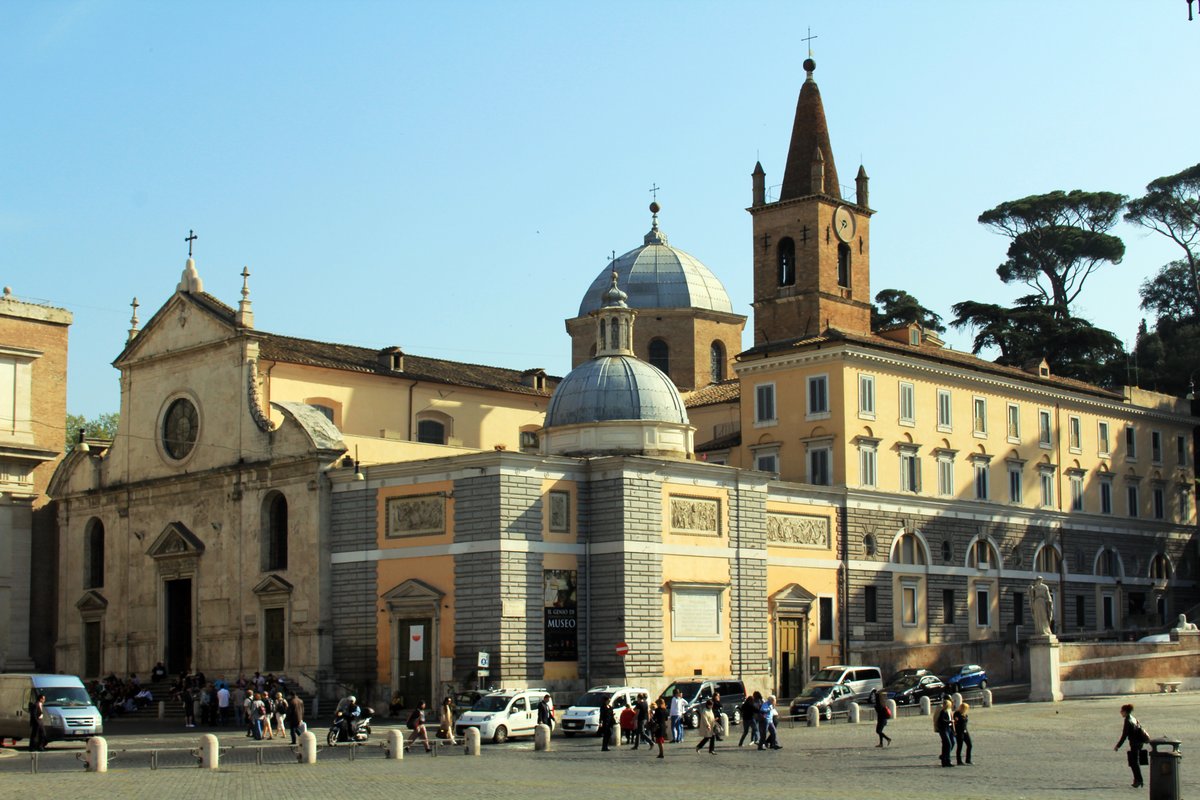 We begin our itinerary Rome in a Day: Art and Hidden Neighborhoods right here, at the Basilica of Santa Maria del Popolo, a place often overlooked by hurried tourists but which instead holds unexpected treasures. Located at the northern entrance of Rome, at Piazza del Popolo 12, this church is a concentration of Renaissance and Baroque art. Inside, you can admire works by Caravaggio, such as the Conversion of Saint Paul and the Crucifixion of Saint Peter, as well as masterpieces by Pinturicchio and Bramante. Its history dates back to 1099, when it was built to exorcise the ghost of Nero, but it was completely renovated in the 15th century. Today, with its simple facade and sumptuous interior, it offers a cozy and authentic atmosphere, away from the crowds of more famous sites. It is the perfect starting point to immediately immerse yourself in Roman art and culture, without wasting time.
- Piazza del Popolo 12, Roma (RM)
- https://www.agostiniani.it/comunita-agostiniane-provincia/parrocchia-santa-maria-popolo/
- Open in Google Maps
- View on Google Images

You should go if...
Stop no. 2
Piazza del Popolo
 After exploring the first glimpses of our itinerary, you now find yourself in Piazza del Popolo, one of the city's most iconic locations. This elliptical square, designed by Giuseppe Valadier in the 19th century, serves as a monumental entrance to Rome for those arriving from the north. At its center stands the Egyptian obelisk of Ramses II, brought here from the ancient Circus Maximus. On the sides, the twin churches of Santa Maria in Montesanto and Santa Maria dei Miracoli create perfect symmetry, while the Basilica of Santa Maria del Popolo, on the left, houses masterpieces by Caravaggio and Raphael. Climbing up to the Pincio, you can enjoy a breathtaking panoramic view of the entire square and beyond, towards the historic center. It's a strategic point to understand how Rome blends different eras into a single, harmonious public space.
- Roma (RM)
- Open in Google Maps
- View on Google Images
You should go if...
Stop no. 3
Pincio
 Leaving behind the wide expanse of Piazza del Popolo, a short climb leads you to the Pincio, one of the city's most famous panoramic points. This hill, an integral part of Villa Borghese, was arranged in the early 19th century based on a design by Giuseppe Valadier, the same architect of the square below. Its main avenue, shaded by maritime pines and holm oaks, invites a contemplative pause. Along the path, busts of illustrious Italian figures seem to watch over the stroll. But it's upon reaching the terrace that the breathtaking view leaves you speechless: from here, you can take in Rome's entire skyline, from the dome of St. Peter's to the Vittoriano, with Piazza del Popolo spreading out in perfect geometry at your feet. It's the ideal place to observe how the city has layered over the centuries, uniting the greenery of gardens with monumental architecture.
- Roma (RM)
- Open in Google Maps
- View on Google Images
You should go if...
Stop no. 4
Piazza di Spagna
 Descending from the Pincio, you find yourself immersed in the eighteenth-century elegance of Piazza di Spagna, a place that perfectly embodies the spirit of Rome between art and daily life. The heart of the square is the famous Spanish Steps, designed by Francesco De Sanctis and completed in 1725, which with its 135 steps connects the church above to the square below. At its feet, the Barcaccia Fountain, a work by Pietro Bernini and the young Gian Lorenzo, appears to float on the water with surprising realism. The square takes its name from the Palazzo di Spagna, seat of the Spanish Embassy to the Holy See since the 17th century, which dominates the southern side with its austere facade. Today, the area is a lively crossroads of tourists, street artists, and locals enjoying the atmosphere, surrounded by luxury boutiques and historic cafes like the Antico Caffè Greco, founded in 1760. It's the ideal spot for a break while watching the comings and goings, before continuing towards the next discoveries on this itinerary dedicated to hidden neighborhoods.
- Roma (RM)
- Open in Google Maps
- View on Google Images
You should go if...
Stop no. 5
Trinità dei Monti Church
 After admiring Piazza di Spagna, climb the 135 steps of the staircase to reach the Trinità dei Monti Church, a French gem that overlooks Rome from above. Built between the 16th and 17th centuries at the behest of the King of France, this Catholic church is managed by monks of the Order of Saint Augustine and offers a unique blend of Gothic and Renaissance styles. Inside, don't miss the frescoes by Daniele da Volterra, such as the famous Deposition, and the chapel dedicated to Saint Francis of Paola. The façade, completed in 1585, overlooks a panoramic terrace that offers a spectacular view of the city's rooftops, perfect for taking memorable photos. It's an ideal spot for a contemplative break away from the tourist crowds, before continuing on to other discoveries in this itinerary dedicated to art and hidden neighborhoods.
- Scalinata della Trinità dei Monti, Roma (RM)
- https://trinitadeimonti.net/
- Open in Google Maps
- View on Google Images
You should go if...
Stop no. 6
Basilica of Sant'Andrea delle Fratte
 Leaving behind the panoramic view of Trinità dei Monti, descend towards Via di Capo le Case to discover the Basilica of Sant'Andrea delle Fratte, a Baroque gem often overlooked by the busiest tourist routes. Built in the 17th century based on a design by Francesco Borromini and completed by other architects, this Catholic church impresses with its facade of red bricks and travertine, which blends discreetly with the surrounding buildings. Inside, prepare to be amazed by the two marble angels created by Gian Lorenzo Bernini, originally intended for Ponte Sant'Angelo and preserved here as masterpieces of Baroque sculpture. The dome, decorated with frescoes by Giovanni Battista Gaulli, illuminates the main altar dedicated to Saint Andrew, creating an intimate atmosphere perfect for a contemplative pause. It is an ideal place for those who, on this one-day itinerary dedicated to art and hidden neighborhoods, want to immerse themselves in an authentic work of art away from the hustle and bustle.
- Via di Capo le Case, Roma (RM)
- https://www.madonnadelmiracolo.it/
- Open in Google Maps
- View on Google Images
You should go if...
Stop no. 7
Basilica of Sant'Andrea della Valle
 After admiring the Bernini sculptures at Sant'Andrea delle Fratte, continue along Corso Vittorio Emanuele Secondo to reach the Basilica of Sant'Andrea della Valle, a Baroque masterpiece that often surprises visitors with its imposing dimensions. Built between the 16th and 17th centuries based on a design by Giacomo della Porta and completed by Carlo Maderno, this Catholic church is famous for its dome, the second highest in Rome after St. Peter's, which towers over the neighborhood with an unmistakable silhouette. Inside, walk along the central nave to discover Domenichino's frescoes in the Chapel of St. John the Baptist and those by Mattia Preti on the vault, which tell stories of Saint Andrew with dramatic realism. The main altar, decorated with polychrome marbles, houses the saint's relics, while the historic organ adds a touch of majesty during celebrations. It is an essential stop on this one-day itinerary dedicated to art and hidden neighborhoods, perfect for those who want to immerse themselves in an authentic Baroque experience without the crowds of more touristy places.
- Corso Vittorio Emanuele Secondo, Roma (RM)
- https://santandrea.teatinos.org/
- Open in Google Maps
- View on Google Images
You should go if...
Stop no. 8
Campo de' Fiori
 Leaving behind the Baroque majesty of Sant'Andrea della Valle, you immerse yourself in one of the most vibrant and authentic squares in the historic center. Campo de' Fiori is a place with a dual soul: in the morning, its neighborhood market, one of Rome's oldest, bursts with stalls of fruit, vegetables, flowers, and local products, offering a genuine glimpse into everyday Roman life. The scent of aromatic herbs mingles with the voices of vendors, creating a lively atmosphere far from the more beaten tourist paths. At the center of the square, the statue of Giordano Bruno, erected in 1889 on the spot where the philosopher was burned at the stake in 1600, recalls the area's historical past. In the evening, the market gives way to tables of local bars and wine bars, turning the square into an informal meeting point. In this one-day itinerary dedicated to art and hidden neighborhoods, Campo de' Fiori represents a vital and sensory break, perfect for savoring the city's popular essence.
- Roma (RM)
- Open in Google Maps
- View on Google Images
You should go if...
Stop no. 9
Farnese Palace
 After the liveliness of Campo de' Fiori, you find yourself in front of one of the most imposing Renaissance palaces in Rome. Farnese Palace, designed by Antonio da Sangallo the Younger and completed by Michelangelo, dominates the namesake square with its travertine façade, an example of architecture that has influenced many subsequent buildings. Today the seat of the French Embassy in Italy, access to the interiors is limited, but it's worth admiring the central courtyard and, if possible, joining a guided tour to see the Gallery of Mirrors with frescoes by Annibale Carracci, considered among the masterpieces of the Baroque. The square in front, with its twin fountains crafted from ancient Roman basins, adds a touch of elegance. In this one-day itinerary dedicated to art and hidden neighborhoods, Farnese Palace represents a moment of reflection on the grandeur of the Renaissance, away from the crowds of the most famous monuments.
- Go to the page: Palazzo Farnese in Rome: Carracci Gallery and Renaissance Facade
- Piazza Farnese, Roma (RM)
- https://www.farnese-rome.it/
- Open in Google Maps
- View on Google Images
You should go if...
Stop no. 10
Church of Sant'Andrea al Quirinale
 After admiring the Renaissance grandeur of Palazzo Farnese, the Church of Sant'Andrea al Quirinale surprises you with its Baroque intimacy. Designed by Gian Lorenzo Bernini for the Jesuits, this church is considered one of his most refined masterpieces. The convex facade, in travertine and brick, anticipates the oval-shaped interior, where light plays a fundamental role: it enters from above through a golden lantern, illuminating the white stuccoes and polychrome marbles. The main altar, with the altarpiece of Sant'Andrea by Guillaume Courtois, creates a focal point of great intensity. In this one-day itinerary dedicated to art and hidden neighborhoods, Sant'Andrea al Quirinale offers a moment of silent contemplation, away from the tourist bustle, allowing you to appreciate how Bernini transformed a small space into a total architectural experience.
- Via del Quirinale 30, Roma (RM)
- https://santandrea.gesuiti.it
- Open in Google Maps
- View on Google Images
You should go if...