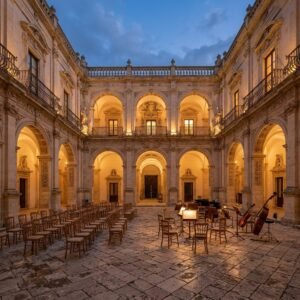
The former Church of Sant’Agostino in Trapani is a 17th-century multipurpose auditorium with a Baroque facade in tuff stone. Located in the heart of the historic center, it hosts concerts, conferences, and exhibitions in an environment with exceptional acoustics and a unique atmosphere.
- Baroque architecture from 1628 converted into an auditorium in 1997
- Natural acoustics perfect for classical and acoustic concerts
- Captivating atmosphere with red armchairs and warm afternoon light
- Free admission when no events are scheduled
Introduction
Have you ever walked into a place and immediately felt it had a soul? The former Church of Sant’Agostino in Trapani is exactly like that. From the outside, the Baroque façade strikes you with its 17th-century Sicilian style, somewhat austere yet rich in details that tell stories. Then you step through the door and the atmosphere changes completely: you’re no longer in a church, but in a modern auditorium, with those red seats contrasting against the ancient walls. It’s one of those places where past and present blend naturally, without any forcing. The space is intimate, the acoustics are excellent – I’ve heard this from those who’ve attended concerts there – and there’s a special light filtering through the high windows, especially in the afternoon. It’s not just a monument to see: it’s a place to experience, particularly when it hosts events. Personally, I like to think that those walls, once dedicated to the silence of prayer, now resonate with music and voices. It’s a small miracle of adaptive reuse, typical of a city like Trapani that knows how to value its history without embalming it.
Historical Background
The history of this building begins in 1628, when the Augustinian friars decided to build their church here, in the heart of Trapani’s historic center. It took them a few years, as was often the case, and the facade we see today was only completed in the 18th century, in full Sicilian Baroque style. For centuries, it was an important place of worship, until after the unification of Italy, laws suppressed many religious orders. The church was closed and began a period of abandonment. Then, in the 1990s, came the turning point:
a clever restoration transformed it into an auditorium, inaugurated in 1997. It wasn’t an invasive intervention: they maintained the original structure, adding only what was needed to host performances. Today, where there were once altars, there is the stage and seats. It always strikes me to think about how many changes this space has seen, from the friars’ prayers to the notes of today’s concerts. A concise timeline:
- 1628: Construction of the church for the Augustinian friars begins.
- 18th century: Completion of the facade in Sicilian Baroque style.
- After 1866: Closure following laws suppressing religious orders.
- 1990s: Restoration and conversion into an auditorium.
- 1997: Inauguration as a municipal auditorium.
The Surprising Acoustics
One of the most interesting aspects of this auditorium, and perhaps the least obvious for those who only visit during the day, is its acoustics. I’m not a sound technician, but I’ve spoken with local musicians who confirmed that the sound here is excellent, truly excellent. The rectangular shape of the nave, the high vaults, and the wall materials (stone and plaster) create a natural resonance that enhances the music, especially classical or acoustic pieces. During a concert, the sound seems to envelop you without any annoying echoes. It’s a detail you might not notice if you just pop in for a quick visit, but it makes all the difference when the auditorium comes to life. Sometimes, if you’re lucky and pass by when there are no events, you can even try clapping your hands to hear the effect – many people do this, it’s a curious little test. This makes the former church not just a beautiful architectural container, but a genuine instrument for art. I believe it’s precisely this quality that makes it one of the preferred venues for Trapani’s more intimate and cozy music festivals, compared to larger theaters.
A Quiet Corner in the Heart of the City
Trapani is a lively city, especially in its historic center where tourists and locals mingle. The former church of Sant’Agostino, however, offers an unexpected island of peace. Even when there are no events, it is often open for visits (just check the hours, which may vary) and stepping inside is like taking a momentary break from the hustle and bustle. The air is cool, the silence is almost palpable, and you can sit in one of the red armchairs and observe the details: the stuccoes on the walls, the light playing on the surfaces. It’s a place to stop and breathe, literally. I happened to visit on a hot August day, and the contrast with the outdoor heat was delightful. It’s not a crowded museum, so you can enjoy it at your own pace. Sometimes, if you’re lucky, you might come across preparations for an evening event—light setups, sound checks—which adds an atmosphere of anticipation. It’s one of those places that works both as a cultural destination and a momentary refuge, a dual soul that makes it special.
Why Visit It
For at least three concrete reasons. First, it’s a perfect example of how to give new life to a historical monument without distorting it: here you won’t find a static church-museum, but a living place that hosts concerts, conferences, and cultural events year-round. Second, the Baroque architecture of the facade is a small gem to admire, with those carved details that tell the story of 17th-century Trapani – if you’re passionate about art history, it’s worth it. Third, the internal atmosphere is unique: the mix of ancient and modern (the red armchairs against the centuries-old walls) creates a strong visual impact, and the acoustics, as I mentioned, are excellent. Visiting it gives you an idea of how Trapani knows how to blend tradition and contemporaneity. And then, let’s face it, it’s free if you enter outside of events, which never hurts.
When to Go
If you want to experience the most enchanting atmosphere, I recommend going in the late afternoon, around sunset. The light streaming through the side windows becomes warmer and longer, illuminating the walls spectacularly and creating shadow plays that highlight the architectural details. Additionally, the auditorium is often quieter at that time, as the morning tour groups have already left. If you prefer to experience it in full swing, try to time your visit with an evening event: a concert or a reading. The atmosphere changes completely, with low lighting and the magic of the performance. Personally, I have a soft spot for the spring or autumn months, when the climate in Trapani is mild and you can stroll through the historic center before or after, without the summer heat that can sometimes be tiring. But even in winter, on a windy day (we have plenty here!), finding shelter here is pleasant.
In the Surroundings
The former church is located in the heart of Trapani’s historic center, so you’re spoiled for choice when it comes to continuing your exploration. Here are two thematic suggestions. First, the Pepoli Regional Museum, just a few minutes’ walk away: housed in a former Carmelite convent, it features artworks, archaeological finds, and decorative arts that tell the story of Trapani and western Sicily. It’s perfect for delving deeper into the city’s cultural context. Second, a stroll along Via Torrearsa, Trapani’s main shopping and promenade street, filled with shops, historic cafés, and elegant palazzos. You’ll immerse yourself in the city’s daily life and might even stop for a cannolo or a granita at one of the traditional pastry shops. Both locations are within walking distance, with no need for transportation.