
The Aidone Archaeological Museum, housed in the former Capuchin monastery, preserves the artifacts of ancient Morgantina, including the famous Goddess of Morgantina, a 5th-century BC acrolithic statue returned after a long restoration. The exhibition includes ceramics, locally minted coins, and everyday objects that tell the story of the Greco-Roman colony.
- Goddess of Morgantina: 5th-century BC marble acrolithic statue, returned in 2011 after a lengthy restoration.
- Domestic collection: Terracotta pots, loom weights, oil lamps, and terracotta toys illustrating daily life.
- Cult artifacts: Architectural terracottas from temples, votive statuettes of Demeter and Kore, and libation vessels.
- Local coins: Evidence of Morgantina’s economic autonomy, minted in the city’s own mint.
Events nearby

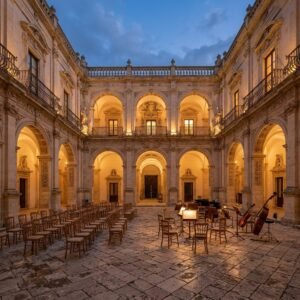

Admire the 5th-century BC acrolithic statue of the Goddess of Morgantina and discover daily life in the ancient Greek city through ceramics, coins, and terracotta toys, displayed in the former Capuchin monastery.
- https://www.regione.sicilia.it/beniculturali/dirbenicult/database/page_musei/pagina_musei.asp?ID=22&IdSito=40
- Largo Torres Truppia 1, Enna (EN)
- +39 0935 87307
- Open in Google Maps
- View on Google Images Museo Archeologico di Aidone a Enna
Good to know
Introduction
Entering the Aidone Archaeological Museum is like opening a window onto ancient Morgantina, the Greek city that once dominated these hills. This is no dusty, conventional museum: here you breathe in history through artifacts that tell stories of daily life, religious cults, and commercial exchanges. The real eye-opener comes with the Goddess of Morgantina, the acrolithic statue that, after a lengthy restoration, has returned to its original home. Her presence dominates the room, with that enigmatic smile that seems to guard millennia-old secrets. Housed in the former Capuchin convent, the museum perfectly blends sacred architecture and archaeology, creating a unique atmosphere where every display case reveals another piece of this territory’s complex history.
Historical Overview
The museum was established to preserve the artifacts from the Morgantina excavations, a city founded by the Sicels and later Hellenized. Systematic excavation campaigns, beginning in the 1950s, have uncovered evidence spanning from the Bronze Age to the Roman era. Particularly significant are the findings from the archaic settlement on the Citadel and those from the Hellenistic agora. The museum itself has an interesting history: the 17th-century convent building has been skillfully repurposed to house the archaeological treasures, creating a perfect dialogue between container and content.
- 5th century BC: Period of Morgantina’s greatest splendor
- 1955: Beginning of systematic American excavations
- 1984: Museum opens in the former convent
- 2011: Definitive return of the Goddess of Morgantina
The Collection of Domestic Treasures
A particularly fascinating section is dedicated to the daily life of the ancient inhabitants of Morgantina. Here you won’t find just luxury items, but especially artifacts that tell us how people actually lived: terracotta pots for cooking, loom weights for wool working, oil lamps for lighting. Particularly evocative are the terracotta toys, small animals and dolls that remind us how children two thousand years ago had the same need for play as ours do. The coins minted at the local mint testify to the city’s economic autonomy, while the remains of lava stone millstones speak of an economy based on cereal cultivation. Every object, however humble, helps reconstruct the puzzle of ancient life.
The Architecture of the Sacred
The museum dedicates ample space to the cult objects from the sanctuaries of Morgantina, offering a privileged insight into ancient religious practices. The architectural terracottas that adorned temple roofs stand out, with their vibrant polychromy still partially visible. The votive statuettes of Demeter and Kore, deities particularly venerated in this grain-rich area, tell of a cult deeply rooted in the territory. Also of interest are the libation vessels and portable altars, which help us imagine the rituals that took place in the sanctuaries. The arrangement of the artifacts follows a topographical criterion, allowing each object to be associated with the specific place of worship from which it originates.
Why You Should Visit
Three concrete reasons not to miss this museum: first, the Goddess of Morgantina is a unique masterpiece in the Sicilian archaeological landscape, with its rare acrolithic technique combining marble and precious materials. Second, the exhibition layout is extremely clear and educational, with panels that explain each artifact without unnecessary technical jargon. Third, the strategic location allows you to combine the museum visit with the archaeological area of Morgantina, just a few minutes’ drive away, creating a complete experience that takes you directly from the museum to the excavation site.
When to Go
The best time to visit is the early afternoon, when natural light filtering through the former convent’s windows creates particularly evocative chiaroscuro effects on the statues. Avoid peak hours for organized groups, typically between 10 am and 12 pm. As for the season, late spring is ideal: the mild weather allows you to fully enjoy both the museum and the subsequent visit to the archaeological area, without the summer heat that can make moving between the two sites tiring.
In the Surroundings
Complete your experience with a visit to the Archaeological Area of Morgantina, where you can walk among the remains of the agora, the theater, and the baths. A few kilometers away, Pietratagliata Castle offers a fascinating example of medieval architecture with panoramic views over the valley. For a taste of local food and wine, stop by one of the area’s farms producing Nero d’Avola, the native grape variety that has characterized these lands for centuries.
Itineraries nearby


💡 Did You Know…?
The Goddess of Morgantina, known as the ‘Venus of Morgantina’, was looted in the 1970s and returned by the Getty Museum only in 2011 after a long legal dispute. Today, her return symbolizes the reclamation of Sicilian cultural heritage. At the museum, don’t miss the silver coins minted in Morgantina, which testify to the city’s economic importance in ancient times.