
Macerata’s Arena Sferisterio, built in 1829, is one of Italy’s most captivating open-air theatres, renowned for its perfect acoustics and summer opera season. With 3000 seats and a 90-metre façade, it offers a unique opera experience without amplification in a neoclassical setting.
- Natural acoustics that require no microphones, with clear sound reaching the back rows
- Macerata Opera Festival from July to August featuring innovative productions and tickets from 25 euros
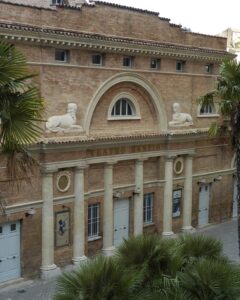
- Neoclassical architecture with 56 red brick arches and one of the world’s largest opera stages
- History beginning in 1823 for the game of pallone al bracciale, transformed into an opera temple since 1921
Events nearby


Macerata’s Arena Sferisterio is a neoclassical amphitheatre from 1829, famous for the summer Macerata Opera Festival with natural acoustics and 3000 seats. Discover its history, architecture, and performances under the stars.
- https://www.sferisterio.it/
- Via Diomede Pantaleoni, Macerata (MC)
- Open in Google Maps
- View on Google Images Arena Sferisterio a Macerata
Good to know
Introduction
When you arrive at the Arena Sferisterio in Macerata, you’re immediately struck by its grandeur: a neoclassical amphitheatre that dominates the cityscape with its imposing red brick arches. Built in 1829 based on a design by Ireneo Aleandri, this place is not just a historical monument but a true temple of opera that transforms every summer into one of Italy’s most evocative stages. Its perfect acoustics, designed to amplify every note without the need for microphones, completely envelop you during performances. Walking among its stands makes you feel part of a centuries-old tradition, while your gaze sweeps from the auditorium to the starry summer night sky. It’s an experience that uniquely combines art, architecture, and emotion in the Marche region.
Historical Overview
The Arena Sferisterio was built in 1823 as a court for the game of pallone al bracciale, a popular sport of the time, on the initiative of a group of Macerata nobles. Architect Ireneo Aleandri designed a semicircular structure inspired by Roman amphitheaters, completed in 1829. In 1921 came the turning point: the first opera season with Verdi’s Aida forever transformed the venue’s purpose. Since then, the arena has hosted artists of the caliber of Maria Callas, Luciano Pavarotti, and Plácido Domingo, becoming an international opera landmark. Today, the Macerata Opera Festival attracts thousands of enthusiasts from around the world each year.
- 1823: Construction begins for pallone al bracciale
- 1829: Completion of the arena designed by Ireneo Aleandri
- 1921: First opera season with Verdi’s Aida
- 1967: Birth of the Macerata Opera Festival
- 1980s-1990s: Performances by major international artists
Perfect Acoustics and Architecture
The magic of the Arena Sferisterio lies in its natural acoustics that require no amplification. The semicircular shape and brick walls create perfect resonance: every whisper on stage reaches the back row of the 3,000 seats with crystal clarity. The 56 neoclassical arches are not merely decorative: they function as sound reflectors that distribute sound evenly throughout the space. During rehearsals, you can witness technicians testing the acoustics by positioning themselves at specific points in the cavea. The 18-meter-high structure creates an amplification effect that has amazed even the most experienced orchestra conductors. It’s one of the few open-air theaters where opera maintains its full power without technical compromises.
Macerata Opera Festival
The Macerata Opera Festival is the event that brings the arena to life every summer from July to August. This is not just an opera season: it’s a celebration of opera that transforms the city. Productions are often innovative, with contemporary stagings that dialogue with the historic architecture. During the festival, the arena lights up with spectacular sets: for Nabucco they recreated the walls of Babylon, for Turandot they used projections that enveloped the entire facade. Before the performances, the square outside comes alive with musical aperitifs and meetings with the artists. Tickets starting from €25 for bleacher seats allow you to experience world-class opera in a truly unique setting.
Why Visit It
Visit the Sferisterio Arena for three concrete reasons. First: the unique acoustic experience – listening to an opera without amplification in an open-air theater is extremely rare. Second: the summer atmosphere – July and August evenings with stars above the stage create pure magic. Third: accessibility – even with inexpensive tickets you get a perfect view thanks to the semicircular structure. Plus, you can combine culture and relaxation: after the show, Macerata’s historic center offers venues where you can continue the evening. It’s an investment in emotions that remain imprinted in your memory.
When to Go
The best time to visit the Arena Sferisterio is during the Macerata Opera Festival evenings between July and August. The mild temperatures of the Marche summer and the starry sky create the perfect atmosphere for enjoying open-air performances. Arrive an hour before the show to admire the sunset painting the brick arches red. If you prefer a quieter visit, spring or autumn afternoons allow you to explore the arena in solitude, when the slanting light enhances the architectural details. Avoid rainy days: performances are postponed if weather conditions don’t permit.
In the Surroundings
Complete your experience with a visit to the Carriage Museum in Macerata, just a few minutes’ walk from the arena, which houses a unique collection of 19th-century historical vehicles. For a striking contrast, head to the Village of Sarnano, characterized by medieval alleys and natural thermal baths where you can relax after the show. If you love craftsmanship, the ceramic workshops in Recanati produce items inspired by Marche tradition. These places enrich your visit by showcasing other aspects of the Macerata territory.
Itineraries nearby

💡 Did You Know…?
The Arena Sferisterio was built based on a design by Ireneo Aleandri, the same architect behind the Sferisterio of Macerata. During World War II, it was used as a shelter for displaced persons. Today, in addition to opera, it hosts pop music concerts and cultural events, keeping alive the Maceratese theatrical tradition that dates back to the 18th century.