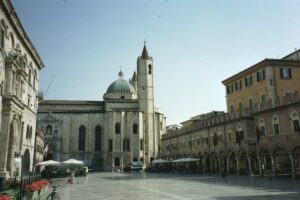
Are you ready to discover the Renaissance heart of Macerata? This cultural itinerary through the historic center will lead you to explore the city's artistic and architectural treasures in an intense yet memorable day. Start at Piazza della Libertà, dominated by the elegant Loggia dei Mercanti, and continue to the majestic Palazzo Buonaccorsi, where you can admire the splendid Sala dell'Eneide. Don't miss the Teatro Lauro Rossi, an 18th-century gem, and the Cathedral of San Giuliano with its unfinished facade. Stroll along Corso della Repubblica among noble palaces and discover the Arena Sferisterio, famous for its opera season. With this Macerata historic center cultural itinerary, you'll experience a journey through time between the Renaissance and Baroque eras, perfect for art lovers who don't want to miss the authenticity of a vibrant university town.
🗺️ Your trip at a glance
A 1-day walking itinerary through the Renaissance heart of Macerata, blending art, architecture, and history in a practical and discovery-rich route.
- Ideal for a cultural city break in the Marche region, perfect for those who love art and architecture without sacrificing the authenticity of a university town.
- Highlights: 7 walking stops in the historic center, including the Torre Civica with panoramic views, Palazzo dei Diamanti, and Museo Palazzo Ricci with 20th-century art.
- Perfect for travelers seeking a practical and intensive itinerary, with integrated maps and well-defined stops to optimize time.
Itinerary stops
Stop no. 1
Liberty Square
 Starting the itinerary from Liberty Square means immediately immersing yourself in the Renaissance atmosphere that characterizes Macerata. This urban space, defined by the skillful combination of civil and religious architectures, presents itself as an open book on the city's history. The Loggia dei Mercanti with its round arches dominates the eastern side, while the City Hall and the Lauro Rossi Theatre complete the quadrilateral with their austere facades. At the center, the octagonal fountain adds a touch of lightness to the monumental complex. The square is not just a collection of buildings, but the place where Maceratesi have been meeting for centuries, where market stalls alternate with cultural events. By observing the details of the decorations and the materials used - mainly the brick typical of the Marche tradition - one understands how each element contributes to defining the identity of this symbolic space.
- Piazza della Libertà, Macerata (MC)
- Open in Google Maps
- View on Google Images

You should go if...
Stop no. 2
Civic Tower
 The Civic Tower dominates Piazza della Libertà with its imposing structure dating back to the 15th century. Built as a symbol of municipal power, it now offers a unique panoramic view over Macerata's historic center and the surrounding hills. As you climb its steps, you can feel the history that has spanned centuries, from medieval origins to Renaissance transformations. The tower is an integral part of the City Hall Palace, and its bell has marked the rhythm of city life for centuries. From the top, your gaze sweeps over terracotta rooftops, Baroque churches, and the Marche landscape, making this experience an unforgettable moment for those seeking to capture the essence of Macerata.
- Piazza della Libertà, Macerata (MC)
- Open in Google Maps
- View on Google Images
You should go if...
Stop no. 3
Lauro Rossi
 Leaving the majestic Civic Tower behind, you'll find yourself facing the Lauro Rossi Theatre, located right at 20 Piazza della Libertà. Inaugurated in 1774, this theatre stands as one of the finest examples of Neoclassical architecture in the Marche region. Designed by Cosimo Morelli, the building impresses with its sober yet elegant façade, which conceals an interior rich with decorations and stucco work. The horseshoe-shaped hall, with its gilded boxes and frescoed ceiling, creates an intimate and evocative atmosphere. Here, internationally renowned artists have performed, and to this day, the theatre hosts opera seasons and concerts. Visiting the Lauro Rossi means immersing yourself in Macerata's cultural life, discovering how art and music have shaped the city's identity through the centuries.
- Piazza della Libertà 20, Macerata (MC)
- http://www.tuttiteatri-mc.net/?page_id=26
- Open in Google Maps
- View on Google Images
You should go if...
Stop no. 4
Palazzo dei Diamanti
 Leaving the Teatro Lauro Rossi, head towards Corso Giacomo Matteotti where the Palazzo dei Diamanti stands, one of Macerata's most iconic buildings. Its façade, crafted with diamond-shaped ashlars, creates a play of light and shadow that shifts with the time of day, a hallmark of Renaissance architecture. Built in the 16th century for the Buonaccorsi family, the palace now houses the Mozzi-Borgetti Municipal Library, with a collection of over 400,000 volumes, including rare manuscripts and incunabula. Inside, you can admire arcaded courtyards and frescoed halls, testaments to the power and taste of Macerata's noble families. This place is not only an architectural masterpiece but also a vibrant cultural hub, with temporary exhibitions and events that bring the historic spaces to life.
- Corso Giacomo Matteotti, Macerata (MC)
- Open in Google Maps
- View on Google Images
You should go if...
Stop no. 5
Ricci Palace Museum
 Leaving behind the iconic facade of the Palazzo dei Diamanti, you'll immerse yourself in the intimate atmosphere of Via Domenico Ricci, where the Ricci Palace Museum stands as a hidden gem of Macerata's artistic heritage. This 18th-century palace, once belonging to the aristocratic family of the same name, houses one of the most significant collections of 20th-century Italian art, with over 200 works ranging from Futurism to Art Informel. The frescoed halls of the noble floor host masterpieces by artists such as Giorgio Morandi, Renato Guttuso, and Osvaldo Licini, offering a journey that documents the evolution of Italian art through its main movements. The visit is completed by exploring the historic rooms, including the ballroom with its original stuccoes and the private chapel, testaments to Macerata's aristocratic life.
- Via Domenico Ricci 1, Macerata (MC)
- https://www.palazzoricci.it/
- Open in Google Maps
- View on Google Images
You should go if...
Stop no. 6
Porta Montana
 Leaving the Palazzo Ricci Museum, you'll head toward one of the city's most ancient symbols: Porta Montana, the southern entrance of the fourteenth-century walls that once marked the urban boundary. This gateway, built from sandstone, still features its original hinges and the pointed arch structure typical of medieval Marche architecture. Its strategic position made it a crucial control point for those entering from the road to Rome, and today it offers a privileged vantage point over the valley below. Architectural details like the guards' arrow slits and the partially preserved city coat of arms narrate centuries of defensive history and commercial traffic. Walking beneath its vault, you immediately sense the transition from the ancient outer village to the Renaissance heart of Macerata, in a continuum that bridges the Middle Ages and modernity.
- Porta Montana, Macerata (MC)
- Open in Google Maps
- View on Google Images
You should go if...
Stop no. 7
Sferisterio Arena
 Leaving the sober Porta Montana behind, you arrive at the imposing Sferisterio Arena, an architectural jewel that dominates the cultural landscape of Macerata. Designed by architect Ireneo Aleandri and completed in 1829, this neoclassical structure stands out for its semicircular shape and brick facade, with a high grandstand that can accommodate up to 2,500 spectators. Originally conceived for the game of pallone al bracciale, today it is famous for its summer opera season, which attracts enthusiasts from all over Italy. The exceptional acoustics and evocative atmosphere, enhanced by evening lighting, make every performance an unforgettable experience. Strolling through its spaces allows you to appreciate the decorative details and majesty of a work that combines functionality and elegance, testifying to the cultural fervor of nineteenth-century Macerata.
- Go to the page: Arena Sferisterio Macerata: Open-air theatre with perfect acoustics and opera season
- Via Diomede Pantaleoni, Macerata (MC)
- https://www.sferisterio.it/
- Open in Google Maps
- View on Google Images
You should go if...