
This Early Christian basilica, consecrated in 549, preserves exceptional mosaics depicting the Transfiguration. The interior, with 24 columns of Greek marble, houses ancient sarcophagi. Here’s what not to miss:
- Apse mosaics with the jeweled cross and Saint Apollinaris among 12 lambs
- Cylindrical bell tower from the 9th century, 37.5 m tall
- Marble sarcophagi of the archbishops from the 5th to 8th centuries
- Crypt with the saint’s relics
Easy visit by bus or bike from Ravenna.
Events nearby
15/11/2025 - 16/05/2026

Just a few km from Ravenna, the Basilica of Sant’Apollinare in Classe is a UNESCO gem with 6th-century mosaics, including the jeweled cross and Saint Apollinaris in prayer. Consecrated in 549, it is the largest Early Christian basilica.
Good to know
Introduction
As soon as you enter the Basilica of Sant’Apollinare in Classe, you are left breathless. It’s not just the size – it’s the largest early Christian basilica that has come down to us – but the light that filters through the 53 small windows and hits the apse mosaics. We are a few kilometers from Ravenna, in what was once the port city of Classe. Here, in the 6th century, a banker named Giuliano Argentario funded a work that still leaves you speechless today. The jeweled cross that dominates the apse basin seems to float on a gold background, and below, Saint Apollinaris prays surrounded by twelve lambs. A place that transports you back in time, between faith and Byzantine art.
Introduction
As soon as you enter the Basilica of Sant’Apollinare in Classe, you are left breathless. It’s not just the size – it’s the largest early Christian basilica that has come down to us – but the light that filters through the 53 small windows and hits the apse mosaics. We are a few kilometers from Ravenna, in what was once the port city of Classe. Here, in the 6th century, a banker named Giuliano Argentario funded a work that still leaves you speechless today. The jeweled cross that dominates the apse basin seems to float on a gold background, and below, Saint Apollinaris prays surrounded by twelve lambs. A place that transports you back in time, between faith and Byzantine art.
Historical Overview
The basilica was built starting in 533 at the behest of Bishop Ursicinus, funded by Julianus Argentarius, and consecrated on May 9, 549 by Archbishop Maximian. It stands on a 2nd-3rd century cemetery area, where Saint Apollinaris, the first bishop and patron saint of Ravenna, is believed to have been buried. Over the centuries, it has suffered spoliation – the marble nave decorations were removed by Sigismondo Malatesta for the Tempio Malatestiano in Rimini – but it has preserved its original structure. Since 1996, it has been a UNESCO World Heritage site. Here are the key moments:
- 533-549 AD – Construction and consecration.
- 9th-10th century – Addition of the cylindrical bell tower and crypt.
- 1449 – Spoliation of marbles by Malatesta.
- 1996 – UNESCO World Heritage designation.
Historical Overview
The basilica was built starting in 533 at the behest of Bishop Ursicinus, funded by Julianus Argentarius, and consecrated on May 9, 549 by Archbishop Maximian. It stands on a 2nd-3rd century cemetery area, where Saint Apollinaris, the first bishop and patron saint of Ravenna, is believed to have been buried. Over the centuries, it has suffered spoliation – the marble nave decorations were removed by Sigismondo Malatesta for the Tempio Malatestiano in Rimini – but it has preserved its original structure. Since 1996, it has been a UNESCO World Heritage site. Here are the key moments:
- 533-549 AD – Construction and consecration.
- 9th-10th century – Addition of the cylindrical bell tower and crypt.
- 1449 – Spoliation of marbles by Malatesta.
- 1996 – UNESCO World Heritage designation.
The Apse Basin: A Sky of Mosaics
The highlight of the visit is the mosaics in the apse, created from the 6th century onward. At the top, a cross studded with gems and mother-of-pearl dominates over a starry sky, with the face of Christ in the center. On the sides, Moses and Elijah, and three sheep representing Peter, James, and John: it is the Transfiguration, but told in a symbolic way. Below, Saint Apollinaris in prayer, with open arms, surrounded by twelve white lambs. The meadow is full of flowers, rocks, and birds – a garden of paradise. The effect is almost hypnotic. On the triumphal arch, the archangels Michael and Gabriel, in precious Byzantine garments. And don’t miss the panel with Emperor Constantine IV granting privileges to the church of Ravenna.
The Apse Basin: A Sky of Mosaics
The highlight of the visit is the mosaics in the apse, created from the 6th century onward. At the top, a cross studded with gems and mother-of-pearl dominates over a starry sky, with the face of Christ in the center. On the sides, Moses and Elijah, and three sheep representing Peter, James, and John: it is the Transfiguration, but told in a symbolic way. Below, Saint Apollinaris in prayer, with open arms, surrounded by twelve white lambs. The meadow is full of flowers, rocks, and birds – a garden of paradise. The effect is almost hypnotic. On the triumphal arch, the archangels Michael and Gabriel, in precious Byzantine garments. And don’t miss the panel with Emperor Constantine IV granting privileges to the church of Ravenna.
Architecture and Light: The Columns and the Bell Tower
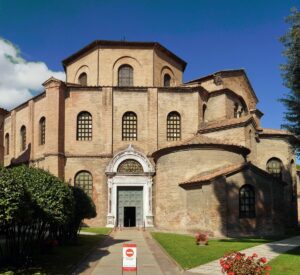
The interior has three naves, separated by 24 columns of Greek marble from the Sea of Marmara. The acanthus leaf capitals seem to move with the wind – a detail that makes you stop and look. Light enters through the windows and single-lancet openings, creating plays of shadow. Outside, the cylindrical bell tower is 37.5 meters tall, with windows that widen as they rise: single, double, and triple lancets. Climb it? Not possible, but from outside it’s a landmark. The facade, 30 meters high, was originally preceded by a quadriporticus that no longer exists. The atmosphere is intimate, almost mystical – even though the original marbles were removed, the structure remains intact. A perfect example of early Christian architecture.
Architecture and Light: The Columns and the Bell Tower
The interior has three naves, separated by 24 columns of Greek marble from the Sea of Marmara. The acanthus leaf capitals seem to move with the wind – a detail that makes you stop and look. Light enters through the windows and single-lancet openings, creating plays of shadow. Outside, the cylindrical bell tower is 37.5 meters tall, with windows that widen as they rise: single, double, and triple lancets. Climb it? Not possible, but from outside it’s a landmark. The facade, 30 meters high, was originally preceded by a quadriporticus that no longer exists. The atmosphere is intimate, almost mystical – even though the original marbles were removed, the structure remains intact. A perfect example of early Christian architecture.
Why Visit It
Three reasons not to miss it. First: it is the largest existing Early Christian basilica, a piece of history that lets you understand what sacred architecture was like in the 6th century. Second: the mosaics are unique – the jeweled cross and the depiction of the Transfiguration are among the finest examples of Byzantine art in Italy. Third: it is part of the Classe Archaeological Park, so you can combine your visit with the Classis Museum and the Ancient Port. Plus, entry is free for under 18s and on the first Sunday of each month. An experience worth the trip to Ravenna.
Why Visit It
Three reasons not to miss it. First: it is the largest existing Early Christian basilica, a piece of history that lets you understand what sacred architecture was like in the 6th century. Second: the mosaics are unique – the jeweled cross and the depiction of the Transfiguration are among the finest examples of Byzantine art in Italy. Third: it is part of the Classe Archaeological Park, so you can combine your visit with the Classis Museum and the Ancient Port. Plus, entry is free for under 18s and on the first Sunday of each month. An experience worth the trip to Ravenna.
When to Go
The best time? I’d say late afternoon, when the low sun streams through the apse windows and makes the mosaics shine. The gold of the jeweled cross seems to catch fire. In summer, the days are long, but autumn also has a soft light. Avoid the weekend if you can – Sunday afternoon opens only from 1:30 PM, but it’s more crowded. I went in May, with clear skies, and it was perfect. In winter, the light is lower, but the interior is still evocative. Don’t go on December 25th, it’s closed.
When to Go
The best time? I’d say late afternoon, when the low sun streams through the apse windows and makes the mosaics shine. The gold of the jeweled cross seems to catch fire. In summer, the days are long, but autumn also has a soft light. Avoid the weekend if you can – Sunday afternoon opens only from 1:30 PM, but it’s more crowded. I went in May, with clear skies, and it was perfect. In winter, the light is lower, but the interior is still evocative. Don’t go on December 25th, it’s closed.
Nearby
Near the basilica, I recommend two stops. First, the Museo Classis Ravenna (former sugar refinery): it tells the story of the port of Classe and Byzantine civilization. Then, the Ancient Port of Classe, an open-air archaeological site with the remains of Roman docks. A few steps away, you can also see the Mausoleum of Theodoric (but it’s in the center of Ravenna). If you have time, Ravenna’s center is full of other UNESCO mosaics: San Vitale, the Neonian Baptistery. All connected by a cycle path – rent a bike and enjoy the plain.
Nearby
Near the basilica, I recommend two stops. First, the Museo Classis Ravenna (former sugar refinery): it tells the story of the port of Classe and Byzantine civilization. Then, the Ancient Port of Classe, an open-air archaeological site with the remains of Roman docks. A few steps away, you can also see the Mausoleum of Theodoric (but it’s in the center of Ravenna). If you have time, Ravenna’s center is full of other UNESCO mosaics: San Vitale, the Neonian Baptistery. All connected by a cycle path – rent a bike and enjoy the plain.
Itineraries nearby

💡 Did You Know…?
It is said that in 1721, the faithful struck the mosaic of the Delivery of the Privileges to chip off tesserae as relics, damaging the work. Today, during the Ravenna Festival, the basilica’s choir echoes Bach’s Mass in B minor.