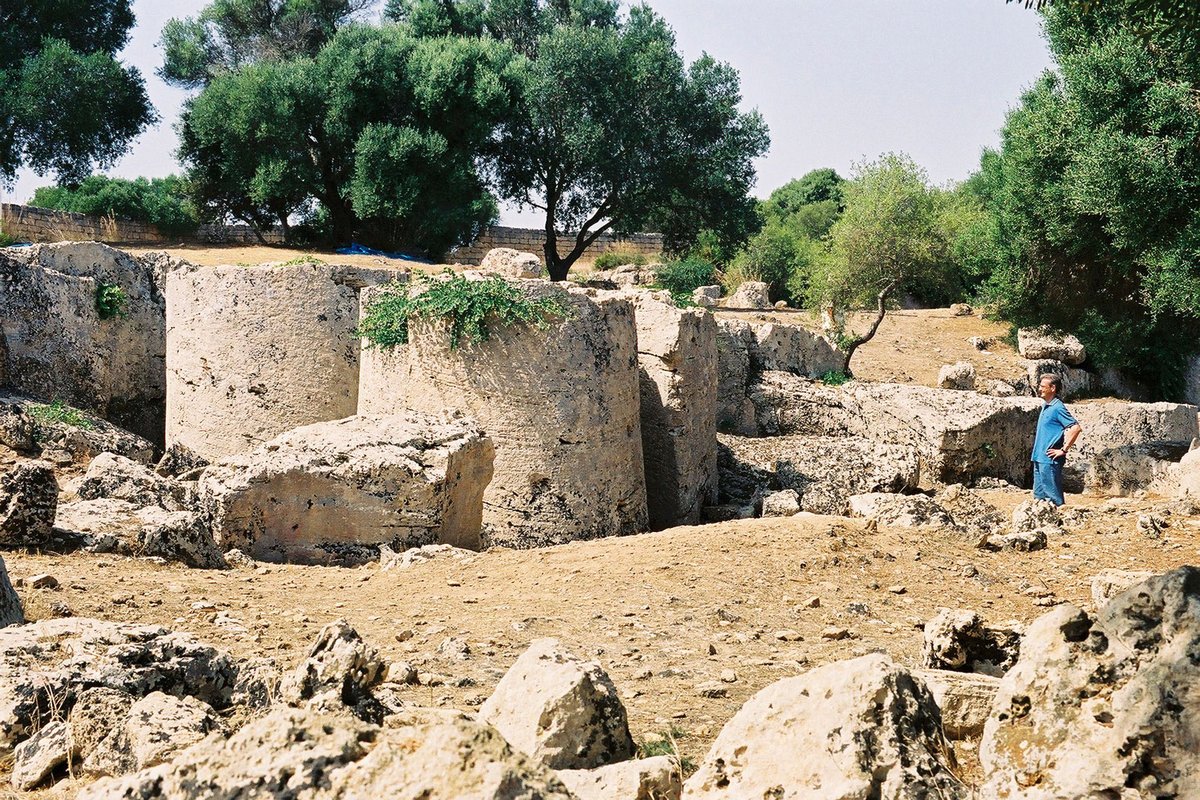
The Cave di Cusa is a Greek construction site interrupted in 409 BC, where enormous limestone blocks for the temples of Selinunte still lie semi-worked. The site extends over 1.8 km through the Trapani countryside, offering a unique experience of palpable ancient history.
- Construction Site Suspended in 409 BC: Blocks and columns abandoned during the Carthaginian siege of Selinunte.
- Marks of Ancient Tools: Incisions and grooves visible on the limestone boulders.
- Countryside Views: Panoramic views over olive groves and almond orchards, with suggestive light in the afternoon.
- Tranquil and Authentic Site: Away from crowds, perfect for leisurely walks and photography.
Introduction
You find yourself in a place that seems frozen in time. The Cave di Cusa, in Campobello di Mazara, is not just an archaeological site: it’s an abandoned construction site from 2,500 years ago, where history literally came to a halt. You walk among enormous blocks of limestone, some already shaped to become columns of the Temple of Selinunte, others still attached to the bedrock as if the workers had left from one moment to the next. The effect is eerie, almost like a film set. There are no ruins here but unfinished work, and this makes the place incredibly evocative. The sensation is of entering an ancient open-air factory, where every boulder tells a story of toil and craftsmanship. Personally, it struck me more than many restored temples: here archaeology is alive, tangible.
Historical Background
These quarries were the
construction lifeline of Selinunte, the powerful Greek colony on the coast. From the 6th to the 5th century B.C., limestone was extracted here to build the city’s magnificent temples, particularly Temple G, one of the largest in the ancient world. Work came to an abrupt halt in 409 B.C. when the Carthaginians besieged and destroyed Selinunte. The workers fled, leaving everything as it was: half-finished column drums, squared blocks ready for transport, even the notches for levers. It’s as if an entire phase of Greek civilization in Sicily was frozen in an instant. The timeline helps grasp the scale of the event:
- 6th century B.C.: Quarrying begins for Selinunte.
- 409 B.C. (exact date): Carthaginian siege; sudden abandonment of the quarries.
- Today: A unique archaeological site managed by the Selinunte Archaeological Park.
The Suspended Construction Site
What makes Cave di Cusa special is precisely its nature as an interrupted process. You don’t see finished monuments, but the various stages of stone working. You can observe the tool marks on the enormous cylinders, the grooves for the ropes used for lifting, the blocks just detached from the quarry. In one corner, there’s an almost complete column, over 8 meters long, that seems ready to be loaded onto a cart. Nearby, another block shows only the rough shape. It’s an open-air manual of ancient industrial archaeology. Walking among these ‘unfinished works,’ you concretely understand the titanic effort behind the construction of Selinunte. I stopped to touch the stone, imagining the sound of chisels and the shouts of the workers. An experience that makes you feel part of history, not just a spectator.
The Landscape and the Light
The quarries are not just archaeology, but also a place of great natural charm. Situated on a gentle hill, they offer a panoramic view of the Trapani countryside, with olive and almond groves stretching towards the sea. The light here has something magical, especially in the early afternoon, when the sun’s rays accentuate shadows and reliefs on the stone, creating chiaroscuro effects that seem to further sculpt the blocks. In spring, wild vegetation – prickly pears, aromatic herbs – frames the ancient stones, adding a touch of colour. It’s a perfect spot for a slow walk, away from the crowds, where you can appreciate both the archaeological detail and the landscape context. Personally, I found a quiet corner to sit and simply watch: the silence, broken only by the wind, makes everything even more intense.
Why Visit It
For three concrete reasons. First: it’s a unique site of its kind in Sicily, perhaps in the entire Mediterranean, because it shows an ancient quarry ‘frozen’ in time, not a finished monument. Second: it offers a different perspective on Selinunte; you see where the stone came from and better understand the grandeur of the temples you’ll admire later. Third: it’s a tranquil and authentic place, not yet overrun by mass tourism, where you can explore calmly, without rush. Additionally, the lack of architectural barriers (if you’re careful) allows you to get really close to the artifacts, which is rare in many archaeological sites. In short, if you want to go beyond the usual ruin photos and immerse yourself in living history, Cave di Cusa is an unmissable stop.
When to Go
The best time? Early afternoon, from April to October. The low-angled afternoon sunlight highlights the stone volumes, creating deep shadows that make the site even more dramatic and photogenic. In summer, avoid the midday hours: it gets very hot and there’s little shade. In spring and autumn, however, temperatures are mild and the colors of the surrounding countryside are splendid. A personal opinion: going at sunset can be evocative, but always check the opening hours, as it’s not always possible. In winter, clear days offer a more austere atmosphere, but the wind can be biting. In short, choose a nice sunny day and take your time.
In the Surroundings
The visit to Cave di Cusa is perfectly complemented by two nearby experiences. The first, of course, is Selinunte: after seeing the ‘factory’ of the stones, go admire the temples built with that material, just a few kilometers away. The contrast between the abandoned quarry and the majestic ruins is enlightening. The second, if you want a different experience, is the Salt Museum of Trapani and Paceco, in the Natural Reserve of the Salt Pans: another example of industrial archaeology, but tied to the centuries-old tradition of salt harvesting, with windmills and breathtaking views over the lagoon. Both places tell stories of work and territory, in complementary ways.