Corvaja Palace in Taormina is a stone book on Sicilian history, built between the 11th and 15th centuries with Arab, Norman, and Catalan Gothic influences. Today, it houses the Tourist Office and the Museum of Popular Arts and Traditions, offering a unique perspective on the city away from the crowds.
- Norman-Swabian architecture with Arab, Norman, and Gothic elements in Taormina stone
- Seat of the Sicilian Parliament in 1410, which elected Ferdinand I of Aragon
- Panoramic view of Mount Etna as a backdrop to the inner courtyard
- Art exhibitions and cultural events in a palace that is still lived in and used
Introduction
As soon as you arrive in Taormina, the Corvaja Palace greets you with its crenellated tower standing out among the alleys of the historic center. It’s not just a palace; it’s a piece of history blending with everyday life. You see it there, in Piazza Badia, with its Norman-Swabian architecture that seems to tell stories from centuries past. And then there’s that unexpected detail: from its position, if you look up, Mount Etna appears like a giant in the background, almost watching over the palace. It’s a sight that immediately makes you understand why this place is special. It’s not a static museum, but a living landmark where past and present meet. I discovered it almost by chance, wandering aimlessly, and was struck by how it manages to be both majestic and accessible at the same time.
Historical Overview
The history of Palazzo Corvaja is a fascinating tapestry of eras and powers. Originally built as an Arab fortress in the 10th century, it was expanded by the Normans in the 13th century, becoming a symbol of their rule in Sicily. In 1410, the
Sicilian Parliament was held here, electing Ferdinand I of Aragon as king—an event that marked the island’s history. The Corvaja family, a noble family of Spanish origin, acquired it in the 16th century, giving it its current name and adding Renaissance elements. Today, it houses the Tourist Office and temporary exhibitions, but walking through its halls, you can still feel the atmosphere of those times. I’ve read that some details, like the bifora windows and arches, clearly show the different architectural influences, but seeing them in person is another thing: it feels like flipping through a 3D history book.
- 10th century: Founded as an Arab fortress.
- 13th century: Norman-Swabian expansion.
- 1410: Hosted the Sicilian Parliament.
- 16th century: Acquired by the Corvaja family.
- Today: Home to the Tourist Office and a cultural space.
Architecture That Speaks
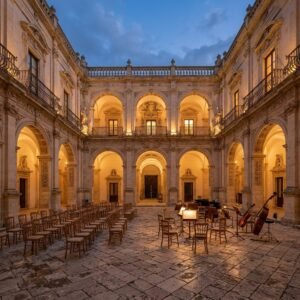
What struck me most is how the palace’s architecture tells stories without needing words. The main facade, made of Taormina stone, displays a unique blend of styles: Arab, Norman, and Gothic elements coexist in harmony. Upon entering, the inner courtyard is a small gem, with arches reminiscent of monastic cloisters and decorations made from Etna’s lava stone, a material typical of the area. Climbing the stairs, you notice the vaulted ceilings and windows framing glimpses of the town and sea. It’s not a huge place, but every corner has something to say. For example, in the Parliament Hall, where the 1410 assembly was held, the acoustics are surprising: try speaking softly and you’ll hear how the sound echoes. It’s a detail that makes you imagine the debates of that era.
A Lived-In Palace
Palazzo Corvaja is not a relic locked away in a display case, but a place that breathes with Taormina. Today, in addition to the Tourist Office, it often hosts art exhibitions and cultural events, making it a meeting point for locals and tourists. I visited during a small exhibition of Sicilian ceramics, and seeing contemporary works in those ancient halls was a captivating experience. Plus, its central location makes it perfect for a stop: you can get information for the rest of your trip, admire the architecture, and maybe have a coffee nearby, all in just a few minutes. Sometimes historic palaces seem distant, but here there’s a welcoming, almost familiar atmosphere. Perhaps because it’s still in use, perhaps because the people of Taormina pass by it every day, but you feel part of the scene, not just an observer.
Why Visit It
Visiting Palazzo Corvaja is worthwhile for at least three concrete reasons. First, it’s a rare example of well-preserved Norman-Swabian architecture in Sicily, where you can literally touch centuries of history in a single building. Second, the view of Mount Etna from its grounds is priceless: it’s not just a backdrop, but an element that completes the scene, especially at sunset when the mountain turns pink. Third, it’s practical: located in the heart of Taormina, you can easily include it in a tour of the historic center without complicated detours. I appreciated it because, unlike other monuments, it doesn’t require hours to visit, yet still offers a meaningful experience. And knowing that the future of Sicily was decided here adds an extra thrill.
When to Go
To fully enjoy Palazzo Corvaja, I recommend visiting in the early morning or late afternoon. The sunlight, especially in spring or autumn, magically illuminates the stone, highlighting the architectural details. Additionally, these times are less crowded compared to midday, when tourists flood Taormina. I’ve noticed that mornings offer a more peaceful atmosphere, perfect for taking photos without the hustle or for pausing to observe the details. If you go in summer, avoid the hottest hours: the palace is in the shade, but the square can become muggy. In winter, however, clear days provide sharp views of Mount Etna, though it’s cooler. In short, you don’t need a specific season—just choose the right time of day for a more intimate experience.
In the Surroundings
After visiting Palazzo Corvaja, don’t miss two nearby experiences that complete the picture of Taormina. Just a few steps away is the Ancient Theatre, one of Sicily’s most iconic archaeological sites, with breathtaking views of the sea and Mount Etna. It’s perfect for those who love ancient history and scenic vistas. Then, immerse yourself in the historic center: stroll along Corso Umberto I, the main street, where you’ll find artisan shops, traditional pastry shops, and picturesque corners. I loved stopping at a pastry shop to taste fresh cannoli, a true Sicilian must. These places, together with the palace, create a rich and varied itinerary, all within walking distance.