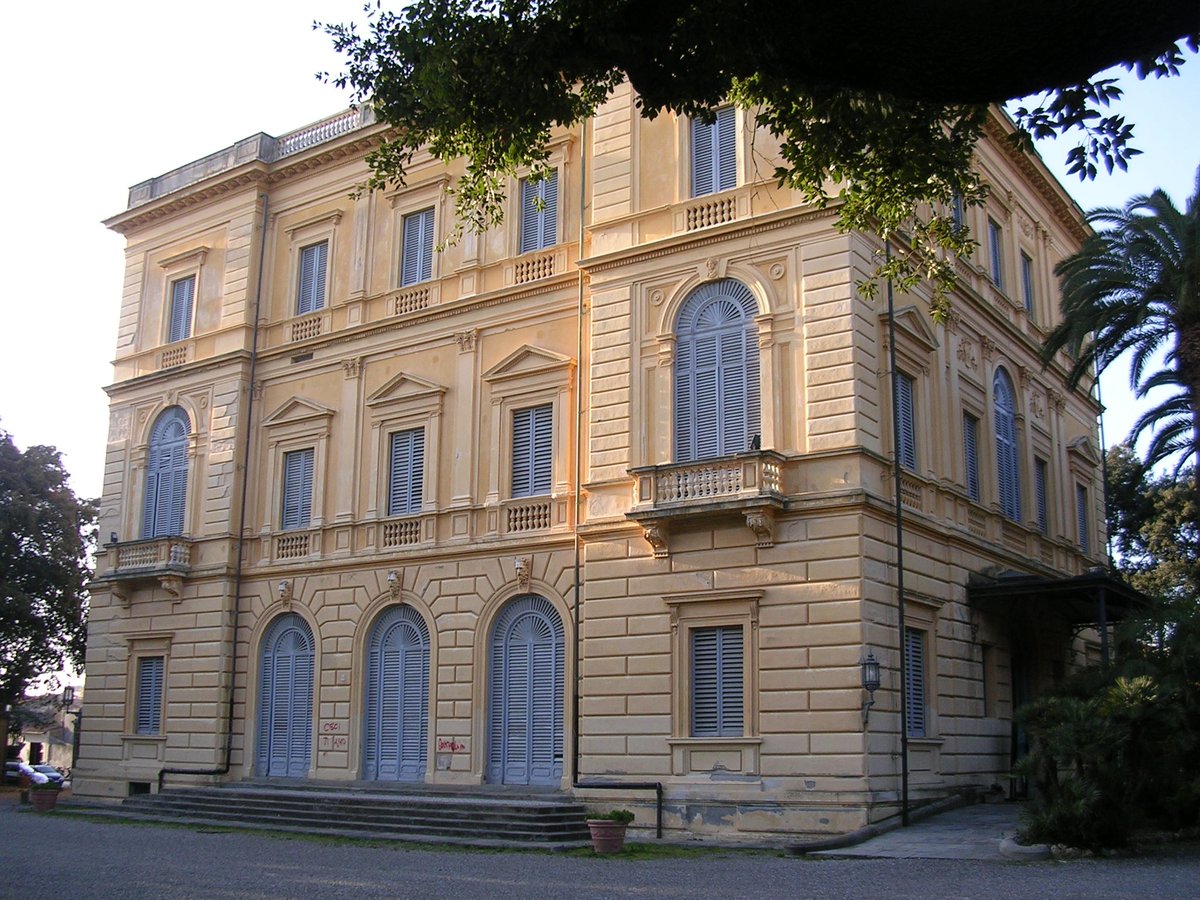
In the heart of Livorno, Villa Mimbelli houses the Giovanni Fattori Civic Museum, dedicated to the master of the Macchiaioli. The permanent collection gathers over 400 works from the 19th to 20th centuries, with masterpieces by Fattori, Lega, Signorini, and other Tuscan artists. The museum also offers themed itineraries, an art library, and a romantic park.
Unmissable works: ‘Maremmane Herds’ by Fattori, ‘The Clothes-Pickers of Livorno’ by Cecconi, and portraits by Corcos.
Villa Mimbelli: 19th-century residence with original frescoes and decorated rooms (Turkish Room, Moorish Room).
Services: educational workshops, library with 12,000 volumes, temporary exhibitions at the Granai.
Accessibility: accessible museum with elevator and ramps.
Introduction
Arriving at the Museo Civico Giovanni Fattori feels a bit like stepping into a home from another era. Villa Mimbelli, with its elegant facade and romantic park, greets you with an atmosphere suspended between the 19th and 20th centuries. This is no ordinary sterile museum: the rooms are still furnished with period pieces, heavy drapes, and frescoed ceilings. You move among paintings and furnishings as if you were a guest of the Mimbelli family. The collection is a gem: from the Macchiaioli to the Divisionists, a journey through Tuscan painting that tugs at your heartstrings. If you love 19th-century art, this place is a must-see.
Introduction
Arriving at the Museo Civico Giovanni Fattori feels a bit like stepping into a home from another era. Villa Mimbelli, with its elegant facade and romantic park, greets you with an atmosphere suspended between the 19th and 20th centuries. This is no ordinary sterile museum: the rooms are still furnished with period pieces, heavy drapes, and frescoed ceilings. You move among paintings and furnishings as if you were a guest of the Mimbelli family. The collection is a gem: from the Macchiaioli to the Divisionists, a journey through Tuscan painting that tugs at your heartstrings. If you love 19th-century art, this place is a must-see.
Historical Background
The origins of the museum date back to 1877, when Livorno inaugurated its art gallery. However, the current location is Villa Mimbelli, built between 1865 and 1868 by architect Vincenzo Micheli for the wealthy merchant Francesco Mimbelli. After various changes (including being occupied by the military), the villa was restored and the museum opened here on December 3, 1994. Today it houses about 400 works, from the mid-19th century to the 1940s, with a focus on the Macchiaioli. The villa itself is a work of art: frescoes by Annibale Gatti and the Della Valle brothers, themed rooms (Turkish, Moorish, Hall of Mirrors), and a monumental staircase with ceramic putti.
Historical Background
The origins of the museum date back to 1877, when Livorno inaugurated its art gallery. However, the current location is Villa Mimbelli, built between 1865 and 1868 by architect Vincenzo Micheli for the wealthy merchant Francesco Mimbelli. After various changes (including being occupied by the military), the villa was restored and the museum opened here on December 3, 1994. Today it houses about 400 works, from the mid-19th century to the 1940s, with a focus on the Macchiaioli. The villa itself is a work of art: frescoes by Annibale Gatti and the Della Valle brothers, themed rooms (Turkish, Moorish, Hall of Mirrors), and a monumental staircase with ceramic putti.
- 1877: inauguration of the Livorno Picture Gallery
- 1865-1868: construction of Villa Mimbelli
- 1994: opening of the museum in the villa
- Today: closed for reinstallation after the Fattori exhibition
- 1877: inauguration of the Livorno Picture Gallery
- 1865-1868: construction of Villa Mimbelli
- 1994: opening of the museum in the villa
- Today: closed for reinstallation after the Fattori exhibition
Among Frescoed Halls and Artworks
Climbing the grand staircase, you encounter a sequence of rooms that are already masterpieces in themselves. The Red Room, the Turkish Room, the Moorish Room: each with original decorations and furnishings. On the first floor, you find works by local artists such as Enrico Pollastrini, Guglielmo Micheli, and Oscar Ghiglia, which tell the story of Livorno at the time. But it is on the second floor that the heart of the collection is concentrated: here are the great Macchiaioli. Giovanni Fattori dominates with paintings like Maremma Herds and Mrs. Martelli at Castiglioncello, alongside Lega, Signorini, and Boldini. An itinerary that makes you understand the revolution of the ‘macchia’.
Among Frescoed Halls and Artworks
Climbing the grand staircase, you encounter a sequence of rooms that are already masterpieces in themselves. The Red Room, the Turkish Room, the Moorish Room: each with original decorations and furnishings. On the first floor, you find works by local artists such as Enrico Pollastrini, Guglielmo Micheli, and Oscar Ghiglia, which tell the story of Livorno at the time. But it is on the second floor that the heart of the collection is concentrated: here are the great Macchiaioli. Giovanni Fattori dominates with paintings like Maremma Herds and Mrs. Martelli at Castiglioncello, alongside Lega, Signorini, and Boldini. An itinerary that makes you understand the revolution of the ‘macchia’.
The Park, the Granaries, and the Library
Outside the villa, the park is an oasis of peace with exotic plants and pathways. Here you will find the former Granaries of Villa Mimbelli, now an exhibition space for temporary shows and home to the Combat Prize, a competition for artists under 50. As you stroll, you can also pop into the Art Library: it houses about 12,000 volumes, many of them rare, specializing in the 19th and 20th centuries. A perfect place to delve deeper after your visit, perhaps leafing through an exhibition catalog. The atmosphere is relaxed, almost one of personal discovery: there is no rush.
The Park, the Granaries, and the Library
Outside the villa, the park is an oasis of peace with exotic plants and pathways. Here you will find the former Granaries of Villa Mimbelli, now an exhibition space for temporary shows and home to the Combat Prize, a competition for artists under 50. As you stroll, you can also pop into the Art Library: it houses about 12,000 volumes, many of them rare, specializing in the 19th and 20th centuries. A perfect place to delve deeper after your visit, perhaps leafing through an exhibition catalog. The atmosphere is relaxed, almost one of personal discovery: there is no rush.
Why Visit
1. A Museum in a Historic Home: Not every day you get to admire paintings in rooms still furnished as they were in the 19th century. The experience is immersive. 2. Understanding the Macchiaioli Up Close: Here you’ll find key works by Fattori and his contemporaries, with thematic paths explaining the movement. 3. The Park and Services: Between galleries, you can relax in the greenery or browse the library. All in a quiet area near the sea.
Why Visit
1. A Museum in a Historic Home: Not every day you get to admire paintings in rooms still furnished as they were in the 19th century. The experience is immersive. 2. Understanding the Macchiaioli Up Close: Here you’ll find key works by Fattori and his contemporaries, with thematic paths explaining the movement. 3. The Park and Services: Between galleries, you can relax in the greenery or browse the library. All in a quiet area near the sea.
When to Go
Honestly, late afternoon is my favorite time. With the light filtering through the curtains of the frescoed rooms, the paintings seem to come to life. Moreover, before closing (at 7:00 PM), the sunset light on the park is magical. As for the season, spring is ideal: the garden is in bloom and the temperatures are mild. Avoid the hottest summer months because the villa has no air conditioning and crowding can be annoying.
When to Go
Honestly, late afternoon is my favorite time. With the light filtering through the curtains of the frescoed rooms, the paintings seem to come to life. Moreover, before closing (at 7:00 PM), the sunset light on the park is magical. As for the season, spring is ideal: the garden is in bloom and the temperatures are mild. Avoid the hottest summer months because the villa has no air conditioning and crowding can be annoying.
Nearby
Just a stone’s throw from the museum is the Terrazza Mascagni: an elegant seafront promenade with black and white mosaics, perfect for a sunset stroll. A bit further on, the Naval Academy is worth a look from the outside (it’s an imposing structure). If you’re in the mood for a dive into history, the Museo della Città di Livorno (opened in 2018) completes the picture with contemporary art. Everything is easily walkable.
Nearby
Just a stone’s throw from the museum is the Terrazza Mascagni: an elegant seafront promenade with black and white mosaics, perfect for a sunset stroll. A bit further on, the Naval Academy is worth a look from the outside (it’s an imposing structure). If you’re in the mood for a dive into history, the Museo della Città di Livorno (opened in 2018) completes the picture with contemporary art. Everything is easily walkable.