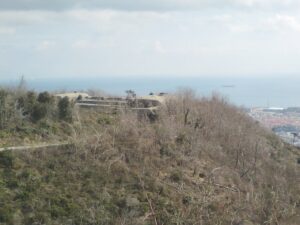
Monte Carmo, at 1389 meters, is the highest peak in the Bardineto area. Ideal for a day trip, it offers trekking and mountain biking trails through chestnut and beech forests. The ascent rewards hikers with panoramic views ranging from the Ligurian Sea to the Alps, along well-marked paths with manageable elevation gain.
– Loop trail of about 8-15 km, suitable for intermediate hikers.
– 360° view from the summit cross, between sea and mountains.
– Forests and karst caves to explore along the way.
– For mountain bikers: over 200 km of forest roads and single tracks.
Welcome to the Roof of the Savona Hinterland
Just a few kilometers from the sea, Monte Carmo rises like a silent giant among the forests of the hinterland. At nearly 1,400 meters, it is the highest peak in the area. From the summit, a panorama unfolds that stretches from the Ligurian Sea to the Alps, a unique mix of blue and white. You don’t need to be super fit: the trails are accessible to hikers and bikers of all levels. The air is fresh, the silence broken only by the rustle of leaves. A place to reconnect with nature.
Welcome to the Roof of the Savona Hinterland
Just a few kilometers from the sea, Monte Carmo rises like a silent giant among the forests of the hinterland. At nearly 1,400 meters, it is the highest peak in the area. From the summit, a panorama unfolds that stretches from the Ligurian Sea to the Alps, a unique mix of blue and white. You don’t need to be super fit: the trails are accessible to hikers and bikers of all levels. The air is fresh, the silence broken only by the rustle of leaves. A place to reconnect with nature.
A Bit of History: From the Benedictines to the Present Day
The surroundings of Monte Carmo hold ancient traces. The abbey of San Pietro, near Toirano, was founded according to tradition by Saint Peter fleeing from Antioch.
The real origins date back to the 8th century, when Charlemagne granted lands and revenues to the convent. The Benedictines cultivated the fields and transcribed manuscripts. In the 15th century, the community moved further down the valley, giving rise to a charterhouse. Today, evocative ruins and a breathtaking panorama remain from that past.
- 8th century: foundation of the Abbey of San Pietro
- Carolingian age: donations of Charlemagne
- 15th century: transfer of the Carthusians
A Bit of History: From the Benedictines to the Present Day
The surroundings of Monte Carmo hold ancient traces. The abbey of San Pietro, near Toirano, was founded according to tradition by Saint Peter fleeing from Antioch.
The real origins date back to the 8th century, when Charlemagne granted lands and revenues to the convent. The Benedictines cultivated the fields and transcribed manuscripts. In the 15th century, the community moved further down the valley, giving rise to a charterhouse. Today, evocative ruins and a breathtaking panorama remain from that past.
- 8th century: foundation of the Abbey of San Pietro
- Carolingian age: donations of Charlemagne
- 15th century: transfer of the Carthusians
Trekking and Mountain Biking: Trails for Everyone
With over 200 km of forest roads, Monte Carmo is a paradise for mountain biking enthusiasts. Single tracks like Dondella and Cormore offer fun descents. For trekkers, trail no. 3 from Bardineto is easy (8 km, 3h30) and leads to the summit. More challenging is the loop from Giogo di Toirano (8.5 km, 3h), with 500 meters of elevation gain. Along the way, mountain huts and junctions, and at the top an iron cross. The ideal? Combine a walk with a packed lunch with a sea view.
Trekking and Mountain Biking: Trails for Everyone
With over 200 km of forest roads, Monte Carmo is a paradise for mountain biking enthusiasts. Single tracks like Dondella and Cormore offer fun descents. For trekkers, trail no. 3 from Bardineto is easy (8 km, 3h30) and leads to the summit. More challenging is the loop from Giogo di Toirano (8.5 km, 3h), with 500 meters of elevation gain. Along the way, mountain huts and junctions, and at the top an iron cross. The ideal? Combine a walk with a packed lunch with a sea view.
Ancient Woods and Authentic Flavors
The slopes of Monte Carmo are covered with dense forests of chestnut, beech, and birch trees. In autumn, the colors are fiery. The area also features karst caves and farms where you can sample local products. In the restaurants of Bardineto, such as Monte Carmo in the main square, you can enjoy traditional dishes: risotto, baked dishes, cheeses, and meat. An experience that combines nature and palate. And for the little ones? The possibility of trekking with donkeys, a slow and fun way to explore.
Ancient Woods and Authentic Flavors
The slopes of Monte Carmo are covered with dense forests of chestnut, beech, and birch trees. In autumn, the colors are fiery. The area also features karst caves and farms where you can sample local products. In the restaurants of Bardineto, such as Monte Carmo in the main square, you can enjoy traditional dishes: risotto, baked dishes, cheeses, and meat. An experience that combines nature and palate. And for the little ones? The possibility of trekking with donkeys, a slow and fun way to explore.
Three Great Reasons to Hike Monte Carmo
First: the view. From the summit you see the sea and the Alps together, a rare postcard in Liguria. Second: the variety of routes. There are easy trails for families and technical single tracks for expert bikers. Third: the tranquility. Away from the chaos of the beaches, here the silence of the woods reigns. And if you arrive early, you can almost have the summit all to yourself.
Three Great Reasons to Hike Monte Carmo
First: the view. From the summit you see the sea and the Alps together, a rare postcard in Liguria. Second: the variety of routes. There are easy trails for families and technical single tracks for expert bikers. Third: the tranquility. Away from the chaos of the beaches, here the silence of the woods reigns. And if you arrive early, you can almost have the summit all to yourself.
The Right Time for the Summit
If you want to avoid the heat and crowds, choose spring or autumn. The colors are stunning and the temperatures perfect for walking. For photographers, dawn and dusk offer magical light over the sea. In winter, with snow, the landscape is even more evocative, but you’ll need boots and to be cautious on icy trails.
The Right Time for the Summit
If you want to avoid the heat and crowds, choose spring or autumn. The colors are stunning and the temperatures perfect for walking. For photographers, dawn and dusk offer magical light over the sea. In winter, with snow, the landscape is even more evocative, but you’ll need boots and to be cautious on icy trails.
After the Hike: Two Must-See Excursions
A few kilometers away, the village of Toirano is worth a visit for its famous karst caves, with stalactites and stalagmites. Another stop is the Abbey of San Pietro, with Romanesque ruins and a panorama overlooking the entire valley. Perfect for ending the day with a picnic or dinner at an agriturismo.
After the Hike: Two Must-See Excursions
A few kilometers away, the village of Toirano is worth a visit for its famous karst caves, with stalactites and stalagmites. Another stop is the Abbey of San Pietro, with Romanesque ruins and a panorama overlooking the entire valley. Perfect for ending the day with a picnic or dinner at an agriturismo.