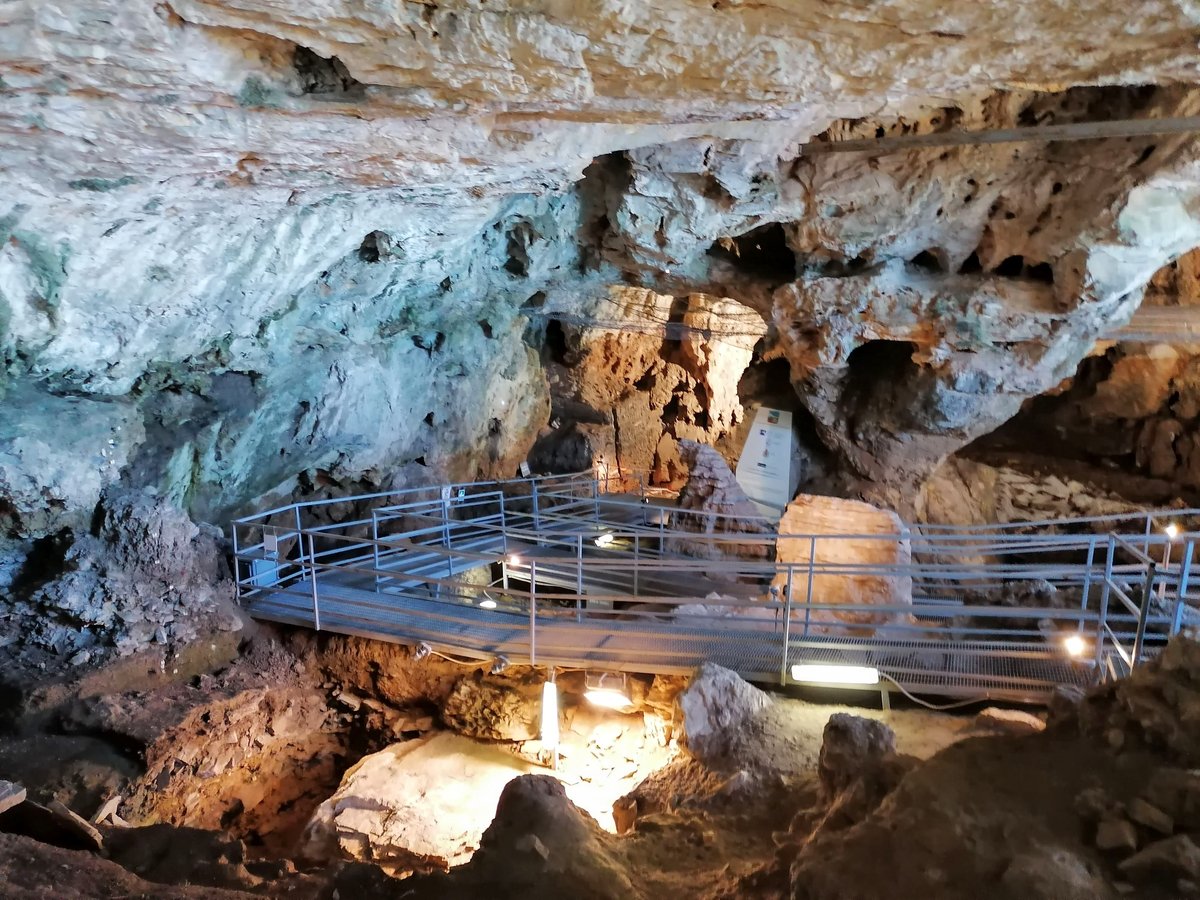
The Cavern of Arene Candide, in Finale Ligure, is one of the most important prehistoric sites in Europe. With a 10-meter stratigraphy spanning from the Upper Paleolithic to the Roman era, it offers a unique testament to the life of Liguria’s earliest inhabitants. The highlight is the burial of the ‘Young Prince,’ a teenager buried 28,000 years ago with a rich grave goods. Here’s what awaits you:
– Burial of the Young Prince: a 15-year-old adolescent, buried with a headdress of shells and deer canines, mammoth ivory pendants, and four perforated batons.
– Epigravettian Necropolis: over 20 burials with extended bodies and red ochre, including double burials and manipulation of remains.
– Continuous Stratigraphy: 10 meters of sediments documenting human presence for over 35,000 years.
– Guided Tours: the site is open on Wednesdays and Saturdays by reservation; the tour lasts one hour and includes access to the cave.
A Cave That Smells of History
The Cavern of Arene Candide, perched 90 meters above the sea, is one of Italy’s most important prehistoric sites. Entering here is like stepping back 28,000 years. The cavity, 70 meters long and 20 meters wide, was once protected by a dune of white quartz sand, the “arene candide,” now vanished. The silence of the cave is broken only by the guide’s story, revealing the secrets of the “Young Prince,” a 15-year-old boy buried with a tribal chief’s grave goods. The feeling is that of touching prehistory.
A Cave That Smells of History
The Cavern of Arene Candide, perched 90 meters above the sea, is one of Italy’s most important prehistoric sites. Entering here is like stepping back 28,000 years. The cavity, 70 meters long and 20 meters wide, was once protected by a dune of white quartz sand, the “arene candide,” now vanished. The silence of the cave is broken only by the guide’s story, revealing the secrets of the “Young Prince,” a 15-year-old boy buried with a tribal chief’s grave goods. The feeling is that of touching prehistory.
Historical Background
The cave was inhabited from the Upper Paleolithic to the Roman era. The first excavations date back to 1864 with Arturo Issel, but the most sensational discovery occurred on May 1, 1942: Luigi Bernabò Brea unearthed the tomb of the “Prince.” The adolescent, who died from facial trauma possibly caused by a bear, was laid on a bed of red ochre, wearing a headdress of shells and deer canines, mammoth ivory pendants, and four perforated batons made of elk antler. In addition to this, over 20 Epigravettian and Neolithic burials have been found, evidence of millennia of frequentation.
- 1864 – First explorations by Arturo Issel
- 1940-1950 – Systematic excavations by Bernabò Brea and Cardini
- 1942 – Discovery of the Prince’s tomb
- 1970s – New Neolithic excavations by Tinè and Maggi
- 2019 – Opening of the cave to the public
Historical Background
The cave was inhabited from the Upper Paleolithic to the Roman era. The first excavations date back to 1864 with Arturo Issel, but the most sensational discovery occurred on May 1, 1942: Luigi Bernabò Brea unearthed the tomb of the “Prince.” The adolescent, who died from facial trauma possibly caused by a bear, was laid on a bed of red ochre, wearing a headdress of shells and deer canines, mammoth ivory pendants, and four perforated batons made of elk antler. In addition to this, over 20 Epigravettian and Neolithic burials have been found, evidence of millennia of frequentation.
- 1864 – First explorations by Arturo Issel
- 1940-1950 – Systematic excavations by Bernabò Brea and Cardini
- 1942 – Discovery of the Prince’s tomb
- 1970s – New Neolithic excavations by Tinè and Maggi
- 2019 – Opening of the cave to the public
The Treasure of the Young Prince
The most famous burial is that of the so-called ‘Prince of the Arene Candide’, a 170 cm tall adolescent, who died at about 15 years old. His body was laid with rich grave goods: a headdress made of hundreds of perforated shells and deer canines, mammoth ivory pendants, four perforated rods of elk antler (perhaps used to straighten bones), and a 23 cm long flint blade. The jaw and left shoulder show injuries, probably inflicted by a cave bear. The young man managed to kill the animal but died in the fight. His burial, with rich grave goods, suggests a high social role. The artifacts are now displayed at the Archaeological Museum of Finale.
The Treasure of the Young Prince
The most famous burial is that of the so-called ‘Prince of the Arene Candide’, a 170 cm tall adolescent, who died at about 15 years old. His body was laid with rich grave goods: a headdress made of hundreds of perforated shells and deer canines, mammoth ivory pendants, four perforated rods of elk antler (perhaps used to straighten bones), and a 23 cm long flint blade. The jaw and left shoulder show injuries, probably inflicted by a cave bear. The young man managed to kill the animal but died in the fight. His burial, with rich grave goods, suggests a high social role. The artifacts are now displayed at the Archaeological Museum of Finale.
Visiting the Cave Today
The Cavern of the Arene Candide has been open to the public since 2019, with one-hour guided tours on Wednesdays and Saturdays at 10:00 AM (reservation required). Access is on foot from the Borgio Verezzi level crossing: follow Via Verezzi, Via della Cornice, and Strada Napoleonica for about 2 km (30 minutes). Bring water and comfortable shoes; the visit is suspended in case of rain. The cost is €10 (reduced €5 for under 10s, over 65s, ICOM members). With the same full-price ticket, you can visit the Archaeological Museum of Finale in Finalborgo at a reduced rate (€3). The cave still preserves stratigraphic evidence and a cast of the Neolithic hearth – a dive into Ligurian prehistory.
Visiting the Cave Today
The Cavern of the Arene Candide has been open to the public since 2019, with one-hour guided tours on Wednesdays and Saturdays at 10:00 AM (reservation required). Access is on foot from the Borgio Verezzi level crossing: follow Via Verezzi, Via della Cornice, and Strada Napoleonica for about 2 km (30 minutes). Bring water and comfortable shoes; the visit is suspended in case of rain. The cost is €10 (reduced €5 for under 10s, over 65s, ICOM members). With the same full-price ticket, you can visit the Archaeological Museum of Finale in Finalborgo at a reduced rate (€3). The cave still preserves stratigraphic evidence and a cast of the Neolithic hearth – a dive into Ligurian prehistory.
Why Visit It
1. A unique journey through time: The 10-meter stratigraphic sequence is the most complete in the Western Mediterranean, from the Paleolithic to the Roman age. 2. The Prince’s Tomb: The funerary equipment is one of the richest in Europe, with ivory objects and shells that tell stories of hunting and rituals. 3. Landscape context: The Napoleonic Road offers a breathtaking view of the Gulf of Finale, and the walk itself is a pleasant excursion.
Why Visit It
1. A unique journey through time: The 10-meter stratigraphic sequence is the most complete in the Western Mediterranean, from the Paleolithic to the Roman age. 2. The Prince’s Tomb: The funerary equipment is one of the richest in Europe, with ivory objects and shells that tell stories of hunting and rituals. 3. Landscape context: The Napoleonic Road offers a breathtaking view of the Gulf of Finale, and the walk itself is a pleasant excursion.
When to Go
The best time is spring or autumn, when temperatures are mild and the trail isn’t too hot. Visit early in the morning (the only available slots are at 10 AM), and the light entering the cave creates suggestive shadow plays. In summer, bring a hat and water because the access trek can be challenging. Avoid rainy days, as the activity is suspended for safety.
When to Go
The best time is spring or autumn, when temperatures are mild and the trail isn’t too hot. Visit early in the morning (the only available slots are at 10 AM), and the light entering the cave creates suggestive shadow plays. In summer, bring a hat and water because the access trek can be challenging. Avoid rainy days, as the activity is suspended for safety.
In the Area
After your visit, don’t miss the Museo Archeologico del Finale in Finalborgo, where the original artifacts of the Prince and other objects from the cave are displayed with multimedia supports. Take the opportunity to explore the medieval village of Finalborgo, with its walls and narrow streets. Another nearby gem is Castel Gavone, a 15th-century fortress with panoramic views, perfect for rounding out a day of history and nature.
In the Area
After your visit, don’t miss the Museo Archeologico del Finale in Finalborgo, where the original artifacts of the Prince and other objects from the cave are displayed with multimedia supports. Take the opportunity to explore the medieval village of Finalborgo, with its walls and narrow streets. Another nearby gem is Castel Gavone, a 15th-century fortress with panoramic views, perfect for rounding out a day of history and nature.