Piazza San Lorenzo is the perfect starting point for a tour of Florence: in front of Brunelleschi’s basilica, amid the market stalls, you immediately feel the weight of Medici history. The Medici Chapels, Michelangelo’s New Sacristy, and Donatello’s pulpits are just steps away, and the Mercato Centrale awaits you for a tasty break. Here are four reasons not to miss it.
– Basilica of San Lorenzo: Florence’s first cathedral, with Brunelleschi’s interiors and masterpieces by Donatello.
– Medici Chapels: the Chapel of the Princes and Michelangelo’s New Sacristy, burial place of the Medici family.
– San Lorenzo Market: souvenir stalls and, at the Mercato Centrale, Tuscan street food like lampredotto.
– Monument to Giovanni delle Bande Nere: Baccio Bandinelli’s statue commemorating the Medici patronage.
Evocative Introduction
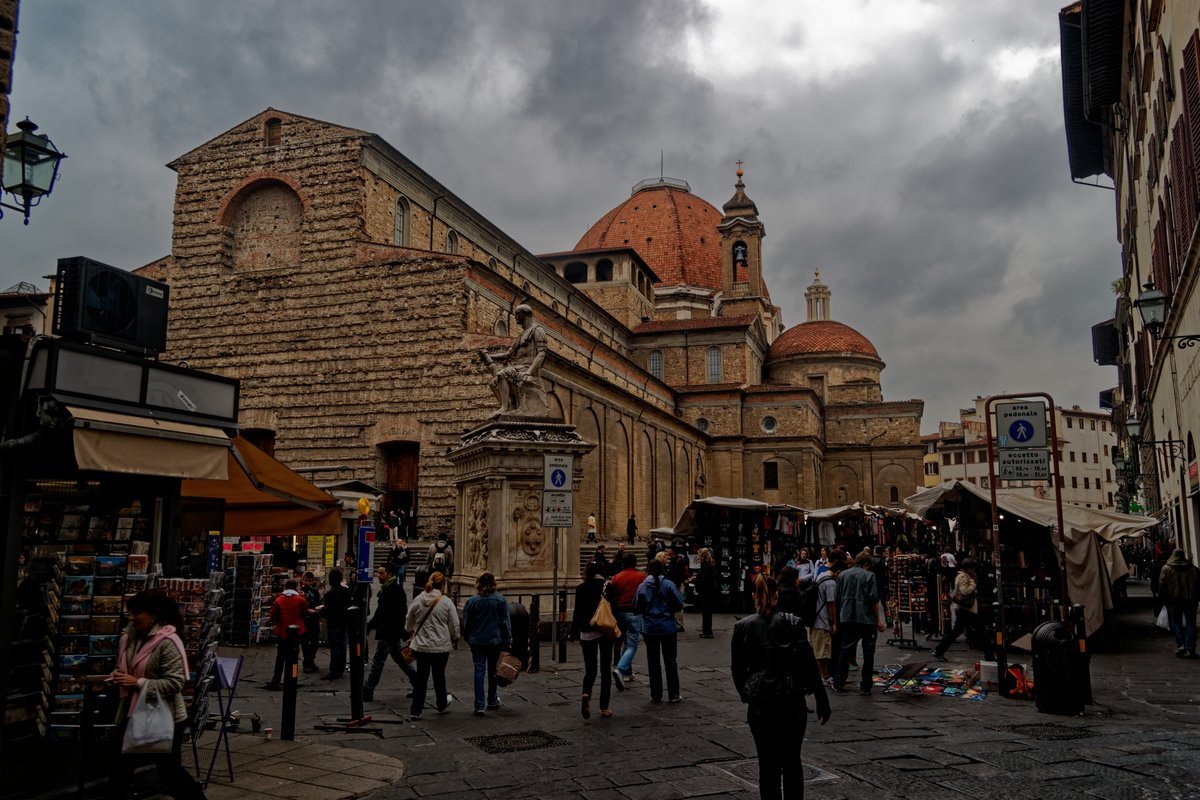
Piazza San Lorenzo is a striking sight that encapsulates Florence in a single space: the unfinished bulk of Brunelleschi’s basilica, the dome of the Medici Chapels in the background, and the chatter of the market that climbs right up to the church steps. A stone’s throw from the Duomo, this pedestrian square is a blend of art, history, and everyday life. The rough brick façade, never clad in marble, may seem bare, but it is precisely that contrast that makes it fascinating. You can smell the souvenir stalls, and if you glance around, the monument to Giovanni delle Bande Nere reminds you that a family once ruled here. This is not a postcard square: it is the beating heart of a neighborhood where the sacred and the profane coexist. On one side the church, on the other the bustling flow of Florentines and tourists. A must-stop to understand the Florence of the Medici.
Historical Notes
The story begins long before the Medici. Here stood the first church in Florence known to us, consecrated in
393 AD by Saint Ambrose. In 1418 the Medici commissioned Brunelleschi to rebuild the basilica, which became their family chapel. The square, once larger, has seen banks and workshops come and go. The monument to Giovanni delle Bande Nere, commissioned in the sixteenth century, was completed in 1850 with the statue by Baccio Bandinelli. Since 2013 the city has begun to clear the square of stalls to give the architecture room to breathe. Over time, palaces, workshops and stories have layered upon each other, but the bond with the Medici has remained indelible.
- 393 – Consecration of the basilica
- 1418 – Beginning of Brunelleschi’s reconstruction
- 1520-1534 – Michelangelo’s New Sacristy
- 1571 – Opening of the Medici Laurentian Library
- 1850 – Placement of the statue of Giovanni delle Bande Nere
- 2013 – Start of stall removal
The Basilica of San Lorenzo: Brunelleschi’s Masterpiece
Entering San Lorenzo means walking through Brunelleschi’s design: three naves with Corinthian columns, arches in pietra serena, and white plaster. Light enters from the clerestory, making everything feel taller, more rational. It’s a space that makes you understand the Renaissance. Don’t miss Donatello’s pulpits, his last masterpiece, and the Old Sacristy (1420-1428), where Donatello himself left stucco medallions and the tomb of Piero and Giovanni de’ Medici. The high altar hides the crypt with the tomb of Cosimo de’ Medici, the patriarch. Just beyond, the Cloister of the Cannon (1457-1460) houses Donatello’s tomb, right opposite his patron: a detail that gives you chills. The unfinished facade is a reminder: even the grand dukes didn’t always manage to fulfill their dreams.
San Lorenzo Market: Souvenirs and Flavors
The square is also famous for its market. Souvenir stalls stretch right up to the basilica, a contrast that some find annoying, but which tells the story of a living city. Since 2013 the area has been partly cleaned up, but the market remains the heart of the neighborhood. A stone’s throw away is the Mercato Centrale, a 19th-century building (1874) inspired by Les Halles in Paris. On the lower floor you’ll find stalls selling fruit, vegetables, meat, and cheese; on the upper floor, gourmet food shops, a cooking school, and jazz concerts until midnight. If you want to try real Florentine street food, try the lampredotto sandwich at Famiglia Bambi: with a mix of celery, carrot, and onion, it still costs 5 euros. Or a Chianina burger from Enrico Lagorio. The square and the market are two sides of the same coin: you can’t understand San Lorenzo without both.
Why Visit It
Three good, practical reasons to put Piazza San Lorenzo on your agenda. First: a concentration of masterpieces. In a single complex you’ll find Brunelleschi, Donatello, Michelangelo, and the Laurentian Library, which alone is worth the trip. Second: the mix of art and daily life. It’s not an open-air museum: it’s a living neighborhood, with shops, students, and the bustle of the market. Third: the food. Between the Central Market and the street stalls, you can eat like a true Florentine for a few euros. The basilica closes on Sundays, so plan ahead: tickets are bought in the cloister and also allow you to see the crypt and the treasure. Oh, and don’t forget to look for Donatello’s tomb: it’s his final resting place.
When to go
The best time? Early in the morning, before the market swallows everything. The low light caresses the serene stone, and the square is almost empty—you can photograph the basilica without dozens of umbrellas in the frame. If you’re a night owl, come back late in the evening: the facades light up, and the silence makes everything more theatrical. As for the seasons, autumn has a special feel: warm colors, fewer crowds, and stalls selling seasonal produce. In winter, with crisp air and holiday markets, it has a different charm. Summer is more chaotic, but in the evening the jazz concerts at the Mercato Centrale on the first floor make the atmosphere magical. In short, there’s no wrong time: you just have to choose which Florence you want to see.
Nearby
From the square, you can complete your visit with two nearby stops. The most immediate is the Mercato Centrale: step inside and get lost among the stalls, head upstairs for a taste or a coffee. The other is Palazzo Medici Riccardi, the first city residence of the Medici family: its rear corner overlooks the square, but the most beautiful part is the chapel frescoed by Benozzo Gozzoli. If you fancy something different, on Via de’ Ginori you’ll find La Ménagère, a space between restaurant and emporium where you could stop for an aperitif. And for those who love secret places, keep an eye on the Museo Sant’Orsola, a former 14th-century convent undergoing renovation, which promises to become a new cultural hub.