
The Pomonte Castle ruins offer an authentic Umbrian experience, away from the crowds. The evocative medieval remains on a hilltop overlook a picture-perfect panorama of olive groves and vineyards. The visit is free and unrestricted, perfect for a short excursion during a road trip.
- 13th-century medieval ruins with traces of walls and towers
- Breathtaking panorama over the Umbrian valley and surrounding hills
- Free and unrestricted visit, without tourist crowds
- Magical sunset light for unforgettable photographs
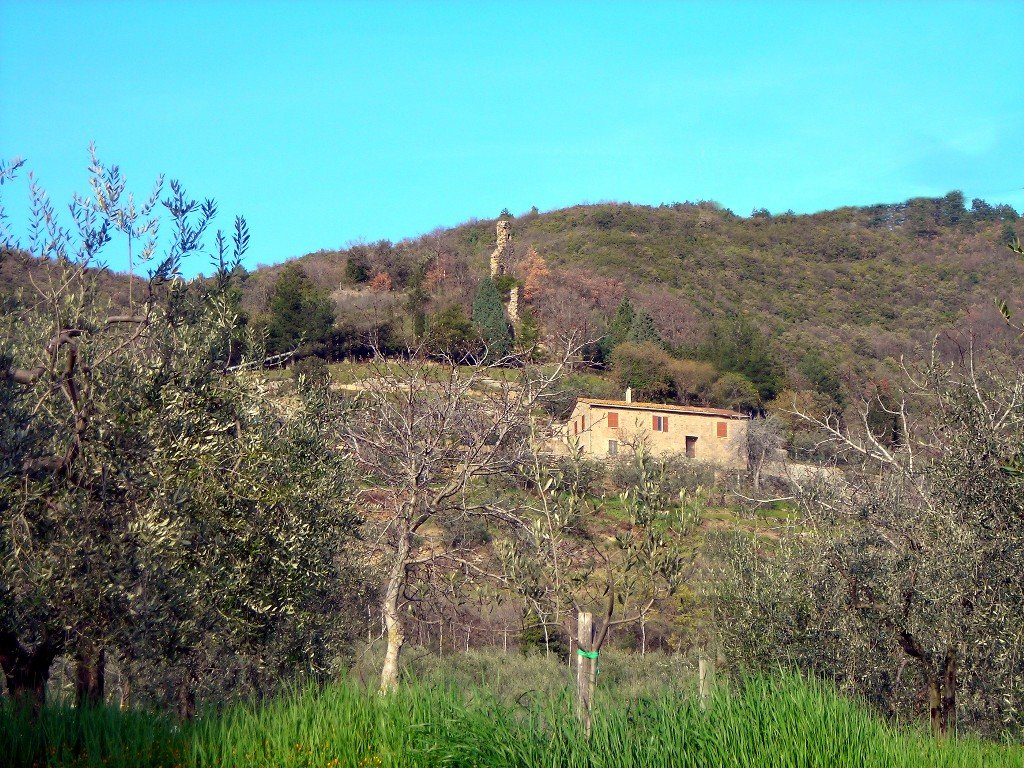
13th-century ruins in Gualdo Cattaneo with views over the Umbrian valley. Free visit, final stretch on unpaved road, sunset light ideal for photography. A stop off the tourist trail.
- Strada provinciale di Collemancio, Perugia (PG)
- Open in Google Maps
- View on Google Images Resti Castello di Pomonte a Perugia
Good to know
Introduction
Reaching the Ruins of Pomonte Castle is a bit like uncovering a secret that the Umbrian hills have guarded for centuries. Don’t expect a perfectly preserved monument, but rather a place where history can be felt firsthand, among walls that tell tales of battles and silences that speak of daily life. You get there by traveling along a scenic road that alone is worth the journey, with glimpses of the valley that make you stop more than once. The castle, or rather what remains of it, stands on a hill overlooking the territory, and the first impression is of an atmosphere suspended in time, far from the chaos. Personally, I was struck by how, despite its condition, it retains a powerful, almost romantic charm. It’s one of those places that makes you feel small in the face of the grandeur of the past, but also lucky to be able to admire it like this, unfiltered.
Historical Overview
The history of Pomonte Castle is a tapestry of power and defense typical of Umbria’s medieval era. The first reliable records date back to the 13th century, when it served as a strategic outpost for controlling the Puglia Valley, often contested among local lordships. It was not merely a military fortress but also a hub of daily life: families resided there, markets were held, and its walls protected a small community. Over time, like many castles in the region, it experienced periods of abandonment and decay, evolving into what we see today: a place of evocative charm rather than former glory. Its isolated location has likely contributed to preserving its authentic aura.
- 13th century: earliest documented evidence of the castle as a fortification.
- Middle Ages: center for territorial control and community life.
- Modern era: gradual abandonment and structural decline.
- Today: ruins of significant historical and scenic appeal.
The Charm of the Ruins
What makes Pomonte special is precisely its being a living ruin. Walking among the stones, you can still distinguish traces of the wall enclosure, the foundations of the towers, and perhaps an opening that must have been a window or an arrow slit. There are no invasive explanatory panels, just stone and the panorama. I found myself imagining what life must have been like here, with the wind lashing the hill and the view stretching to the horizon. One detail I noticed: in some spots, vegetation has reclaimed its space, with ivy enveloping the boulders, creating a beautiful contrast between nature and history. It’s a perfect place for photography lovers, with corners that change light with every hour. It might not be suitable for those seeking comfort, but for me, it was a more authentic experience than many overly restored sites.
Postcard-Perfect Views
If the ruins tell you the story, the view gives you the emotion. From up here, your gaze sweeps over a typical Umbrian landscape: gentle hills dotted with olive groves, oak woodlands, and in the distance, the silhouettes of other hilltop villages. On clear days, you can even glimpse part of the Tiber Valley. I spent quite some time sitting on a boulder, simply watching. It’s one of those places that invite you to slow down, breathe fresh air, and forget the rush. In winter, with a bit of mist, the atmosphere becomes almost mysterious; in summer, the colors are vivid and the warm sun accentuates the shadows on the stones. I recommend bringing a water bottle and maybe a snack, because once you’re up there, you won’t want to hurry back down.
Why Visit It
Visiting the Ruins of Pomonte Castle is worthwhile for at least three concrete reasons. First, it’s an experience off the beaten tourist track: you’re unlikely to encounter crowds, allowing you to enjoy the silence and peace. Second, it offers a tangible history lesson: here you don’t just read about castles, you walk inside one, feeling firsthand what the passage of centuries means. Third, the view is simply breathtaking and provides vistas you’ll hardly forget, especially at sunset when golden light envelops the hills. It’s a place that speaks to those seeking authenticity, not just postcards. Personally, I found it more interesting than some overly ‘perfect’ villages because here history shows itself raw, without embellishments.
When to Go
The best time? Definitely late afternoon, especially in spring or early autumn. The light is warm, oblique, and casts long shadows on the stones, highlighting the volumes of the ruins. In summer, going early in the morning avoids excessive heat, but sunset remains magical. In winter, with a bit of luck, you might find a light mist that makes everything more evocative, almost cinematic. Avoid days of heavy rain: the path can become slippery. I was there in September, and the cool evening air, combined with the warm colors of the setting sun, created an unforgettable atmosphere. Perhaps it’s not a place for a rushed visit: take your time to absorb the surroundings.
In the Surroundings
Your visit to Pomonte can be enriched with two nearby stops that complete the Umbrian experience. Just a few minutes’ drive away is Gualdo Cattaneo, the medieval village that the castle depends on: it’s worth a stroll through its narrow streets, the fortress, and its tranquil atmosphere. A bit further, but still in the area, I recommend stopping at a local winery to sample Umbrian wines, such as Sagrantino: many offer tastings in rustic settings, perfect after a day spent between history and nature. These experiences make you feel part of the territory, not just a passing tourist.
💡 Did You Know…?
Not far from the ruins, along the road descending towards the village, there is a small votive shrine. Local legend, passed down by the elders, tells that centuries ago, a shepherd found a sacred image of the Madonna at that spot, an event that led to the construction of the small chapel. It’s not a story from major guidebooks, but it’s one of those details that makes the connection between these places and those who inhabit them unique.