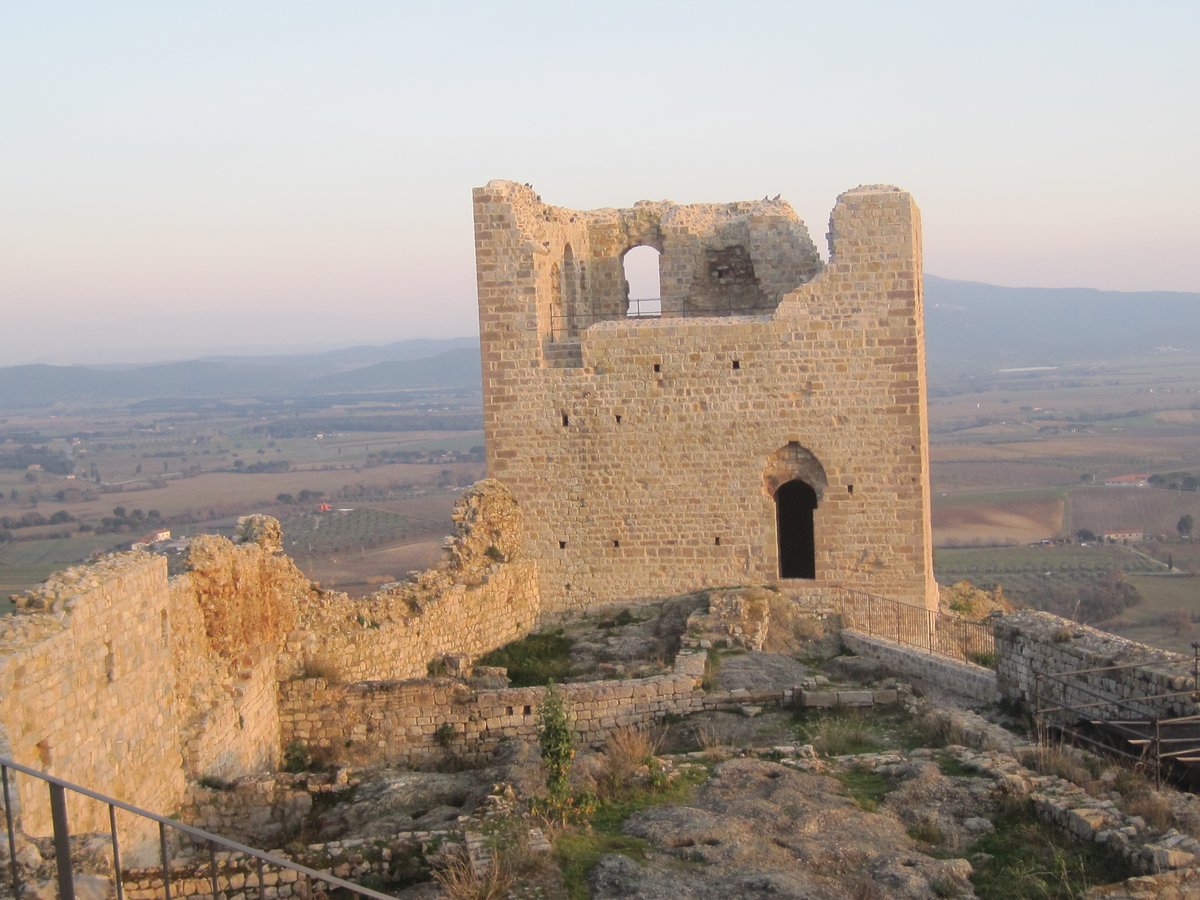
The Castello di Montemassi is a 14th-century Sienese fortress with stone walls and a keep, always accessible from the outside. It offers 360° views over the Tuscan hills and an immersive experience among medieval ruins. The village below preserves stone-paved streets and historic houses.
- Imposing stone walls and a perfectly preserved medieval keep
- 360° panoramic view over the hills of the Tuscan Maremma
- Authentic village with stone-paved streets and medieval houses at the foot of the castle
- Always accessible from the outside with a short detour from the provincial road
Introduction
Arriving at Montemassi, the first impression is that of a severe silhouette standing out against the sky of the Tuscan Maremma. It’s not just a castle, but an icon. The Sienese fortress dominates the valley from the top of a hill, and even though today it’s largely a ruin, it retains a powerful atmosphere. One feels small in front of those stone walls, which tell centuries of battles and dominion. The position is strategic: from up there, the gaze sweeps over the rolling hills, wheat fields, and olive groves, until it gets lost in the horizon. Visiting it means immersing oneself in a piece of Tuscan history, but also enjoying a breathtaking panorama. Personally, I stopped for a long time to admire that contrast between the ancient solidity of the stones and the lightness of the surrounding landscape. It’s a place that speaks of power and beauty, and that leaves a mark.
Historical Overview
The history of Montemassi Castle is a tapestry of sieges, alliances, and powerful families. Likely built in the 12th century, it became a
crucial outpost for the Republic of Siena in controlling the Maremma region. Its most famous moment is the 1328 siege, when Sienese troops led by Guidoriccio da Fogliano recaptured it after a rebellion. This event is immortalized in Simone Martini’s fresco in Siena’s Palazzo Pubblico, making the castle renowned in art as well. In subsequent centuries, it passed under Medici and then Lorraine rule, gradually losing military importance and falling into abandonment. Today, what remains are the perimeter walls, part of the tower, and the ruins of interior spaces, but it takes little to imagine the life that once pulsed within those stones. Its history is one of stone and power, still palpable in the air.
- 12th century: probable construction as a fortification
- 1328: siege and recapture by Siena, celebrated by Simone Martini
- 16th century: comes under Medici control
- 18th century: begins decline and abandonment
The Climb and the View
Reaching the castle is part of the experience. You start from the village of Montemassi, a quiet hamlet where time seems to have stood still. The dirt road leading to the fortress is uphill but passable, and along the way you encounter patches of Mediterranean scrub and some ancient olive trees. I recommend taking it easy, perhaps stopping to notice the details: a boundary wall peeking through the vegetation, a stone arch worn by time. Once at the top, the reward is complete. From there, you can see everything: the hills of Maremma stretching as far as the eye can see, the red roofs of the village below, and on the clearest days, you can even glimpse the sea in the distance. It’s a privileged vantage point that makes you understand why the Sienese wanted it so much. I suggest bringing a bottle of water and a camera: the view is worth every effort.
Ruins That Speak
Entering the castle grounds is like stepping back into the Middle Ages. Don’t expect furnished rooms or museums: here the essence lies in the bare stone and architectural forms. You can still recognize the remains of the defensive walls, which follow the hill’s contours, and the main tower, which must have been imposing. Walking among the ruins, you’ll notice traces of staircases, window openings, and what remains of the interior spaces. I like to imagine daily life: the soldiers on guard, the sounds from the kitchen, the voices echoing through the walls. It’s a place that sparks the imagination, and perhaps that’s its very charm. There aren’t explanatory panels everywhere, so sometimes you might get a bit lost… but in the end, it’s nice to let instinct guide you. Wear comfortable shoes because the terrain is uneven, and keep your eyes open to capture the details: a faded inscription, a particularly worked stone.
Why Visit It
Visiting Castello di Montemassi is worthwhile for at least three concrete reasons. First, it’s an authentic, unembellished historical experience: here you won’t find modern reconstructions, but the raw material of history, with all its evocative power. Second, the view is simply extraordinary: from the top, you can take in a piece of the Maremma that looks like it came from a painting, perfect for photography enthusiasts or those who simply want to pause and contemplate. Third, it’s a place off the beaten tourist track: you’ll breathe in a tranquil, almost intimate atmosphere, ideal for a trip in search of peace and beauty. I’ve returned several times, and each visit reveals a new corner or a different light on the stones. It’s one of those places that stays with you, without needing many explanations.
When to Go
The best time to visit the castle? Early morning or late afternoon, when the light is softer and the summer heat isn’t at its peak. In spring and autumn, the weather is perfect for walking, and the countryside colors are vibrant: the tender greens of April or the warm hues of Tuscan October. In summer, avoid the midday hours because the sun can be intense, and there are no shadows along the path. In winter, however, clear days offer crystalline views, but beware of the wind that sometimes blows strong on the hill. I visited in September, with that golden sun caressing the stones, and they almost seemed alive. Every season has its charm, but for a truly evocative experience, try to capture the silence of a sunrise or the magic of a sunset.
In the Surroundings
The castle visit can be enriched with other stops in the area. A few kilometers away is Roccastrada, a medieval village perched on a rocky outcrop, with narrow alleys and a breathtaking view over the Bruna river valley. It’s worth a stop for a coffee and a stroll among its ancient stones. If you prefer to immerse yourself in nature, head to the Montenero Nature Reserve, a protected area with trails through holm oak and oak woods, perfect for a short hike in the Mediterranean scrub. Both places share with Montemassi that authentic, non-touristy atmosphere that characterizes this part of Maremma. I visited them on the same day and appreciated the contrast between the castle’s history and the reserve’s tranquility.