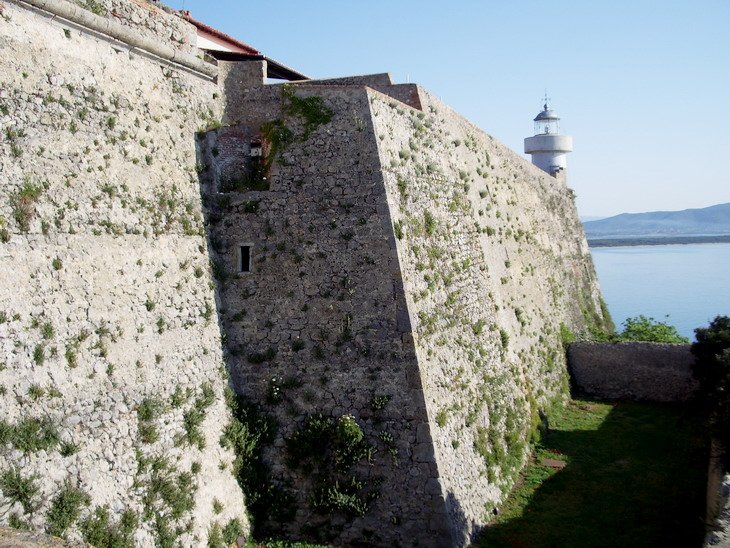
The Porto Ercole Lighthouse, built in 1862, offers 360-degree views of the Tyrrhenian Sea, Monte Argentario, and Giglio Island. The walk up from the historic center provides glimpses of the village and an immersive experience in nature. The best time to visit is late afternoon to admire the sunset painting the sea with vibrant colors.
- 360° panoramic view of Monte Argentario, Giglio Island, and the Tuscan coast
- Walking trail through Mediterranean scrub with views of Porto Ercole and Forte Filippo
- Spectacular sunset with colors that tint the sea and sky
- Historic 1862 lighthouse with stone structure and white lantern, still operational
Introduction
The Porto Ercole Lighthouse is not just a navigational landmark, but a true balcony overlooking the Tyrrhenian Sea. Reaching it means treating yourself to a breathtaking panorama: from here, your gaze spans the entire Argentario promontory, with its hidden coves and the sea fading into infinite shades of blue. The climb, though challenging, is rewarded by a 360-degree view that’s hard to forget. This isn’t just a passing spot, but a destination worth seeking out. The feeling, once at the top, is like dominating the world from the highest point of the village, with the wind carrying the scent of the sea and Mediterranean scrub. An experience that perfectly blends effort and beauty.
Historical Notes
The history of this lighthouse is closely intertwined with that of the Spanish Fortress overlooking Porto Ercole. Built in 1862, it served for decades as a crucial safeguard for navigation along this often treacherous coastline. Its light guided fishing boats, sailing ships, and, during World War II, even military vessels. Today it is automated, but its stone structure and distinctive white lantern retain an ancient charm.
Little known is that the lighthouse stands on an ancient lookout point already used in medieval times, a testament to how this rocky outcrop has always been strategic.
- Medieval era: lookout point.
- 1862: construction of the current lighthouse.
- World War II: used for military purposes.
- Today: automated lighthouse and tourist destination.
The Climb and the Path
Reaching the lighthouse is a miniature adventure. There are no shuttle buses; you ascend on foot starting from the historic center of Porto Ercole, near the Porta a Mare. The well-marked trail begins as a stone staircase between houses, then transforms into a dirt path that climbs through the vegetation. The final stretch is the steepest, but also the most panoramic: at every turn, a new glimpse opens up of the village below, with its red roofs overlooking the small harbor. I recommend comfortable shoes and a bottle of water, especially in summer. The beauty is that it’s not just a simple walk, but a true taste of the most authentic Maremma, filled with intense scents and silences broken only by the rustle of the wind. Personally, I like to stop halfway to enjoy the view without rushing.
The View That Conquers
Once you arrive, you realize every step was worth it. The lighthouse terrace offers an unparalleled view. To the southeast, Giglio Island stands out clearly, while looking north, the coastline fades toward the Feniglia Pine Forest. The magical moment is when the sun begins to set, painting the sky and sea in shades of orange and pink. Watching the boats return to the harbor from up here is a mesmerizing spectacle. However, be aware: there are no bars or services on-site, so it’s best to come prepared. I always bring a snack to enjoy the show at leisure. Sometimes you might encounter a patient photographer waiting for the perfect light, and I completely understand why.
Why Visit It
Visiting the Porto Ercole Lighthouse is worthwhile for three concrete reasons. First, for the unique and total panorama over the Argentario, impossible to replicate from other points. Second, for the experience of the climb itself, which offers direct contact with the territory, away from the chaos of the seafront. Third, because it’s an authentic, non-commercial place that retains intact its charm as an outpost on the sea. You won’t find kiosks or souvenirs, but only the raw beauty of the landscape. It’s the right place to truly disconnect, to breathe deeply, and to take photos that will genuinely tell the story of the trip.
When to Go
The best time? Definitely late afternoon, to catch the sunset. The colors over the Tyrrhenian Sea are incredible. In summer, the climb can be a bit hot, so it’s better to avoid the midday hours. I prefer late spring or early autumn: the light is warm, the air is fresh, and the Mediterranean scrub is in bloom or takes on the hues of the season. In winter, if the day is clear, visibility can be exceptional, but the wind at that height can be biting. In short, every season has its charm, but the sunset light beats them all.
In the Surroundings
After visiting the lighthouse, as you descend towards the village, it’s worth getting lost in the alleys of Porto Ercole, perhaps stopping for an aperitif at one of the waterfront venues. For a thematically linked experience, a few minutes’ drive away is the Spanish Fortress. Climbing its walls offers another perspective, more historical and military, on the same stretch of coastline you’ve just admired from above. The lighthouse-fortress pairing perfectly tells the dual soul of this place: guiding light and defensive stronghold. If you have time, a boat trip to explore the coves of the promontory completes the picture.