Introduction
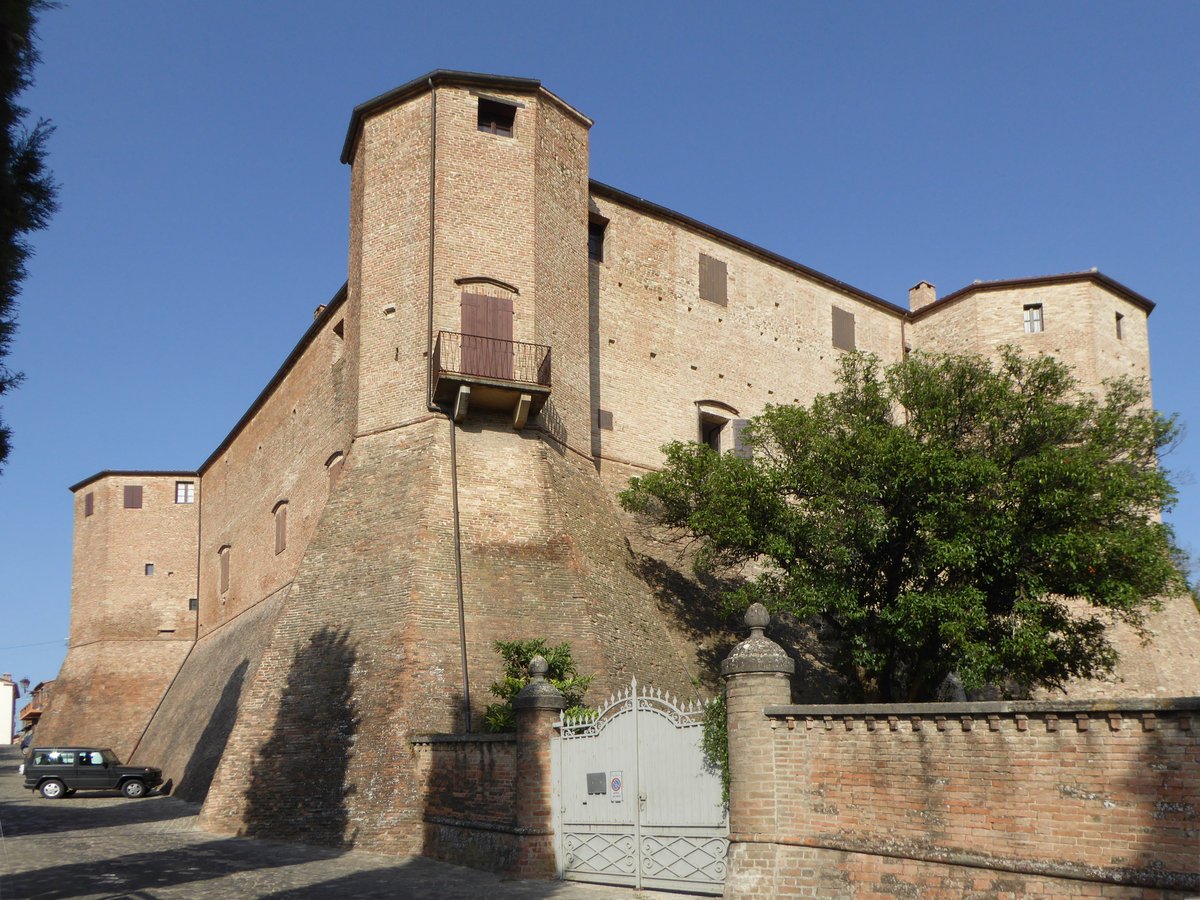
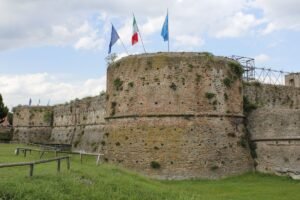
The Rocca of Santarcangelo di Romagna is not just a castle; it’s a viewpoint. Literally. Approaching from the medieval village, its massive silhouette in red brick suddenly appears, like a guardian watching over the Marecchia valley. The feeling is that of standing before a sleeping giant, with a history you can breathe in the air. The panoramic view from up there is the real reward: a carpet of hills, terracotta roofs, and, in the distance, the outline of the sea. It’s not a monument to admire only from the outside; climbing up here means entering the beating heart of the town, discovering a corner of Romagna that speaks of power, defense, and, today, of simple, authentic beauty. I was struck by how, despite its imposing presence, the fortress doesn’t overwhelm the village below but seems almost to embrace it.
Historical Background
Its history is a tapestry woven by powerful families and changing hands. The first fortifications date back to the communal period, but the structure we see today is the work of the Malatesta family, who rebuilt it in the fourteenth century. It then passed to the Borgias, the Venetians, and finally to the Papal States. This fortress was not built to be a sumptuous palace, but to control the territory. Walking among its walls, you can still see the arrow slits for archers and the marks of sieges. A curious fact? For a period, it also served as a prison. Today, after careful restoration, it hosts cultural events and exhibitions, but its warrior soul is still palpable.
Its history is written in the stones, much more than on an information panel.
- Communal period: first fortifications
- 14th century: reconstruction commissioned by the Malatesta family
- 15th-16th centuries: transitions between the Borgias, Venetians, and Papal States
- Today: venue for cultural events and panoramic viewpoint
The ascent path and the village
The visit to the fortress begins with the climb itself. Don’t take the car—you’ll miss half the charm. The best way is to hike up through the narrow lanes of the medieval village of Santarcangelo, passing under the Arco Ganganelli and past stone houses and artisan shop signs. It’s a small climb that prepares you for the arrival. Once at the top, beyond the breathtaking panorama, explore the inner courtyard. You’ll immediately notice the contrast between the severity of the outer walls and the relative tranquility of the inner space, where performances are sometimes held today. A detail I loved? The steps worn down by time, which tell of all the footsteps that have trodden them over the centuries. It’s not a huge place, but every corner has its own story to whisper.
Photography and Light
If you’re a photography enthusiast, this is your spot. The fortress offers incredible plays of light, especially in the late afternoon, when the setting sun paints the bricks a vibrant red and creates long, dramatic shadows on the walls. The best spots? From the square in front of the entrance, to frame the majestic facade, and naturally from the city walls, for bird’s-eye view shots of the village and the valley. Be cautious on overly hazy days: the view of the sea might disappear into the mist. I’ve found that days with clear skies after rain are the most spectacular. Bring a wide-angle lens to capture the full vastness of the panorama, but also a telephoto lens for architectural details, like the battlements against the sky.
Why Visit
For three concrete reasons. First, it’s a natural balcony overlooking Romagna that offers a unique geographical perspective, helping you orient yourself in the area. Second, it’s a zero-cost experience (external access is free) that perfectly combines culture, light exercise (the climb!), and beauty. Third, because it’s authentic. It’s not an overcrowded or hyper-commercialized attraction; it has the slow pace of the surrounding village. It’s the ideal place for a contemplative break away from the chaos of the coast, to read a book in the shade of the walls or simply to watch the world from above, as its ancient lords once did.
When to Go
Avoid the midday hours during the hottest summer days: the sun beats down intensely, and the climb can become strenuous. The magical time is late afternoon, around sunset. The light turns golden, the air cools down, and the landscape lights up with warm colors. It’s also splendid in late spring or early autumn, when the hills are green or begin to tinge with red and yellow. In winter, on clear days, the view can stretch all the way to the coast, but always check that it isn’t closed due to bad weather. A personal preference of mine? Going there early on Sunday morning, when the village below is still quiet and the fortress feels entirely yours.
In the Surroundings
A visit to the fortress pairs perfectly with exploring the village of Santarcangelo, designated as one of the Most Beautiful Villages in Italy. Don’t miss the mysterious tuff caves that wind beneath the town, visitable with guides. For a thematically connected experience, a few kilometers away lies Verucchio, with its imposing Rocca Malatestiana, offering another perspective on the Malatesta lordship and equally spectacular views over the Valmarecchia valley. Two fortresses, two distinct characters, one historical thread that binds them.