St. Martin’s Cathedral is the artistic and religious heart of Lucca, featuring Romanesque and Renaissance masterpieces in the easily walkable historic center. Its asymmetrical facade with loggias and marble inlays introduces a solemn atmosphere. Inside, you’ll find artworks of great historical and spiritual value.
- Holy Face: a wooden crucifix venerated for centuries, legendarily carved by Nicodemus
- Sarcophagus of Ilaria del Carretto: a Renaissance sculpture by Jacopo della Quercia in the sacristy
- Matteo Civitali’s Pulpit: a masterpiece of Tuscan Renaissance in the left nave
- St. Martin’s Altarpiece: a work by Filippino Lippi and a crypt with ancient traces
Introduction
St. Martin’s Cathedral is not just a religious building; it’s an experience that takes you by surprise. As soon as you enter the square, the asymmetrical and richly detailed facade immediately strikes you, with that portico that almost seems like an invitation. Inside, the atmosphere is different: there’s a silence that speaks of history, and the light filtering through the stained glass creates shifting patterns that change with the hours. It’s not an immense cathedral, but it has a strong character, typical of Lucca, where every stone tells a story. I stopped to look at the labyrinth carved on the pillar near the entrance – a mysterious symbol that few notice, but which instantly gives the feeling of a special place. If you visit Lucca, skipping it would be a shame, because it’s here that you truly feel the soul of the city, enclosed within these ancient walls.
Historical Overview
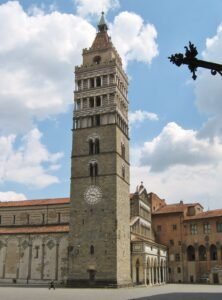
The cathedral’s history begins in the 6th century, but the building we see today is primarily Romanesque, the result of successive reconstructions. A key date is 1070, when it was reconsecrated after an expansion, and over time it has undergone modifications that have shaped its appearance. The Holy Face, a wooden crucifix venerated for centuries, is said to have arrived here in the 8th century according to legend, becoming a symbol of devotion for the people of Lucca. Figures like the military leader Castruccio Castracani have left their mark, with tombs and memorials blending with sacred art. It’s not a linear history – there have been fires, renovations, and that bell tower that seems a bit crooked if you look closely. The timeline below gives you an idea of the key moments, but walking through the aisles, you can truly feel the weight of the centuries, without needing precise dates.
The Holy Face and Its Chapel
The Holy Face is not just a crucifix—it is an icon that has defined Lucca’s identity for centuries. It is housed in a dedicated chapel, just inside to the left, and even if you are not religious, it is worth stopping to observe. Legend says it was carved by Nicodemus, with an intense expression that changes depending on the light. I saw it on a quiet afternoon, and there was a line of people approaching in silence, almost uneasy in its presence. The chapel itself is a small gem, with decorations dating back to the Renaissance, and fresh flowers are often placed at the statue’s base. It is a piece of living history, not a dusty relic, and it helps you understand why medieval pilgrims came here from all over Europe. If you pass by, try to notice the details of the wood—it almost seems to breathe.
Architectural details not to be missed
Beyond the Holy Face, the cathedral hides treasures that risk being missed if you rush too much. Matteo Civitali’s pulpit, in the left nave, is a masterpiece of Tuscan Renaissance – carved with figures so realistic they seem to speak. Then there’s the tomb of Ilaria del Carretto, a work by Jacopo della Quercia, located in the sacristy: a sculpture so delicate it hardly seems made of marble. I spent a quarter of an hour looking at the drapery, which appears moved by the wind. And don’t forget the floor: in some spots, under the carpets, there are ancient tomb slabs with faded inscriptions. The external facade, with its bas-reliefs, deserves a slow walk – you’ll notice biblical stories and symbols that tell of medieval faith. It’s these details that make San Martino unique, not just another church to check off.
Why Visit It
Visiting the Cathedral of San Martino offers at least three compelling reasons, beyond its obvious beauty. First, it’s a concentration of Romanesque and Renaissance art in a compact space – you can admire masterpieces like Civitali’s pulpit and Ilaria’s tomb without getting tired. Second, the Holy Face is a unique symbol, tied to legends and popular devotion that you can still feel in the air today. Third, the location is perfect: in the heart of Lucca, just steps from the walls, so you can easily combine your visit with a stroll through the historic center. I’ve returned multiple times, and each visit reveals a new detail – last time, I noticed a hidden angel on a capital. It’s not just for art enthusiasts; even if you’re passing through, stepping inside gives you an authentic snapshot of the city.
When to go
The best time to visit the cathedral? I recommend the early morning hours, when sunlight streams through the stained-glass windows and illuminates the Holy Face in a spectacular way, and there are fewer tourist groups. In summer, avoid the midday hours – inside can become stuffy, and the entrance line gets longer. In autumn or spring, however, the atmosphere is more intimate, and you can enjoy the details without rushing. If you get the chance, try going in the evening during a special event – I’ve heard they sometimes open for concerts, and the acoustics under those vaults must be incredible. Personally, I prefer weekdays, when the square outside is quieter and you can appreciate the façade without distractions.
In the Surroundings
After the cathedral, explore Lucca’s historic center – it’s small and entirely walkable. Climbing the Walls of Lucca is an unmissable experience: you can walk or rent a bike along the tree-lined path, with views over the city and hills. Nearby, there’s the Church of San Michele in Foro, with its intricate facade that rivals San Martino in beauty. If you’re in the mood for something different, pop into the Villa Guinigi Museum, where you’ll find local art that complements the history seen in the cathedral. I usually stop for a coffee in one of the nearby shops – the smell of fresh bread mingles with the air of history, reminding you that Lucca is alive beyond its monuments.