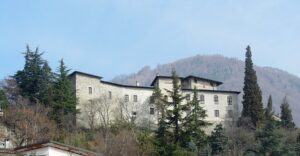
The Scaliger Castle of Sirmione is a perfectly preserved medieval fortress, built in the 13th century by the Scaliger family to control access to the peninsula on Lake Garda. Surrounded by water on three sides, it offers a unique atmosphere with original military architecture. Climbing the towers and walking along the ramparts provides breathtaking views of the lake and the village of Sirmione, creating an immersive historical experience.
Introduction
As soon as you arrive in Sirmione, the Rocca Scaligera immediately strikes you. It looks like it’s straight out of a fairy tale, with its crenellated towers mirrored in the blue waters of Lake Garda. It’s not just a castle; it’s an icon. The feeling is that of a place perfectly preserved in time, dominating the entrance to the peninsula like a silent guardian. I first saw it from afar, from the lakeside promenade, and I stopped to stare. It’s one of those places that makes you think: ‘Wow, this really exists.’ The visual impact is strong, almost emotional. It’s not just history; it’s pure photography. Every corner, every tower, every reflection on the water seems designed to be immortalized. If you love medieval castles, you’ll find exactly what you’re looking for here. And even if you’re not a history enthusiast, the view from the drawbridge alone is worth the visit. It’s a place that stays with you, simple and direct.
Historical Notes
The Scaliger Castle was not built by chance. It was constructed in the 13th century by the powerful Scaliger family, lords of Verona, to control Lake Garda and defend Sirmione. Think about it: it was a crucial strategic outpost. Over the centuries, it witnessed various dominations, from the Visconti of Milan to the Republic of Venice, which transformed it into an arsenal. Then, for a period, it even became a prison. Today it is a museum, but walking among its walls you can still breathe that air of power and defense. It’s not just a pile of stones, it’s a piece of living history. The towers, the walkways, the underground prisons tell stories of battles and control. I like to imagine the soldiers on the walls, scanning the horizon. It’s a place that speaks, if you know how to listen.
- 13th century: construction at the behest of the Scaligeri
- 14th-15th centuries: expansions and reinforcements under various dominations
- 16th century: transformation into an arsenal by the Republic of Venice
- 19th-20th centuries: restoration and opening to the public as a museum
Climbing the Towers
If there’s one thing you can’t miss, it’s climbing the towers. It’s not strenuous, but the stairs are narrow and steep, typical of the era. Once at the top, the view takes your breath away. On one side, Lake Garda stretches as far as the eye can see, with mountains in the background. On the other, you see the entire village of Sirmione, with its narrow streets and colorful houses. It’s one of the most beautiful panoramic spots on the lake. I was there on a slightly cloudy day, and the atmosphere was magical. The low clouds made everything more dramatic. I recommend bringing a camera, because every corner is a photo opportunity. Note: if you suffer from vertigo, you might feel a bit uneasy, but it’s worth it. The patrol walkways make you feel a bit like a medieval guard. It’s an immersive experience, not just a visit.
Hidden Details
Beyond the towers, the fortress conceals small treasures. For example, the inner courtyard with its central well, which looks like a film set. Or the inscriptions and coats of arms carved on the walls, which tell stories of families and power. I noticed a well-preserved Scaliger coat of arms with the ladder, the family’s symbol. Then there are the underground prisons, dark and damp, giving an idea of what life was like for prisoners. They’re not cheerful places, but they make you reflect. Another detail that struck me are the arrow slits, still visible along the walls. They’re small things, but they enrich the visit. If you rush through, you risk missing them. Take the time to observe. Sometimes, details make the difference between a castle and a castle with a soul.
Why Visit It
Why is it worth it? First, for the unique panoramic view of Lake Garda from the towers, which you won’t find in many other places. Second, because it’s a rare example of perfectly preserved medieval military architecture, with original features like the drawbridge. Third, because it naturally combines history and photography: every corner is a ready-to-shoot scene, no filters needed. It’s a place that works both for history enthusiasts, who can immerse themselves in the past, and for those simply seeking a beautiful view. I found it versatile. Plus, it’s easily accessible from Sirmione’s center, without requiring long walks. It’s not just a tourist stop; it’s a complete experience. If you’re in Sirmione, skipping it would be a shame.
When to Go
The best time? I’d recommend going early in the morning or late in the afternoon, especially if you want to avoid the crowds. The sunset light reflecting on the lake’s waters creates unforgettable atmospheres. In summer, it can get crowded, but if you manage to find a quiet moment, the experience feels more authentic. In spring or autumn, with cooler days, the visit is more pleasant, and the lake’s colors are intense. Avoid the midday hours during peak season if you’re not a fan of queues. Personally, I prefer the quieter moments when you can enjoy the silence within the walls. There’s no wrong season, but the atmosphere changes with the light.
In the Surroundings
After visiting the Rocca, explore the village of Sirmione. Stroll through the medieval alleyways, filled with small shops and eateries. Then, head to the Grotte di Catullo, the remains of a Roman villa overlooking the lake. It’s another fascinating historical site that completes the picture. If you’re in the mood for relaxation, there’s Jamaica Beach, a small free area with pebbles and crystal-clear waters, perfect for a swim. These are all nearby experiences that enrich your day without needing to travel far. Sirmione offers more than meets the eye.