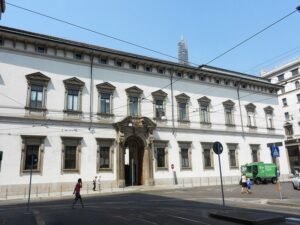
The Teatro Grande is the cultural heart of Brescia: a national monument since 1912, it stands on Corso Zanardelli, where the city’s first public theatre opened in 1664. Today it is home to opera and ballet, with 970 seats arranged in a horseshoe shape, three tiers of boxes and two galleries, and a season ranging from opera to jazz. Guided tours throughout the year and, in summer, the Grand Tour that reveals the stage and backstage.
• Sala Grande inaugurated in 1810 to a design by Luigi Canonica
• Rococo Ridotto with frescoes by Francesco Zugno and the Caffè Berlucchi
• Sala delle Statue with busts of Giuseppe Verdi and Benedetti Michelangeli
• Here Madama Butterfly triumphed on 28 May 1904
Introduction: Teatro Grande of Brescia
If there is one place that embodies the soul of Brescia, it is the Teatro Grande. It is not just a theatre, but a national monument since 1912, a treasure chest of art and history in the heart of Corso Zanardelli. Stepping through its monumental façade means taking a journey through time: from the first public theatre of 1664 to the 970-seat Sala Grande, by way of the Rococo Ridotto and the Sala delle Statue. The atmosphere is that of a temple of opera, where every detail tells of three centuries of culture. Whether you are an opera enthusiast or simply curious, you will be enchanted by the beauty and elegance of this place. I entered it for the first time during a summer guided tour and was utterly captivated: there is something magical in the air, as if the notes of Puccini and Verdi still lingered among the boxes. And it is no coincidence that artists of the calibre of Maria Callas and Arturo Toscanini have passed through here. Prepare to discover a piece of Italian history that continues to live.
Historical Background
The origins of the Teatro Grande date back to 1643, when the Republic of Venice granted the Accademia degli Erranti the area where Brescia’s first public theatre was built in 1664. In 1735–39 the architect Manfredi rebuilt it, and in 1760–69 the Rococo Ridotto by Antonio Marchetti was added. The current Sala Grande was inaugurated in 1810 to a design by Luigi Canonica, with decorations by Giuseppe Teosa. In 1862 Girolamo Magnani redesigned the interiors in Neo-Baroque style. The theatre became a national monument in 1912. In the twentieth century it hosted legends such as Maria Callas and Arturo Toscanini. Since 2010 it has been managed by the Fondazione del Teatro Grande. Today it is a cultural landmark for the city.
- 1643: The Republic of Venice grants the area to the Accademia degli Erranti.
- 1664: The first public theatre opens.
- 1735–39: Reconstruction to a design by Manfredi.
- 1760–69: Addition of the Rococo Ridotto.
- 1810: Inauguration of the new Sala Grande.
- 1862: Neo-Baroque decoration by Magnani.
- 1912: Recognition as a national monument.
- 2010: The Fondazione del Teatro Grande is established.
The Great Hall and the Ridotto: Unmissable Masterpieces
The Great Hall is the beating heart of the theatre: 970 seats, a horseshoe layout and five tiers of boxes that give it a unique elegance. The hall was inaugurated in 1810 and in 1862 was decorated in neo-Baroque style by Girolamo Magnani. Walking among the seats, you can feel the history: here Maria Callas sang and Arturo Toscanini conducted. The Ridotto, added between 1760 and 1769, is a Rococo jewel. Its walls are frescoed by Francesco Zugno with costumed figures playing music or conversing, while the ceiling, painted by the same artist, shows Apollo surrounded by Minerva and the allegories of Astronomy, History, Music, and Commerce. The quadrature paintings by Francesco Battaglioli complete the scene. Don’t miss the Hall of Statues, with the busts of Verdi and Benedetti Michelangeli. Every corner exudes art and history. And if you look up, the vault frescoed by Campini takes your breath away. A visit here is a sensory experience.
Caffè Berlucchi and guided tours: experiences to enjoy
After so much beauty, treat yourself to a break at the Caffè del Teatro Grande – Berlucchi, housed in the Regency Room, frescoed in 1787 by Francesco Tellaroli. Open on Saturdays and Sundays, it’s perfect for an aperitivo in an atmosphere of times gone by, with occasional jazz evenings. But the best way to discover the theatre’s secrets is to join a guided tour. In summer, the Grand Tour takes you behind the scenes: you’ll explore the stage, the backstage area, the Deputation Room and even the boxes, with technicians explaining how the theatre machinery works. It’s an experience that makes you appreciate even more what happens on stage. Throughout the year there are tours for adults, children and over-65s. I took the Grand Tour and it left me speechless: seeing the theatre from an unusual perspective is thrilling. And then, sitting at the Caffè with a glass of Berlucchi while city life flows by outside is a small luxury.
Why Visit
There are at least three good reasons to visit Teatro Grande. First: it’s a national monument with more than 300 years of history, one of a kind. Second: its programming is top-notch, featuring opera, ballet, concerts and the renowned International Piano Festival. Third: the architecture will leave you amazed, from the Rococo Ridotto to the Great Hall. What’s more, the Opera Festival in June turns the city into a stage across the city. And if you’re a music lover, you can’t miss a concert in this hall with perfect acoustics. In short, whether you’re a tourist or a Brescia local, Teatro Grande is well worth a visit. The Foundation also runs social and children’s projects, a sign of a living theater open to everyone. The theater is accessible to people with disabilities and accepts electronic payments. The box office is open from Tuesday to Saturday. The Great Hall has 970 seats, so even the most crowded performances have their charm.
When to Go
The best time to visit the Teatro Grande? It depends on what you’re looking for. If you want to experience the magical atmosphere of backstage, summer is ideal thanks to the Grand Tour that reveals the secrets of the stage. If, instead, you dream of an evening at the opera, winter is the perfect season, with a programme full of titles. But even in spring, when the city awakens, an aperitivo at Caffè Berlucchi is an experience not to be missed. Personally, I love winter Sunday afternoons, when light filters through the windows and the theatre is quiet. And if you happen to be there in June, don’t miss the Festa dell’Opera: melodies echo through the streets from dawn to midnight. In any case, check the calendar on the official website. The beauty of the Teatro Grande is that every season offers something different. For example, in autumn there are often symphonic concerts. And in winter, the opera season is the crown jewel. So, choose based on your interests. But any time is good to admire the beauty of the Ridotto.
In the Surroundings
The Teatro Grande is right in the historic centre, so you can easily combine your visit with other wonders of Brescia. Just a stone’s throw away you’ll find Piazza della Loggia, with its scenic Venetian architecture, and the Duomo Nuovo and Duomo Vecchio. For art lovers, the Santa Giulia Museum and Brescia Castle offer panoramas and treasures. If you have time left, a stroll along Corso Zanardelli among shops and cafés is a must. And after the theatre, why not treat yourself to dinner at one of the traditional restaurants serving casoncelli and polenta? Brescia is a city that surprises. What’s more, the metro stops at Vittoria and buses make the theatre easy to reach. If you arrive by car, there’s an underground car park in Piazza Vittoria. And if you fancy another cultural experience, the Mille Miglia Museum is a gem for motoring enthusiasts. All in all, the Teatro Grande is the ideal starting point for exploring Brescia. Don’t forget to try a slice of bossolà, the local sweet.