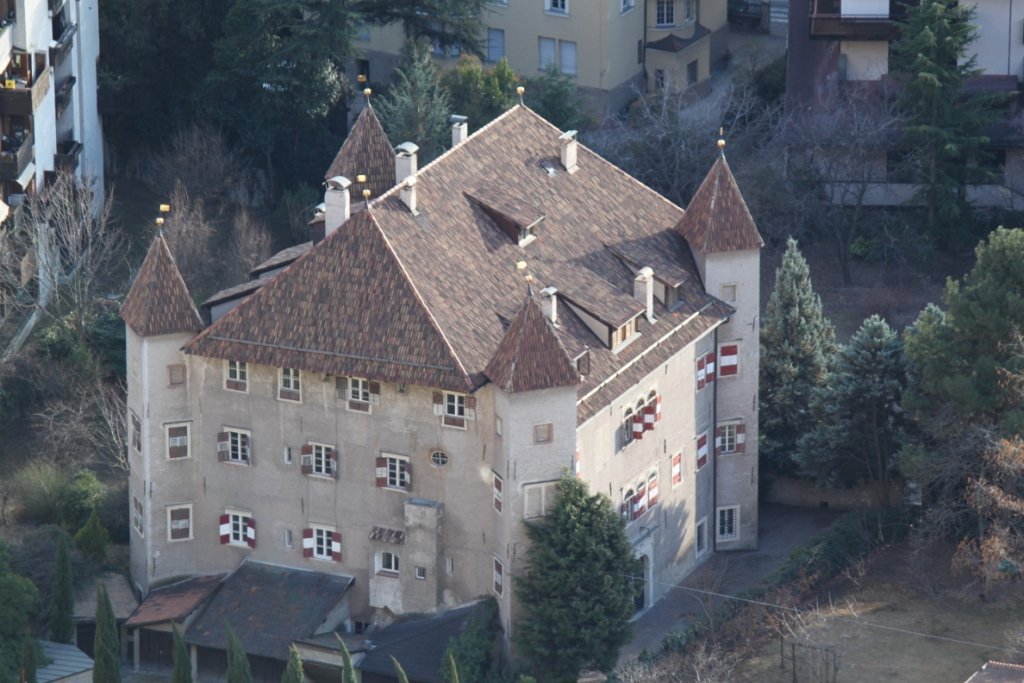
Castel Hörtenberg is a Renaissance castle in the Dodiciville district, just a few minutes’ walk from the center of Bolzano. Built on a 15th-century farmstead, it is now a 5-star hotel with 24 suites between the historic building and a new wing in the garden, a spa with an outdoor pool heated year-round, and a historic vaulted cellar. From its windows, the view stretches to the UNESCO Dolomites and the woods rising toward the Renon plateau.
– 24 suites with antique furniture, modern design, and family artworks
– Spa with Finnish sauna, bio-sauna, salt wall, and outdoor pool
– Buffet breakfast by pastry chef Berardino Aversa with regional products
– Tastings in the vaulted cellar and a romantic garden with centuries-old trees
Introduction
Hörtenberg Castle peeks out among the ancient trees of Dodiciville, on the slopes of the Renon plateau, and in Bolzano you spot it right away: four corner turrets, ancient walls and a garden that smells of the Mediterranean. It is a 15th-century Renaissance castle transformed into a 5-star hotel with 24 suites, but it doesn’t feel like just any hotel. Inside you’ll find antique furniture, contemporary design and pieces from the art collection of the Podini family, who run it. From the windows your gaze sweeps toward the Dolomites, a UNESCO World Heritage Site, while below lies Bolzano’s city centre, reachable on foot. The effect is that of a noble residence that has opened its doors without losing its character: exclusive, quiet, a little out of time. An address that surprises even those who think they know South Tyrol well.
Historical notes
Its origins are not aristocratic: this was once a farmstead documented in the 15th century as Obergassen or Jochimshof. In
1471 the property passed to the Hiertmair (Hörtmair) family of Bolzano, ennobled in
1487 and later known as Hörtmair zu Hörtenberg. In the late 16th century the building was enlarged into a palatial residence and given the
four corner turret oriels that still characterize it. From
1682 until the 19th century it belonged to the Barons Giovanelli zu Gerstburg und Hörtenberg. When Dodiciville was an independent municipality (1849-1911), the council meetings were held in the manor. Since 1951 it has been under the protection of the artistic heritage authorities.
- 15th century: Obergassen/Jochimshof farmstead
- 1471: Hiertmair family
- 1487: ennoblement
- Late 16th century: mansion with four oriels
- 1682: Giovanelli family
- 1849-1861: Dodiciville independent municipality
- 1951: protection of artistic heritage
Spa and wellness, all year round
Here, wellness is part of the experience, not an add-on. There is a heated outdoor pool open all year round, and swimming while looking at the trees as it’s cold outside is probably the moment you’ll remember most. The fitness area is equipped with Technogym, then you’ll find a Finnish sauna, a bio sauna overlooking the garden, a Himalayan salt wall, and chromotherapy showers. Nothing like the anonymous spas of chain hotels: the setting is a Renaissance palazzo, and you only have to look up to be reminded of that. After the sauna, the romantic garden with centuries-old trees and Mediterranean blooms is the right place to truly slow down. A practical detail: the pool operates in every season, so even a winter escape makes sense.
The vaulted wine cellar and the pastry chef’s breakfast
The historic vaulted cellar is one of the most evocative spaces: tastings are held here, featuring wines from the Tuscan estate Ampeleia and other international labels. The contrast between the stone vaults and the wine glasses is striking. In the morning, by contrast, the ritual is the buffet breakfast curated by pastry chef Berardino Aversa, with regional products and natural preparations. Don’t expect an anonymous room with an endless buffet: the selection is more thoughtful, and the homemade offerings come through. On request, dinners and tastings can also be arranged, so if you’re interested in the gastronomic side, it’s worth asking in advance. For me, it’s one of the reasons Hörtenberg isn’t just a nice place to sleep.
Suites and art in a historic building
The 24 suites are not all the same: 21 are in the main historic building, 3 in a new wing in the garden. Inside, antique furniture sits alongside modern design and pieces from the Podini family art collection. The result is an interior that feels more like a cultured family home than a hotel. If you can, ask for a room facing the mountains: the Dolomites are part of the show. Location matters too: you are in the S. Osvaldo area, in the Dodiciville district, a few minutes’ walk from the center of Bolzano but far enough from the bustle. I’d call it a rare compromise: the convenience of the city and the quiet of a centuries-old garden.
Why visit it
Three concrete reasons. First: it’s a heritage-listed building since 1951 that you can experience from the inside, not just photograph from outside. Second: the combination of Renaissance history and five-star hotel amenities — heated pool, spa, wine cellar — is hard to find elsewhere in Bolzano. Third: the location, at the foot of the Renon plateau and close to the center, lets you alternate between culture in the city and walks in the woods climbing toward Monte Tondo (1110 m). If you’re looking for an elegant but unpretentious base for exploring South Tyrol, this address works. And if you’re interested in art, the private collection is an unexpected surprise.
When to go
The pool is heated year-round, so there’s no wrong season. That said, my favorite time is autumn: the woods above Dodiciville light up with color and the garden remains enjoyable. Winter also has its charm, with Bolzano’s center in festive mode and returning to the hotel to the warmth of the spa. In summer, on the other hand, the outdoor pool is at its best in the late afternoon hours, when the sun is lower and the light on the mountains is just right. Early morning, with the garden still quiet, is ideal for breakfast. If I can give one piece of advice: don’t schedule everything and leave room for an off-season swim.
In the Surroundings
From here, Bolzano’s old town is close at hand: Walther Square with its cathedral, the Portici arcades, and Museion are the city’s most classic sights. If you feel like heading up, the Renon cable car takes you to the plateau, where the historic little train links Soprabolzano and Collalbo: an easy way to change scenery without wandering too far. Alternatively, Runkelstein Castle with its medieval frescoes is a perfect outing for history lovers. And the woods above Hörtenberg, toward Monte Tondo and the Hörtenberger Kreuz cross, are the right choice if you fancy a walk without taking the car. Personally, I’d mix a morning in the city with an afternoon on the Renon.