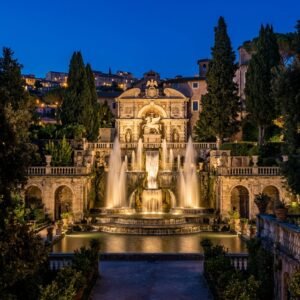
Villa Lante is in Bagnaia, 5 km from Viterbo, and is one of the masterpieces of 16th-century Italian Mannerism. The visit includes the loggias of the two twin pavilions, the Italian-style terraced garden with fountains and water features, and part of the 12-hectare woodland. Tickets: full price €5, reduced €2 (18-25 years), free on the first Sunday from October to March; booking is recommended.
– Fountain of the Moors by Giambologna
– Cardinal’s Table with a stream
– Two frescoed pavilions: Gambara and Montalto
– Water features and panoramic terraces
Introduction – Villa Lante in Viterbo: Gardens and Water Features
In Bagnaia, a hamlet of Viterbo, there is a place that seems to have stepped out of a Renaissance drawing: Villa Lante. Don’t expect a single palace: here the surprise is all in the garden. Two twin pavilions, almost identical, face each other from opposite sides of a boxwood parterre, while water descends along the terraces with fountains, cascades and water features. It is one of the most famous 16th-century Italian gardens, Mannerist and full of surprises, along with Bomarzo. In 2011 it was voted the most beautiful park in Italy. Its impact is spectacular yet intimate: you walk among holm oaks, plane trees and oaks, with water accompanying every step. The complex is state-owned and managed by the Regional Directorate of Museums of Lazio. For me, the magic lies in the details: the table with a stream to chill wine, the artificial grottoes, the Fountain of the Moors. A place that deserves time, comfortable shoes and curiosity.
A Brief History
The history of Villa Lante begins in
1511, when construction was started at the behest of Cardinal
Gianfrancesco Gambara. The work was completed around
1566. The design is attributed to
Jacopo Barozzi da Vignola, although contemporary documentation is lacking; for the waterworks,
Tommaso Ghinucci came from Siena, with advice from Pirro Ligorio. After Gambara’s death in 1587, Cardinal Alessandro Peretti di Montalto completed the project and had the second building erected (1611–1613). In the 17th century the villa passed to
Ippolito Lante Montefeltro della Rovere, 1st Duke of Bomarzo, from whom it takes its current name. In 2011 it was voted Italy’s most beautiful park, and in 2014 a commemorative coin was dedicated to it. Today it is state-owned and since December 2014 has been managed by the Polo Museale del Lazio, now the Regional Directorate of Museums of Lazio.
- 1511: construction begins.
- 1566: completed for Cardinal Gambara.
- 1568–1578: Gambara Pavilion.
- 1587: death of Gambara.
- 1611–1613: Montalto Pavilion.
- 17th century: passes to the Lante family.
- 2011: Italy’s most beautiful park.
A water garden on terraces
The real spectacle of Villa Lante is its garden, a system of terraces connected by water. The entrance leads to the Fontana del Pegaso (1588), with its winged horse, the Muses and Apollo. Then the Quadrato dei Mori opens up, with the Fontana dei Mori at its center, traditionally attributed to Giambologna: four life-size figures support the heraldic mountain of the Montalto family, crowned by a star-shaped jet. As you ascend, you come across the Fontana dei Lumini, the artificial grottoes of Venus and Neptune, the Mensa del Cardinale – a stone table with running water to keep drinks and fruit cool – and the Fontana dei Giganti, which represents the Arno and the Tiber. There is also the Fontana del Gambero, the Fontana dei Delfini and, at the top, the Fontana del Diluvio, a grotto with six openings from which water drips. The water comes from a natural spring in the Monti Cimini and flows down by gravity. A symbolic and sensory route, hard to forget.
The Twin Palazzine and Their Frescoes
Villa Lante is not a single villa but two twin palazzine: the Palazzina Gambara and the Palazzina Montalto. They are almost identical, yet built about thirty years apart. The first, commissioned by Cardinal Gambara, was completed between 1568 and 1578; the second, added by Alessandro Peretti di Montalto, between 1611 and 1613. Both have a square plan, a small tower, three-arched loggias with rusticated stonework, and a piano nobile with smaller windows. The differences are inside: the Palazzina Gambara contains frescoes by Antonio Tempesta, Raffaellino da Reggio, Girolamo Muziano and others; the Sala della Caccia e della Pesca (Hall of Hunting and Fishing) is attributed to Tempesta. The Palazzina Montalto combines stuccoes, tapestries, paintings, a coffered ceiling, and trompe-l’oeil by Cavalier d’Arpino and Agostino Tassi. As a rule, the loggias can be visited; the piano nobile of the Gambara can be visited by reservation on Wednesdays, and that of the Montalto on specific days. Always check the calendar.
In the woods: secret gardens and an icehouse
Beyond the Italian garden opens a 12-hectare woodland (within a park of more than 20 hectares) with centuries-old holm oaks, plane trees, and oaks. Here there were once fountains that have now disappeared, such as the Fountain of the Acorns, which evoked Ovid’s Golden Age, and that of Bacchus, linked to the wine flowing in the streams. The path between shade and stone is quieter, but it holds surprises: secret gardens, labyrinths, topiary, and a cylindrical icehouse buried almost 10 metres deep, built in the early 1600s to store snow and ice. There are also two small garden pavilions that form a water theatre. This is the part many overlook, but for me it is the one that reveals how much the design by Vignola and Ghinucci was meant to astonish step by step. Wear comfortable shoes and bring water: the elevation change is noticeable, but the silence of the woods pays you back.
Why Visit It
There are at least three reasons to include Villa Lante in an itinerary in Lazio. First: it is one of the most accomplished Italian gardens of the 16th century, with a use of water that is not merely decorative but structural. The fountains, waterfalls and water features accompany the entire route and make the visit different from any “postcard” garden. Second: the two twin casino buildings are a rare architectural choice, splitting the residence in two to leave more space for greenery. Third: the ticket is affordable – full price €5, reduced €2 – and the visit suits either a short trip or a slow afternoon. Note: until spring 2026, PNRR works are underway that may limit some areas and leave some fountains without water; the ticket is reduced. It is best to check in advance. For those who love art, water and landscape, it remains an unmissable stop.
When to Go
There’s no perfect time for everyone, but I’d choose early morning or late afternoon, when the light is low and the water seems to sparkle more. At midday, especially in summer, the uphill path between the terraces can feel muggy: better to avoid the middle of the day. Spring and autumn also show the garden at its best, with mild temperatures and softer colours; in winter, if a clear day comes along, the woodland has a quiet, melancholy charm. If you can, avoid the full weekend: entry is limited and the Moors’ parterre deserves to be seen without a crowd. Always check the calendar: opening hours are seasonal and closed on Mondays, and PNRR works may change access to some fountains. A practical tip? Save the Fountain of the Flood for the end, so the descent will feel like another visit.
Around the Area
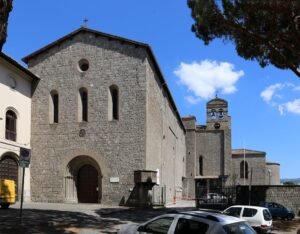
Villa Lante is in Bagnaia, in the municipality of Viterbo: it is well worth stopping in the medieval historic centre, among its palaces and the San Pellegrino area. Nearby you will also find Vitorchiano, a peperino-stone village, and Soriano nel Cimino, at the gateway to the Monti Cimini. If Mannerism is your theme, another natural stop is Caprarola, with the Palazzo Farnese, also by Vignola: comparing it with Villa Lante is illuminating. For lovers of “surprise” gardens, Bomarzo is also a point of reference. I won’t give distances or times: the area is best explored slowly, perhaps dividing the day between water, woods, and villages. Bring comfortable shoes and a willingness to stray from the main route.