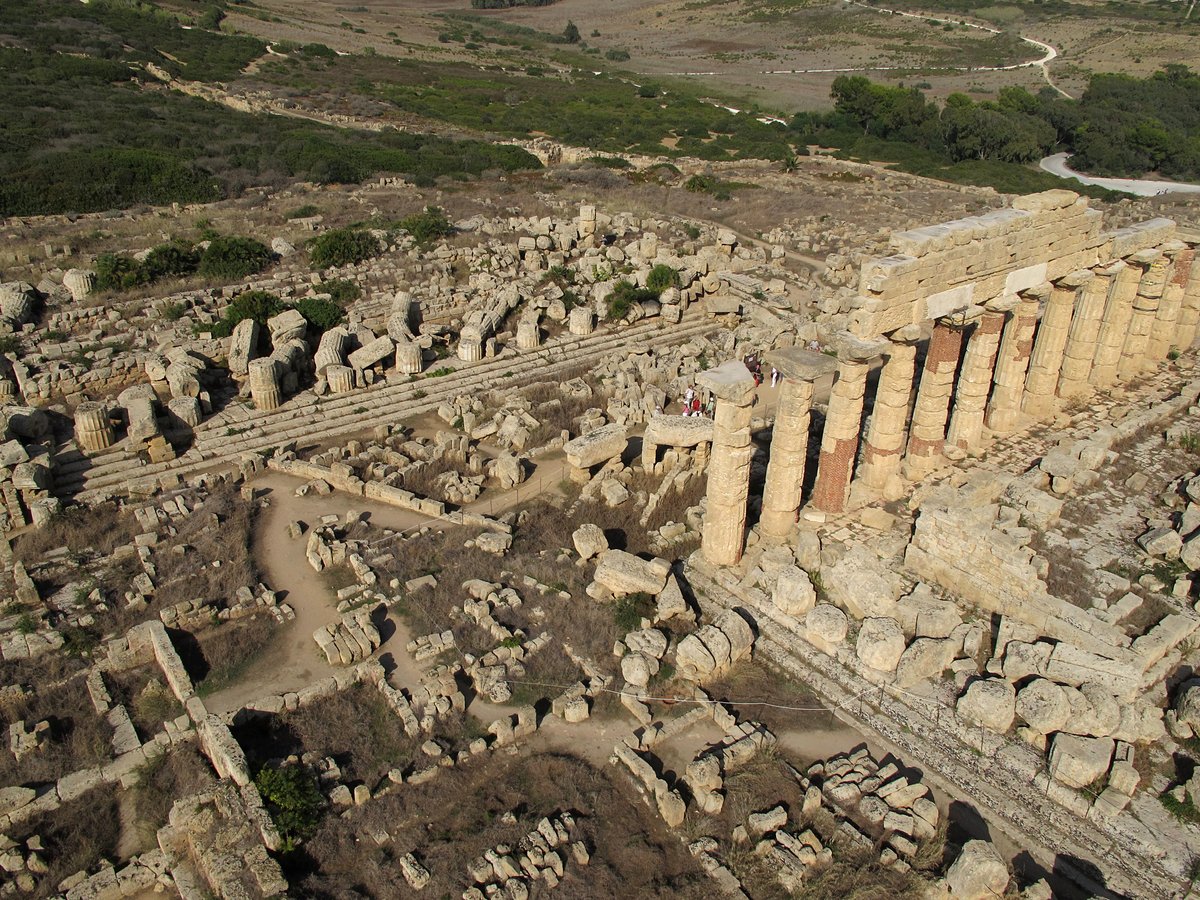
Temple D of Selinunte in Castelvetrano is one of the best-preserved temples in the Selinunte Archaeological Park, with Doric columns standing against the sky of western Sicily. It sits on a hill overlooking the Mediterranean Sea, offering a striking contrast between ancient ruins and coastal landscape. The visit is a sensory experience, with wind blowing through the columns and views stretching to the African coast.
- Doric columns mostly standing with intact capitals and vertical fluting
- Parts of the cella and peristyle visible, providing a clear idea of sacred architecture
- Panoramic hilltop position with views of the Mediterranean Sea
- Atmospheric setting at sunset when columns turn golden and pink
Introduction
Arriving at Temple D of Selinunte is like taking a leap back in time. It’s not just a pile of ancient stones: it’s a colossus that watches you, with its Doric columns standing out against the blue sky of western Sicily. There are more famous temples in Greece, but here, in Castelvetrano, there’s something special. Perhaps it’s the light caressing the local travertine, or the silence broken only by the wind coming from the sea. I sat on a boulder and imagined the rituals that took place here, millennia ago. It’s not a static museum: it’s a place that breathes history, and makes you feel small, in a beautiful way.
Historical Overview
Temple D, dedicated to Athena, was built around
540 BC, during the golden age of Selinunte, one of the most powerful Greek colonies of Magna Graecia. It was never fully completed, giving it an imperfect charm. It endured Carthaginian and Roman dominations, as well as earthquakes, yet it stood resilient. Today, it is one of the best-preserved temples in the archaeological park, thanks to intelligent restorations that reinforced its structure without altering it. Its slightly elevated position suggests it served as a visual landmark for those arriving by sea.
- 540 BC: Construction of the temple
- 409 BC: Carthaginian siege of Selinunte
- Around 250 AD: Likely abandonment following earthquakes
- 1950s: Beginning of modern restorations
The Details That Tell a Story
As you walk around the temple, you’ll notice that the roof is missing, but the columns are almost all standing, some with their capitals intact. Look closely at the vertical grooves on the columns: they aren’t perfectly straight, but have a slight curvature called ‘entasis’, an optical trick used by the Greeks to make them appear more slender. On the east side, you can still see the remains of the altar where sacrifices took place. One detail that struck me: some stones have inscriptions almost erased by time, perhaps signatures of ancient stonemasons. Don’t look for elaborate decorations: here, beauty lies in essential power, in that severe geometry that speaks of divinity and community.
The Sunset Glow
If there’s a magical time to see Temple D, it’s late afternoon, when the sun dips toward the sea. Shadows lengthen, columns turn golden and pink, and the atmosphere becomes almost surreal. I’ve seen photographers wait for hours to capture that moment. In summer, avoid midday: the heat is intense and the flat light doesn’t do it justice. In spring or autumn, however, the days are longer and the weather is perfect for enjoying the spectacle in peace. Sometimes, if you’re lucky, you’ll encounter other visitors in quiet contemplation, just like you. It’s an experience that goes beyond tourism: it’s a rendezvous with history, illuminated by nature.
Why Visit It
First: it’s accessible and immediate. You don’t need a guide to appreciate its grandeur; just look. Second: it gives you a concrete idea of how Greeks lived in Sicily, away from postcard clichés. Third: it’s part of a broader context, the Selinunte Archaeological Park, which includes other temples and the acropolis, but Temple D has its own distinct personality, perhaps more intimate. And let’s face it, it’s a place where you can take incredible photos without crowds, if you choose the right moment. It’s not just for archaeology enthusiasts: it’s for anyone seeking a peaceful corner filled with stories.
When to Go
I’d recommend visiting in late spring or early autumn. April-May and September-October are ideal: the weather is mild, the surrounding fields are green or golden, and you won’t suffer from the stifling heat of the Sicilian summer. Avoid August if you dislike crowds, though the park is vast and spreads out well. For the time of day, as I mentioned, aim for late afternoon. But if you’re an early riser, the first light of day also offers special atmospheres, with dew sparkling on the stones. In winter, it can be windy, but the clear sky and low clouds create dramatic contrasts. In short, every season has its charm, but to enjoy it at a leisurely pace, choose the shoulder seasons.
In the Surroundings
After the temple, take a trip to Marinella di Selinunte, the seaside hamlet near the park. It’s a peaceful fishing village where you can enjoy fresh seafood at a sea-view trattoria, perhaps trying the fish couscous, a Trapani specialty. Another idea: visit the Museo del Satiro in Mazara del Vallo, just a few kilometers away. It displays the Dancing Satyr, a Greek bronze statue recovered from the sea, which will continue your journey through Magna Graecia with emotion. Both places are along the same route, perfect for a themed itinerary without rushing.