Thapsos: The Ancient Prehistoric Village with a Cliffside Necropolis Overlooking the Sea

Thapsos is not just an archaeological site; it’s a journey back 3,500 years in time. This Bronze Age settlement, overlooking the sea in Priolo Gargallo, preserves traces of one of Sicily’s most important prehistoric civilizations. Admission is free and it’s reachable with a short walk from the main road.

See the circular huts that show the village’s organization
Explore the rock-cut necropolis carved into the limestone
Admire the sea panorama that the Thapsians controlled
Discover the artifacts at the Archaeological Museum of Syracuse


Events nearby


Copertina itinerario Thapsos: The Ancient Prehistoric Village with a Cliffside Necropolis Overlooking the Sea
Thapsos in Priolo Gargallo is a Bronze Age archaeological site featuring circular huts and a rock-cut necropolis overlooking the sea. Accessible free of charge, it offers a dive into prehistoric Sicily.

Good to know


Introduction

Thapsos is not your typical archaeological site. It’s a place that grabs you by the throat, with those circular huts that still seem inhabited by the wind and the necropolis that literally plunges into the sea. You almost stumble upon it by chance, hidden as it is among the industrial plants of Priolo Gargallo, yet the moment you set foot on the path, you feel catapulted into another era. The sensation is strange, almost surreal: on one side, the intense blue of the Ionian Sea; on the other, traces of a civilization that lived and traded here over three thousand years ago. Access is free and there are no barriers, just a dirt path that leads you straight into the heart of Sicilian prehistory. Personally, I was struck by the silence, broken only by the sound of waves crashing on the rocks beneath the tombs. A powerful contrast that makes the visit much more than a simple stroll among ruins.

Historical Overview

Thapsos flourished during the Middle Bronze Age, between 1500 and 1200 BC, becoming a crucial crossroads in the Mediterranean. This was no ordinary village: goods arrived here from Mycenaean Greece, Anatolia, and the Aeolian Islands, as evidenced by the ceramic artifacts discovered. Archaeologists refer to a distinct Thapsos culture, characterized by these particular circular huts with stone foundations and rock-cut chamber tombs carved into the limestone. Then, around 1050 BC, the site was abandoned, possibly due to climate changes or conflicts. Its traces remained buried until systematic excavations began in the 1970s. Today, visitors walk among the stone circles of the foundations, imagining the daily life of fishermen, farmers, and skilled traders.

  • 1500-1200 BC: Peak of Thapsos as a commercial center.
  • 13th century BC: Construction of the chamber tombs in the necropolis.
  • Around 1050 BC: Abandonment of the village.
  • 1970-1980: Archaeological excavations that brought the site to light.

The Circular Huts: Houses from 3500 Years Ago

What immediately strikes you are the stone circles scattered across the plateau. These aren’t just piles of rocks, but the foundations of dwellings. The huts were circular, with diameters that could exceed ten meters, and likely had a structure of wood and branches covered in clay. Walking among them, I tried to imagine the layout: perhaps the largest one was a meeting place, the smaller ones family homes. Some still have the central hearth visible. The fascinating aspect is their organization: they aren’t placed randomly, but seem to follow a pattern, as if delineating common spaces and pathways. You realize you’re treading on what was the ‘floor’ of a Bronze Age house. There are no reconstructions, just the stones at ground level, and perhaps that’s better: the suggestion is stronger when you have to use a bit of imagination.

The Cliffside Necropolis: A Salute to the Ancestors

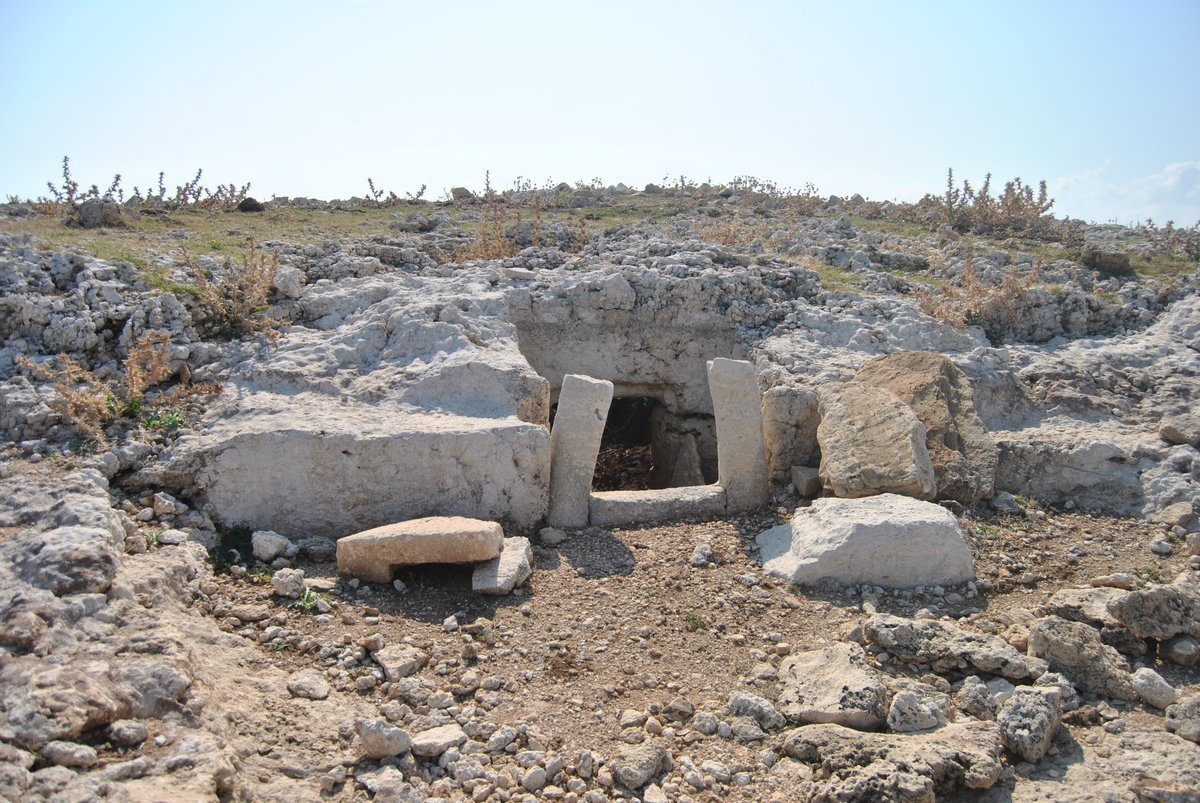
The most spectacular part is undoubtedly the necropolis. It’s reached by descending a short slope toward the sea. The tombs, called ‘grotticella,’ are carved into the rock face and overlook the Ionian Sea directly. They are small cells, often with a rectangular entrance. Entering them today is impossible (and dangerous), but standing there in front, with the sound of the sea entering those ancient burial chambers, is an intense experience. I wondered why they built them right there, with this breathtaking view. Perhaps to be close to the water, a vital element, or maybe for a symbolic meaning related to the journey to the afterlife. The wind whips strongly, the saltiness is palpable, and you understand why this place is not just an archaeological site, but a spiritual one. Watch the edges: there are no railings, so keep an eye on children and watch your step.

Why Visit

For three very concrete reasons. First: it’s a unique site of its kind. Sicily has many Greek and Roman remains, but a prehistoric Bronze Age village this well-preserved and in such a dramatic location is rare. Second: access is free and unorganized. There are no tickets, closing hours, or set paths. You can explore at your own pace, though this means there’s little information on-site (it’s better to do your research beforehand). Third: the contrast. Seeing these ancient human traces set within a landscape now marked by industry is a powerful lesson in history and geography. It makes you reflect on how places transform, yet some marks remain indelible.

When to Go

Avoid the midday hours during summer days. The site is completely exposed to sun and wind, with no shelter. The best time is early morning or late afternoon, when the light is low and warms the stones to a golden hue. In spring and autumn, it’s absolutely pleasant, and you’ll often have the place entirely to yourself. In winter, if the day is clear, it can be magical, but the northeast wind (the grecale) can be icy and biting. I visited in October, around five in the afternoon, and the light filtering into the tombs of the necropolis created incredible shadow plays. In summer, going at dawn could be an idea to beat the heat and enjoy the spectacle in solitude.

In the Surroundings

The visit to Thapsos pairs perfectly with another industrial archaeology experience (yes, you read that right). Just a few minutes’ drive away is the former sugar refinery in Priolo Gargallo, an abandoned reinforced concrete giant that tells another, much more recent chapter of this coast’s history. It’s a surreal and photogenic place, though obviously to be visited with utmost caution. For a total contrast, you can head towards Syracuse and lose yourself in the Ortigia neighborhood, with its Baroque palaces and lively atmosphere. There, the history is Greek, Roman, medieval, but after Thapsos you’ll look at it with different eyes, thinking about how long and layered this land’s history is.

Itineraries nearby


💡 Did You Know…?

Excavations have revealed that Thapsos was a commercial crossroads of the ancient Mediterranean. The Thapsians traded with Mycenaeans and Cypriots, as shown by the pottery and objects found. The strategic position on the peninsula allowed control of maritime traffic. Today, walking among the ruins, one can still sense the importance of this place, which was mysteriously abandoned around 1200 BC.