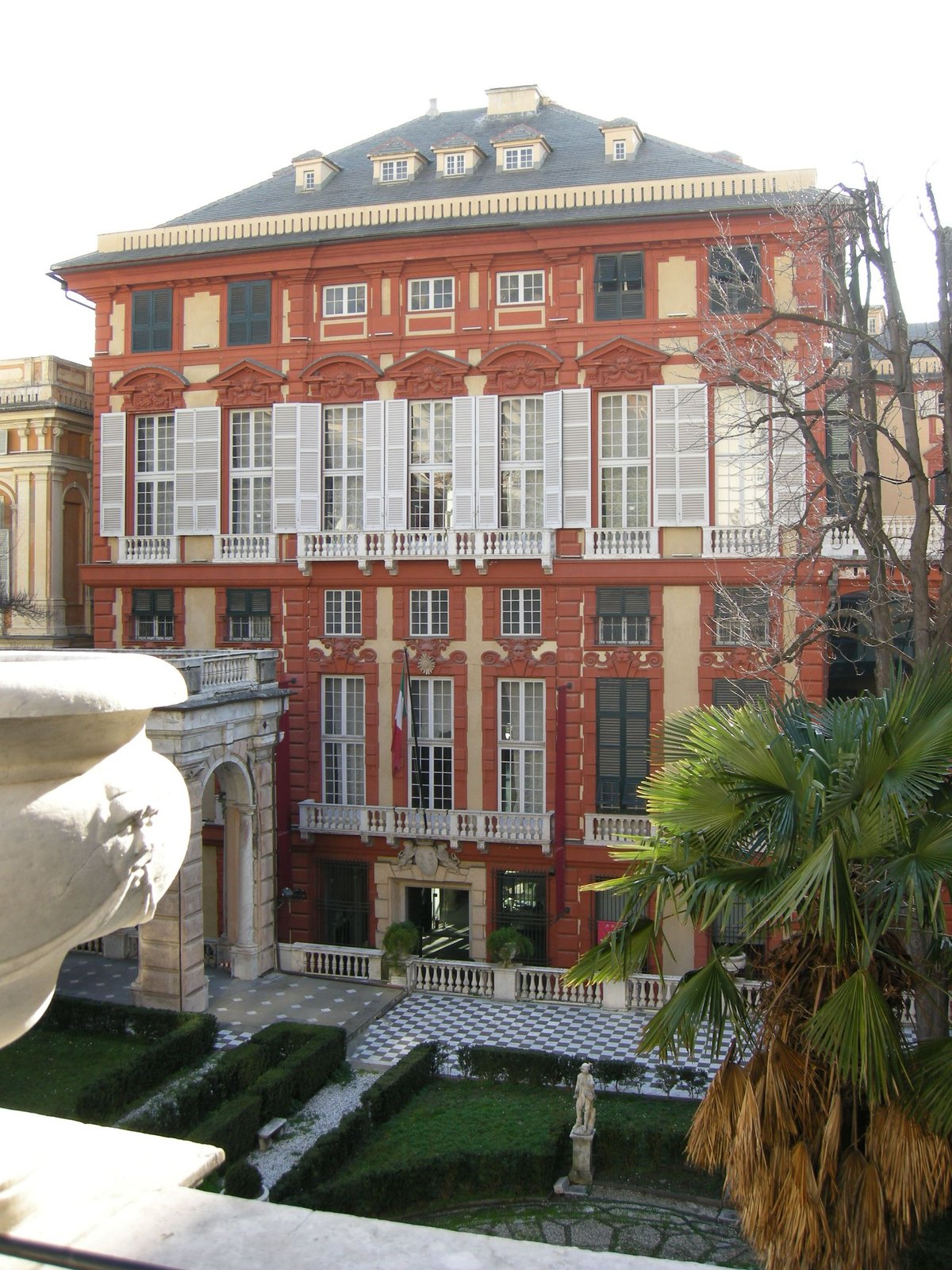
Palazzo Rosso is a 17th-century museum-house in the heart of Genoa, among the UNESCO Palazzi dei Rolli. Built between 1671 and 1677 for the Brignole Sale brothers, it preserves frescoes by Piola and De Ferrari and an art collection with masterpieces from the 16th to the 18th century. Visitable with a single ticket that also includes Palazzo Bianco and Palazzo Tursi.
– Baroque frescoes in the Hall of the Seasons and the Loggia of the Ruins.
– Brignole-Sale Art Collection with works by Dürer, Van Dyck, Veronese, and Guido Reni.
– Panoramic terrace with a 360° view of Genoa.
– Cabinet of Drawings and Prints with 10,000 drawings and 7,000 engravings.
Introduction: A Dive into Genoese Baroque
Palazzo Rosso, with its purple façade, is one of those places that leaves you breathless the moment you enter. Overlooking Via Garibaldi, the palace is part of the Strada Nuova Museums, a UNESCO World Heritage site. Every room is a riot of Baroque frescoes, gilded stuccoes, and paintings by masters like Van Dyck and Veronese. Walking through the rooms feels like stepping back into the 17th century, when the Brignole-Sale family hosted ambassadors and nobles. It’s not a cold museum: you can still breathe the atmosphere of a lived-in home, with original furnishings and that panoramic terrace that makes you fall in love with Genoa. Prepare to be amazed.
Introduction: A Dive into Genoese Baroque
Palazzo Rosso, with its purple façade, is one of those places that leaves you breathless the moment you enter. Overlooking Via Garibaldi, the palace is part of the Strada Nuova Museums, a UNESCO World Heritage site. Every room is a riot of Baroque frescoes, gilded stuccoes, and paintings by masters like Van Dyck and Veronese. Walking through the rooms feels like stepping back into the 17th century, when the Brignole-Sale family hosted ambassadors and nobles. It’s not a cold museum: you can still breathe the atmosphere of a lived-in home, with original furnishings and that panoramic terrace that makes you fall in love with Genoa. Prepare to be amazed.
Historical Notes: From the Brignole-Sale Family to the City
Built between 1671 and 1677 to a design by Pietro Antonio Corradi, the palace was commissioned by the brothers Rodolfo and Gio Francesco Brignole-Sale. After Rodolfo’s death, Gio Francesco consolidated the property and summoned the finest artists of the Genoese Baroque to decorate the halls. In 1874, the last descendant Maria Brignole-Sale, Duchess of Galliera, donated everything to the city. The bombings of World War II destroyed part of the frescoes, but Franco Albini’s restoration in the 1950s restored the palace’s splendor. Today it is the heart of the Musei di Strada Nuova.
- 1671-1677 – Construction of the palace
- 1679-1694 – Decoration of the halls with Baroque frescoes
- 1874 – Donation to the Municipality of Genoa
- 1953-1961 – Restoration by Franco Albini
- 2006 – UNESCO World Heritage
Historical Notes: From the Brignole-Sale Family to the City
Built between 1671 and 1677 to a design by Pietro Antonio Corradi, the palace was commissioned by the brothers Rodolfo and Gio Francesco Brignole-Sale. After Rodolfo’s death, Gio Francesco consolidated the property and summoned the finest artists of the Genoese Baroque to decorate the halls. In 1874, the last descendant Maria Brignole-Sale, Duchess of Galliera, donated everything to the city. The bombings of World War II destroyed part of the frescoes, but Franco Albini’s restoration in the 1950s restored the palace’s splendor. Today it is the heart of the Musei di Strada Nuova.
- 1671-1677 – Construction of the palace
- 1679-1694 – Decoration of the halls with Baroque frescoes
- 1874 – Donation to the Municipality of Genoa
- 1953-1961 – Restoration by Franco Albini
- 2006 – UNESCO World Heritage
The Second Piano Nobile: A Journey into Genoese Baroque
Climbing to the second floor, you find yourself immersed in a triumph of colors and illusions. The Sala dell’Autunno is a masterpiece: frescoed by Gregorio De Ferrari and Domenico Piola, it feels like stepping inside a painting. The walls are designed to highlight works by Guido Reni and Veronese, purchased specifically by the family. A bit further, the Loggia delle Rovine makes you feel like you’re in an ancient Roman city, with fake ruins and painted monkeys. Each room has a theme: the seasons, the liberal arts, the life of man. Don’t miss the Salotto delle Virtù romane, with frescoes by Lorenzo De Ferrari.
The Second Piano Nobile: A Journey into Genoese Baroque
Climbing to the second floor, you find yourself immersed in a triumph of colors and illusions. The Sala dell’Autunno is a masterpiece: frescoed by Gregorio De Ferrari and Domenico Piola, it feels like stepping inside a painting. The walls are designed to highlight works by Guido Reni and Veronese, purchased specifically by the family. A bit further, the Loggia delle Rovine makes you feel like you’re in an ancient Roman city, with fake ruins and painted monkeys. Each room has a theme: the seasons, the liberal arts, the life of man. Don’t miss the Salotto delle Virtù romane, with frescoes by Lorenzo De Ferrari.
The Picture Gallery: From Dürer to Van Dyck, an Invaluable Treasure
The Brignole-Sale collection is one of the richest in Genoa. Here you’ll find Albrecht Dürer’s Portrait of a Young Venetian (1506), an extremely rare work. Nearby, Van Dyck’s Portrait of Paolina Adorno-Brignole-Sale hypnotizes you with its gaze. And then Veronese, with his Judith and Holofernes, and the famous The Cook by Bernardo Strozzi, which seems to step right out of the canvas. Masterpieces by Guercino, Palma il Vecchio, and Orazio Gentileschi are also on display. An art gallery that spans from the 15th to the 18th century, with rooms specifically designed to house the paintings.
The Picture Gallery: From Dürer to Van Dyck, an Invaluable Treasure
The Brignole-Sale collection is one of the richest in Genoa. Here you’ll find Albrecht Dürer’s Portrait of a Young Venetian (1506), an extremely rare work. Nearby, Van Dyck’s Portrait of Paolina Adorno-Brignole-Sale hypnotizes you with its gaze. And then Veronese, with his Judith and Holofernes, and the famous The Cook by Bernardo Strozzi, which seems to step right out of the canvas. Masterpieces by Guercino, Palma il Vecchio, and Orazio Gentileschi are also on display. An art gallery that spans from the 15th to the 18th century, with rooms specifically designed to house the paintings.
Why Visit: Three Good Reasons
First: the panoramic terrace (the Mirador). From there you see all of Genoa, from the old port to the Lanterna, in one breathtaking glance. Second: the portraits by Van Dyck – the Brignole-Sale family was his main patron, and these paintings are among the artist’s best. Third: the combined ticket that also includes Palazzo Bianco and Tursi: for €9 you visit three museums. Not bad, right? And then the atmosphere is unique: it feels like being a guest at a Baroque party.
Why Visit: Three Good Reasons
First: the panoramic terrace (the Mirador). From there you see all of Genoa, from the old port to the Lanterna, in one breathtaking glance. Second: the portraits by Van Dyck – the Brignole-Sale family was his main patron, and these paintings are among the artist’s best. Third: the combined ticket that also includes Palazzo Bianco and Tursi: for €9 you visit three museums. Not bad, right? And then the atmosphere is unique: it feels like being a guest at a Baroque party.
When to Go: The Perfect Moment
If you can, choose a weekday afternoon in autumn or spring. The rooms are less crowded and the light filtering through the windows enhances the frescoes. On summer Friday evenings, the museum stays open until 9 PM—a chance to see the sunset from the terrace. Avoid Monday – it’s closed – and if you go on Sunday, entry is free for Genoa residents, but tourists are advised to book ahead.
When to Go: The Perfect Moment
If you can, choose a weekday afternoon in autumn or spring. The rooms are less crowded and the light filtering through the windows enhances the frescoes. On summer Friday evenings, the museum stays open until 9 PM—a chance to see the sunset from the terrace. Avoid Monday – it’s closed – and if you go on Sunday, entry is free for Genoa residents, but tourists are advised to book ahead.
Nearby: What to See Next
Just steps away, Palazzo Bianco and Palazzo Tursi are included in the ticket: don’t miss them. Above Tursi, overlooking Piazza De Ferrari, is the Galleria di Palazzo Tursi with Paganini’s famous violins. If you have time, stroll down via Garibaldi: it’s an open-air museum, with other historic palaces like Palazzo Doria and Spinola. For a break, stop at a café in the historic center: Genoese focaccia is a delight.
Nearby: What to See Next
Just steps away, Palazzo Bianco and Palazzo Tursi are included in the ticket: don’t miss them. Above Tursi, overlooking Piazza De Ferrari, is the Galleria di Palazzo Tursi with Paganini’s famous violins. If you have time, stroll down via Garibaldi: it’s an open-air museum, with other historic palaces like Palazzo Doria and Spinola. For a break, stop at a café in the historic center: Genoese focaccia is a delight.