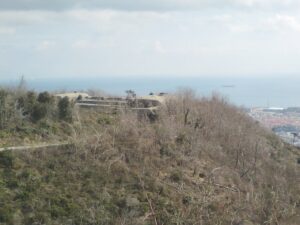
Perched 232 meters above sea level, Forte della Madonna degli Angeli overlooks the Gulf of Savona. Built by the Savoy in 1881, this fortress was part of the coastal defense system along with Forte Madonna del Monte and Forte Ciuto. Today it is a must-see destination for enthusiasts of history, trekking, and partisan memory, reachable on foot along the Ring of Forts. Panoramic location: from the top you enjoy a breathtaking view of the city and the sea. Hiking trail: the Ring of Forts is an 18 km route with a 487 m elevation gain, suitable for experienced hikers. Historical memory: in the courtyard, a plaque commemorates the seven partisans executed on December 27, 1943 (the “Christmas of blood”). Military architecture: two stories, with positions for howitzers and cannons, telemetric stations, and traces of reinforced concrete covering.
Introduction
Perched 232 meters above sea level, the Fort of Our Lady of the Angels dominates Savona and its gulf with a breathtaking view. It is a place that intertwines military history, lush nature, and a still-vivid partisan memory. Reachable on foot along the Ring of Forts, this 19th-century fort offers a unique atmosphere, suspended between the grandeur of stone and the silence of the Mediterranean maquis. It is not just a fortress: it is a privileged vantage point, a piece of history to discover, and a monument to resistance. Prepare to walk, to gaze at the sea from up there, and to let yourself be told what happened within these walls.
Introduction
Perched 232 meters above sea level, the Fort of Our Lady of the Angels dominates Savona and its gulf with a breathtaking view. It is a place that intertwines military history, lush nature, and a still-vivid partisan memory. Reachable on foot along the Ring of Forts, this 19th-century fort offers a unique atmosphere, suspended between the grandeur of stone and the silence of the Mediterranean maquis. It is not just a fortress: it is a privileged vantage point, a piece of history to discover, and a monument to resistance. Prepare to walk, to gaze at the sea from up there, and to let yourself be told what happened within these walls.
Historical Background
Built by the House of Savoy around 1881, the fort was part of the coastal defense system of Savona-Vado Ligure, together with the forts Madonna del Monte and Ciuto. Classified as a battery, it initially housed 280 mm howitzers, later cannons. During World War II, it was a Wehrmacht garrison and an anti-aircraft battery with Flak 88s. But its most dramatic episode is the massacre of December 27, 1943, when seven anti-fascists were executed by shooting as a reprisal. Today a plaque in the courtyard preserves their memory. Military use ceased in 1947, and since then the fort has been in a state of abandonment, but it can be visited with caution. Here are the key moments:
Historical Background
Built by the House of Savoy around 1881, the fort was part of the coastal defense system of Savona-Vado Ligure, together with the forts Madonna del Monte and Ciuto. Classified as a battery, it initially housed 280 mm howitzers, later cannons. During World War II, it was a Wehrmacht garrison and an anti-aircraft battery with Flak 88s. But its most dramatic episode is the massacre of December 27, 1943, when seven anti-fascists were executed by shooting as a reprisal. Today a plaque in the courtyard preserves their memory. Military use ceased in 1947, and since then the fort has been in a state of abandonment, but it can be visited with caution. Here are the key moments:
- 1596: first mention of the Church of Our Lady of the Angels
- 1881: construction of the fort
- 1943: massacre of December 27 (7 victims)
- 1947: end of strategic function
- 2010: included in the list of state property to be transferred
- 1596: first mention of the Church of Our Lady of the Angels
- 1881: construction of the fort
- 1943: massacre of December 27 (7 victims)
- 1947: end of strategic function
- 2010: included in the list of state property to be transferred
Architecture and Location
The fort is built on two levels: the first housed stables and storage, the second the howitzer positions and telemeter stations, still visible. In front of the entrance was a drawbridge over a moat that has now almost disappeared. Later modifications include a reinforced concrete cover to withstand modern artillery fire. Outside, to the northwest, lie the ruins of the barracks for the soldiers. The location, halfway between the city and the namesake small church, is strategic: from here the entire gulf could be controlled. The building, though partly hidden by vegetation, still exudes an air of power and abandonment that fascinates.
Architecture and Location
The fort is built on two levels: the first housed stables and storage, the second the howitzer positions and telemeter stations, still visible. In front of the entrance was a drawbridge over a moat that has now almost disappeared. Later modifications include a reinforced concrete cover to withstand modern artillery fire. Outside, to the northwest, lie the ruins of the barracks for the soldiers. The location, halfway between the city and the namesake small church, is strategic: from here the entire gulf could be controlled. The building, though partly hidden by vegetation, still exudes an air of power and abandonment that fascinates.
Memory and Resistance
In the inner courtyard, a memorial plaque and the bullet marks on the wall tell the saddest chapter in the fort’s history. Here on December 27, 1943, after a partisan attack, seven anti-fascists were shot in the back: lawyers, workers, farmers, soldiers. Among them were Cristoforo Astengo, a 56-year-old lawyer, and the very young Aniello Savarese, a 21-year-old soldier. The reprisal was one of the first in Liguria and sparked strikes and protests. Today, that courtyard is a place of silence and respect, where commemorations are held every year. Pausing for a moment to read the names is a simple but necessary gesture.
Memory and Resistance
In the inner courtyard, a memorial plaque and the bullet marks on the wall tell the saddest chapter in the fort’s history. Here on December 27, 1943, after a partisan attack, seven anti-fascists were shot in the back: lawyers, workers, farmers, soldiers. Among them were Cristoforo Astengo, a 56-year-old lawyer, and the very young Aniello Savarese, a 21-year-old soldier. The reprisal was one of the first in Liguria and sparked strikes and protests. Today, that courtyard is a place of silence and respect, where commemorations are held every year. Pausing for a moment to read the names is a simple but necessary gesture.
Why Visit It
Three good reasons: first, the panorama: from up there the Gulf of Savona is all yours, especially at sunset. Second, the hiking trail of the Ring of Forts is an immersion in nature among Mediterranean scrub and old fortifications. Third, it is an authentic place of memory, not museumified: you can touch the signs of history, from bullet holes to plaques. It is not a packaged tourist attraction, but a piece of true history that deserves respect and curiosity. It is ideal for those who love walking and want to understand the past of this coast.
Why Visit It
Three good reasons: first, the panorama: from up there the Gulf of Savona is all yours, especially at sunset. Second, the hiking trail of the Ring of Forts is an immersion in nature among Mediterranean scrub and old fortifications. Third, it is an authentic place of memory, not museumified: you can touch the signs of history, from bullet holes to plaques. It is not a packaged tourist attraction, but a piece of true history that deserves respect and curiosity. It is ideal for those who love walking and want to understand the past of this coast.
When to Go
The most evocative moment is sunset, when the sun sets behind the sea and the fort turns orange. The atmosphere becomes almost melancholic, perfect for reflecting on the history of the place. If you don’t like the heat, choose spring or autumn: the path is cooler and the vegetation is lush. In summer, early morning is best to avoid the heat. In winter, with a clear sky, the view extends all the way to Capo Noli. Whatever season you choose, bring water and a bit of silence to listen to the wind among the walls.
When to Go
The most evocative moment is sunset, when the sun sets behind the sea and the fort turns orange. The atmosphere becomes almost melancholic, perfect for reflecting on the history of the place. If you don’t like the heat, choose spring or autumn: the path is cooler and the vegetation is lush. In summer, early morning is best to avoid the heat. In winter, with a clear sky, the view extends all the way to Capo Noli. Whatever season you choose, bring water and a bit of silence to listen to the wind among the walls.
Nearby
Two must-see stops: just a stone’s throw from the fort you’ll find the Church of Madonna degli Angeli, small and bare, built in 1596 and rebuilt in 1930. It’s a peaceful resting point before the climb. Still on the same loop, you can continue towards the Forte della Madonna del Monte, a twin to ours, offering another perspective over the coast. If you prefer the sea, head down to Savona and stroll along the waterfront or visit the historic center with its cathedral. The fort is an excellent starting point for a day between history and nature.
Nearby
Two must-see stops: just a stone’s throw from the fort you’ll find the Church of Madonna degli Angeli, small and bare, built in 1596 and rebuilt in 1930. It’s a peaceful resting point before the climb. Still on the same loop, you can continue towards the Forte della Madonna del Monte, a twin to ours, offering another perspective over the coast. If you prefer the sea, head down to Savona and stroll along the waterfront or visit the historic center with its cathedral. The fort is an excellent starting point for a day between history and nature.