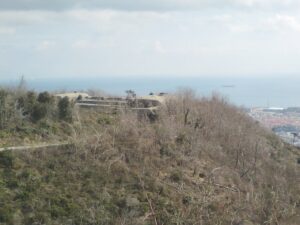
Priamar Fortress is the symbol of Savona: an imposing seaside fortification, now transformed into a vibrant cultural hub. Inside you’ll find two museums, an open-air theater, and event spaces. Here’s what not to miss:
– Civic Archaeological Museum: Etruscan, Greek, and Roman artifacts from excavations on the promontory.
– Sandro Pertini and Renata Cuneo Museum: contemporary art works donated by the former president.
– Giuseppe Mazzini’s Cell: where the patriot conceived the Young Italy movement.
– Open-air Theater: over 600 seats for summer concerts and shows with a view of the gulf.
Introduction
As soon as I cross the entrance from the Ponte di San Giorgio, the fortress looms before me in all its bulk. It is massive, stern, yet the sea surrounding it makes it seem almost suspended between sky and water. The Priamar – “stone on the sea” in Ligurian – is not just a monument: it is a journey through time among bastions, squares, and breathtaking views. I walk along the walls and feel the weight of history, but also the energy of the events that animate it today.
Introduction
As soon as I cross the entrance from the Ponte di San Giorgio, the fortress looms before me in all its bulk. It is massive, stern, yet the sea surrounding it makes it seem almost suspended between sky and water. The Priamar – “stone on the sea” in Ligurian – is not just a monument: it is a journey through time among bastions, squares, and breathtaking views. I walk along the walls and feel the weight of history, but also the energy of the events that animate it today.
Historical Background
Built by the Genoese between 1542 and 1544 based on a design by Giovanni Maria Olgiati, the fortress was meant to keep Savona in check and protect the territory. To make space, an entire medieval quarter was destroyed, including the Cathedral of Santa Maria di Castello (825-887). In the 18th century, bastions and palaces were added, and in 1815 it became a military prison. Here, between 1830 and 1831, Giuseppe Mazzini was imprisoned, and he conceived the Young Italy movement. Decommissioned in 1878, after restorations it is now a cultural hub. Here is the timeline:
Historical Background
Built by the Genoese between 1542 and 1544 based on a design by Giovanni Maria Olgiati, the fortress was meant to keep Savona in check and protect the territory. To make space, an entire medieval quarter was destroyed, including the Cathedral of Santa Maria di Castello (825-887). In the 18th century, bastions and palaces were added, and in 1815 it became a military prison. Here, between 1830 and 1831, Giuseppe Mazzini was imprisoned, and he conceived the Young Italy movement. Decommissioned in 1878, after restorations it is now a cultural hub. Here is the timeline:
Mazzini’s Cell and the Prison’s Past
One of the most intense experiences is visiting Giuseppe Mazzini’s cell. It is small, bare, yet here the patriot imagined a united Italy. The fortress served as a prison until the late 19th century, with cells that today tell stories of imprisonment and resistance. Walking through the restored rooms – such as the Commissioner’s Palace or the Small Cells – you breathe in a gloomy yet fascinating atmosphere, far from the city’s chaos.
Mazzini’s Cell and the Prison’s Past
One of the most intense experiences is visiting Giuseppe Mazzini’s cell. It is small, bare, yet here the patriot imagined a united Italy. The fortress served as a prison until the late 19th century, with cells that today tell stories of imprisonment and resistance. Walking through the restored rooms – such as the Commissioner’s Palace or the Small Cells – you breathe in a gloomy yet fascinating atmosphere, far from the city’s chaos.
The Museum Complex: Between Archaeology and Art
Inside the Palazzo della Loggia you’ll find two unmissable museums. The Civic Archaeological Museum displays artifacts from the Middle Bronze Age to the Roman period, including Etruscan and Greek pottery – some excavations are still visible. Upstairs, the Sandro Pertini and Renata Cuneo Museum houses contemporary artworks donated by the former president and sculptures by his wife. A perfect contrast between ancient history and modernity, all within a building that is itself a relic.
The Museum Complex: Between Archaeology and Art
Inside the Palazzo della Loggia you’ll find two unmissable museums. The Civic Archaeological Museum displays artifacts from the Middle Bronze Age to the Roman period, including Etruscan and Greek pottery – some excavations are still visible. Upstairs, the Sandro Pertini and Renata Cuneo Museum houses contemporary artworks donated by the former president and sculptures by his wife. A perfect contrast between ancient history and modernity, all within a building that is itself a relic.
Why Visit It
Three reasons not to miss it. First: the view. From the walkways and the Sibyl Square, you can enjoy a breathtaking panorama over the sea, the port, and the mountains – the sunset is spectacular. Second: the events. In summer, the 600-seat open-air theater in Maschio Square hosts operas and concerts, and cultural festivals enliven the squares. Third: living history. Touching the 16th-century walls and Mazzini’s cell provides an emotion that no guidebook can convey.
Why Visit It
Three reasons not to miss it. First: the view. From the walkways and the Sibyl Square, you can enjoy a breathtaking panorama over the sea, the port, and the mountains – the sunset is spectacular. Second: the events. In summer, the 600-seat open-air theater in Maschio Square hosts operas and concerts, and cultural festivals enliven the squares. Third: living history. Touching the 16th-century walls and Mazzini’s cell provides an emotion that no guidebook can convey.
When to Go
If you want to avoid the crowds, I recommend early morning or late afternoon. In summer it’s open until midnight, and sunset time is magical: the golden light lights up the bastions and the sea. In spring or autumn temperatures are milder, and the fortress is less crowded. The best time? May or September, when the weather is perfect for strolling barefoot between history and the sea.
When to Go
If you want to avoid the crowds, I recommend early morning or late afternoon. In summer it’s open until midnight, and sunset time is magical: the golden light lights up the bastions and the sea. In spring or autumn temperatures are milder, and the fortress is less crowded. The best time? May or September, when the weather is perfect for strolling barefoot between history and the sea.
In the Vicinity
After the fortress, take a stroll through Savona’s historic center: the maze of alleyways around Piazza Sisto IV hides shops and the Cathedral of Our Lady of the Assumption, which houses the wooden choir saved from the destruction of Priamar. If you’re in the mood for the sea, just a few steps away is the marina with bars and restaurants – perfect for an aperitivo with a view of the boats. Everything within walking distance.
In the Vicinity
After the fortress, take a stroll through Savona’s historic center: the maze of alleyways around Piazza Sisto IV hides shops and the Cathedral of Our Lady of the Assumption, which houses the wooden choir saved from the destruction of Priamar. If you’re in the mood for the sea, just a few steps away is the marina with bars and restaurants – perfect for an aperitivo with a view of the boats. Everything within walking distance.