Introduction
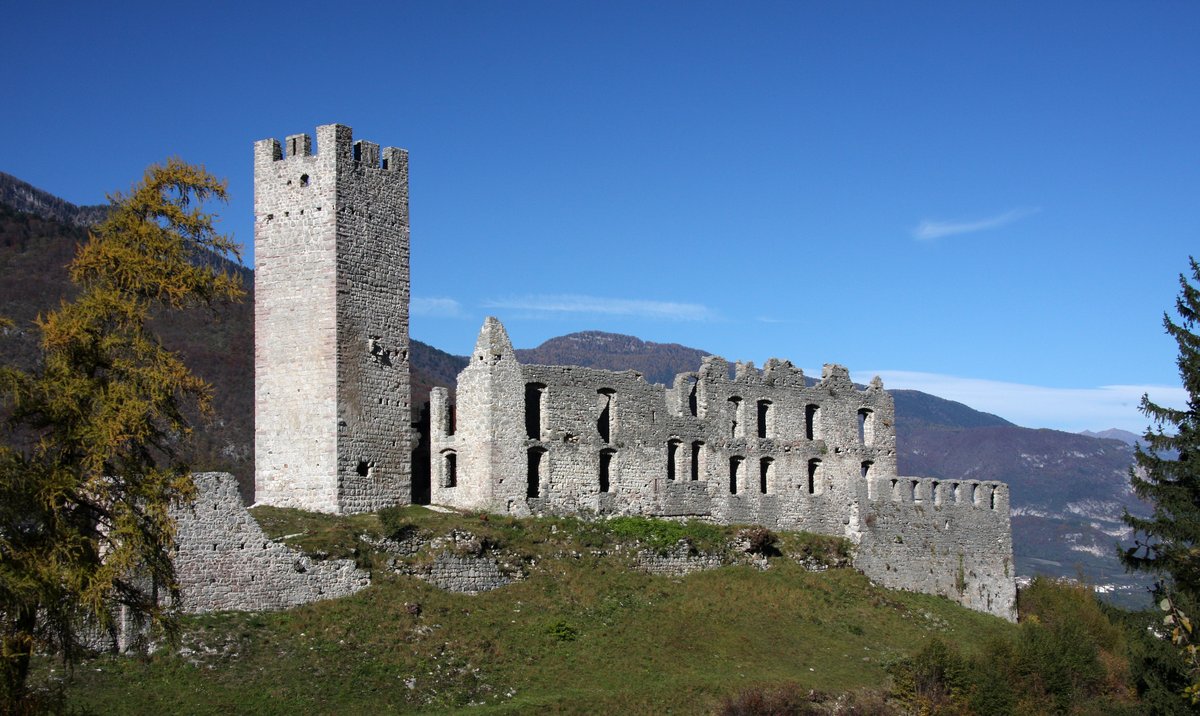
You are driving along the SS421 between Cavedago and Spormaggiore when suddenly it appears before you: a crenellated tower rising on a hill, surrounded by stone walls. This is Castel Belfort, a ruin that doesn’t go unnoticed. Don’t expect a fairy-tale castle: here history is written in the remains, in the stones worn by time, in the silence broken only by the wind. Access is free; you park on the roadside and climb for a few minutes. The atmosphere is that of an abandoned place, yet alive with memories. The tower, tall and massive, dominates the scene. Around it, the remains of the Baroque palace and a portal with the Saracini coat of arms tell you that power and intrigue once crossed here. A place that grips you by the throat, with no need for filters or tickets.
Introduction
You are driving along the SS421 between Cavedago and Spormaggiore when suddenly it appears before you: a crenellated tower rising on a hill, surrounded by stone walls. This is Castel Belfort, a ruin that doesn’t go unnoticed. Don’t expect a fairy-tale castle: here history is written in the remains, in the stones worn by time, in the silence broken only by the wind. Access is free; you park on the roadside and climb for a few minutes. The atmosphere is that of an abandoned place, yet alive with memories. The tower, tall and massive, dominates the scene. Around it, the remains of the Baroque palace and a portal with the Saracini coat of arms tell you that power and intrigue once crossed here. A place that grips you by the throat, with no need for filters or tickets.
Historical Notes
The history of Castel Belfort begins in 1311, when Henry, Count of Tyrol, authorized Tissone of Altspaur to build a watchtower along the Via Nuova. The castle was built to control the road between Andalo and Trento. Over the centuries, it passed through many hands: the Thun, Reifer, Spaur, Neideck, Concini, Nogarola, and Saracini families. In 1670, a devastating fire almost completely destroyed it; it was rebuilt in the 18th century as a Baroque palace, but its decline began with the Napoleonic campaigns. By the mid-19th century, the roof was removed and the castle became a ruin. In 1990, the municipality of Spormaggiore purchased it, and in 2013 began a conservation restoration that made it accessible and safe.
Historical Notes
The history of Castel Belfort begins in 1311, when Henry, Count of Tyrol, authorized Tissone of Altspaur to build a watchtower along the Via Nuova. The castle was built to control the road between Andalo and Trento. Over the centuries, it passed through many hands: the Thun, Reifer, Spaur, Neideck, Concini, Nogarola, and Saracini families. In 1670, a devastating fire almost completely destroyed it; it was rebuilt in the 18th century as a Baroque palace, but its decline began with the Napoleonic campaigns. By the mid-19th century, the roof was removed and the castle became a ruin. In 1990, the municipality of Spormaggiore purchased it, and in 2013 began a conservation restoration that made it accessible and safe.
What to see today
Although in ruins, Castel Belfort still holds elements that speak of its past. The 14th-century crenellated tower is about 25 meters high, and thanks to a metal spiral staircase you can climb halfway up: from there, the view stretches over woods and fields, with the Val di Non lying at your feet. The ruined Baroque palace reveals windows, doors, and traces of the interior floors, with stone perimeter walls still standing. Don’t miss the 18th-century entrance portal with the coat of arms of the Saracini counts. The inner courtyard separates the defensive part from the residential one. The visit path, made safe by the 2013 restorations, includes walkways and steps. The ground is uneven, so closed-toe shoes and caution are advised.
What to see today
Although in ruins, Castel Belfort still holds elements that speak of its past. The 14th-century crenellated tower is about 25 meters high, and thanks to a metal spiral staircase you can climb halfway up: from there, the view stretches over woods and fields, with the Val di Non lying at your feet. The ruined Baroque palace reveals windows, doors, and traces of the interior floors, with stone perimeter walls still standing. Don’t miss the 18th-century entrance portal with the coat of arms of the Saracini counts. The inner courtyard separates the defensive part from the residential one. The visit path, made safe by the 2013 restorations, includes walkways and steps. The ground is uneven, so closed-toe shoes and caution are advised.
The Legend of the Mad Count
Among the walls of Castel Belfort, the spirit of Cristoforo Reifer is said to still wander. He lived there from 1450 to 1470. He suffered from fits of madness and persecution mania. Obsessed with the fidelity of his third wife, Orsola Künigl, he nearly killed her. Arrested and tried, he was sentenced to prison, then freed in 1464 and died within these walls. Tradition has it that his ghost, still searching for proof of betrayal, roams the ruins at night. It is not hard to imagine, when the wind whistles through the stones and the sun sets behind the tower. A gloomy atmosphere that makes the visit even more fascinating, especially for those who love ghost stories.
The Legend of the Mad Count
Among the walls of Castel Belfort, the spirit of Cristoforo Reifer is said to still wander. He lived there from 1450 to 1470. He suffered from fits of madness and persecution mania. Obsessed with the fidelity of his third wife, Orsola Künigl, he nearly killed her. Arrested and tried, he was sentenced to prison, then freed in 1464 and died within these walls. Tradition has it that his ghost, still searching for proof of betrayal, roams the ruins at night. It is not hard to imagine, when the wind whistles through the stones and the sun sets behind the tower. A gloomy atmosphere that makes the visit even more fascinating, especially for those who love ghost stories.
Why Visit It
First reason: free admission and the freedom to explore at your own pace. No tickets or strict opening hours—you can come whenever you like and stay as long as you want. Second: the view from the tower offers a 360° panorama of the Val di Non and the surrounding forests, a sight that alone is worth the climb. Third: the authentic atmosphere of a ruin that isn’t overly touristy. You won’t find intrusive informational panels or crowds—just stones, wind, and history. It’s the perfect place for those seeking a corner of Trentino off the beaten path, where time seems to have stood still.
Why Visit It
First reason: free admission and the freedom to explore at your own pace. No tickets or strict opening hours—you can come whenever you like and stay as long as you want. Second: the view from the tower offers a 360° panorama of the Val di Non and the surrounding forests, a sight that alone is worth the climb. Third: the authentic atmosphere of a ruin that isn’t overly touristy. You won’t find intrusive informational panels or crowds—just stones, wind, and history. It’s the perfect place for those seeking a corner of Trentino off the beaten path, where time seems to have stood still.
When to Go
If you want to enjoy the castle in complete tranquility, avoid weekends and aim for a weekday afternoon. The late afternoon light is magical: the low sun illuminates the tower and casts long shadows among the walls, creating an almost theatrical atmosphere. In autumn, the colors of the surrounding woods explode between yellow and red, and the silence is broken only by the rustle of leaves. In summer, on the other hand, the air is warmer and the days longer: perfect for combining the visit with a hike in the surroundings. But even in spring, the castle has its charm, with nature awakening.
When to Go
If you want to enjoy the castle in complete tranquility, avoid weekends and aim for a weekday afternoon. The late afternoon light is magical: the low sun illuminates the tower and casts long shadows among the walls, creating an almost theatrical atmosphere. In autumn, the colors of the surrounding woods explode between yellow and red, and the silence is broken only by the rustle of leaves. In summer, on the other hand, the air is warmer and the days longer: perfect for combining the visit with a hike in the surroundings. But even in spring, the castle has its charm, with nature awakening.
Nearby
A few kilometers from Castel Belfort, there are two destinations that enrich your visit. Andalo is the tourist hub of the Paganella plateau, with shops, restaurants, and the Andalo Lake biotope, ideal for a stroll. Lake Molveno, nestled among the mountains, is one of the most beautiful alpine lakes in Italy: you can cycle or walk around the lake, or relax on its beaches. Both are reachable by car in just a few minutes. If you have time, the trail connecting Spormaggiore to the castle continues toward Val dello Sporeggio, a wooded area perfect for those who love walking in nature.
Nearby
A few kilometers from Castel Belfort, there are two destinations that enrich your visit. Andalo is the tourist hub of the Paganella plateau, with shops, restaurants, and the Andalo Lake biotope, ideal for a stroll. Lake Molveno, nestled among the mountains, is one of the most beautiful alpine lakes in Italy: you can cycle or walk around the lake, or relax on its beaches. Both are reachable by car in just a few minutes. If you have time, the trail connecting Spormaggiore to the castle continues toward Val dello Sporeggio, a wooded area perfect for those who love walking in nature.