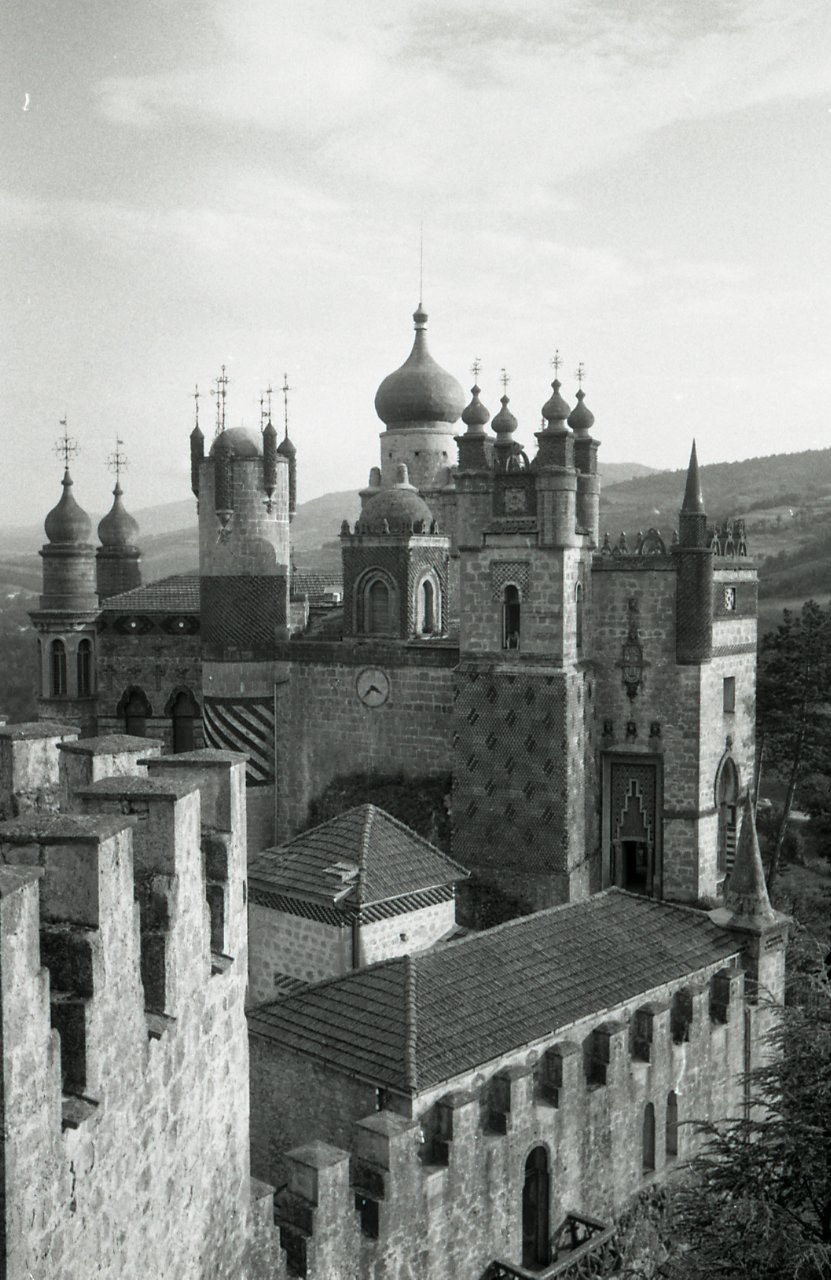
Rocchetta Mattei is an eclectic castle built from 1850 on the ruins of a medieval fortress. Count Cesare Mattei, self-taught doctor and founder of electropmeopathy, wanted it as his residence and center for alternative medicine. Today it can be visited with a guide on weekends, reservation required.
– Unique architecture: fusion of Moorish, medieval, and Art Nouveau styles, with courtyards inspired by the Alhambra in Granada.
– Fascinating history: hosted Tsar Alexander II and King Ludwig III of Bavaria, mentioned by Dostoevsky.
– 1-hour guided tour: includes a chapel similar to the Mezquita, the Hall of Ninety, and panoramic terraces.
– How to get there: by car from Bologna (SS64) or train to Riola (1 km on foot).
A fairy-tale castle in the Apennines
Imagine a castle mixing medieval towers with arabesque arches, Liberty flourishes, and a touch of the Alhambra. That’s Rocchetta Mattei. Perched at 407 meters in Grizzana Morandi, this eccentric gem of Count Cesare Mattei seems straight out of a storybook. The first time you see it from the road, it’s a sketch of turrets and domes against the green hills, almost unreal. Stepping inside is like discovering a maze of rooms, each with its own personality. It’s not just a building: it’s the manifesto of a man’s dreams.
A fairy-tale castle in the Apennines
Imagine a castle mixing medieval towers with arabesque arches, Liberty flourishes, and a touch of the Alhambra. That’s Rocchetta Mattei. Perched at 407 meters in Grizzana Morandi, this eccentric gem of Count Cesare Mattei seems straight out of a storybook. The first time you see it from the road, it’s a sketch of turrets and domes against the green hills, almost unreal. Stepping inside is like discovering a maze of rooms, each with its own personality. It’s not just a building: it’s the manifesto of a man’s dreams.
From the Laying of the First Stone to the Restoration
The story begins on
November 5, 1850, when Count Cesare Mattei laid the first stone on the ruins of a medieval fortress. By 1859 the castle was habitable, and Mattei moved in, creating a private court complete with a jester. A politician, writer, and self-taught physician, he invented
electrohomeopathy, an alternative medicine that attracted nobles such as Tsar Alexander II and Ludwig III of Bavaria. After his death, the castle changed hands, was damaged during the war, became a hotel, and was eventually abandoned. In 2005 the
Fondazione Carisbo purchased it and, after restoration, reopened it to the public on August 9, 2015.
- 1850: First stone
- 1859: Habitable
- 1896: Death of the count
- 1959: Becomes a hotel
- 2005: Purchased by Fondazione Carisbo
- 2015: Reopened to the public
From the Laying of the First Stone to the Restoration
The story begins on
November 5, 1850, when Count Cesare Mattei laid the first stone on the ruins of a medieval fortress. By 1859 the castle was habitable, and Mattei moved in, creating a private court complete with a jester. A politician, writer, and self-taught physician, he invented
electrohomeopathy, an alternative medicine that attracted nobles such as Tsar Alexander II and Ludwig III of Bavaria. After his death, the castle changed hands, was damaged during the war, became a hotel, and was eventually abandoned. In 2005 the
Fondazione Carisbo purchased it and, after restoration, reopened it to the public on August 9, 2015.
- 1850: First stone
- 1859: Habitable
- 1896: Death of the count
- 1959: Becomes a hotel
- 2005: Purchased by Fondazione Carisbo
- 2015: Reopened to the public
Andalusian Courtyards and Trompe-l’œil
Upon entering, you are greeted by a hippogriff and then a courtyard carved into the rock. The highlight is the Court of the Lions, a faithful reproduction of the Patio de Los Leones at the Alhambra, with Seville azulejos. Everywhere illusions: painted plaster columns, pressed paper ceilings, a chapel imitating the Mezquita of Cordoba. The Staircase of Visions depicts an allegory of electropathy triumphing over traditional medicine. Don’t miss the Music Room in Liberty style, where Mattei entertained guests like Rossini. It’s a dizzying mix, but it works.
Andalusian Courtyards and Trompe-l’œil
Upon entering, you are greeted by a hippogriff and then a courtyard carved into the rock. The highlight is the Court of the Lions, a faithful reproduction of the Patio de Los Leones at the Alhambra, with Seville azulejos. Everywhere illusions: painted plaster columns, pressed paper ceilings, a chapel imitating the Mezquita of Cordoba. The Staircase of Visions depicts an allegory of electropathy triumphing over traditional medicine. Don’t miss the Music Room in Liberty style, where Mattei entertained guests like Rossini. It’s a dizzying mix, but it works.
Where Medicine Meets Imagination
Cesare Mattei was more than a builder; he was a healer. His electrohomeopathy combined herbal extracts with “vegetable electricity.” In his study, the Red Room, personal items and a rare Orchestrion—a precursor to the jukebox—are on display. The Peace Room features an alabaster chandelier weighing over 100 kg and a view of three peaks. The Count’s tomb lies in the chapel, nameless, marked only by an inscription. During the war, German soldiers desecrated it. It is said that Mattei never went to Spain: he copied the Alhambra from photos of the 1851 Great Exhibition in London. What audacity!
Where Medicine Meets Imagination
Cesare Mattei was more than a builder; he was a healer. His electrohomeopathy combined herbal extracts with “vegetable electricity.” In his study, the Red Room, personal items and a rare Orchestrion—a precursor to the jukebox—are on display. The Peace Room features an alabaster chandelier weighing over 100 kg and a view of three peaks. The Count’s tomb lies in the chapel, nameless, marked only by an inscription. During the war, German soldiers desecrated it. It is said that Mattei never went to Spain: he copied the Alhambra from photos of the 1851 Great Exhibition in London. What audacity!
Three good reasons not to miss it
1. One of a kind: In Italy, you won’t find another blend of Moorish, medieval, and Liberty styles. 2. Fascinating history: The tale of Count Mattei and his electrohomeopathy is bizarre and captivating. 3. Exclusive experience: Visits are guided, with a maximum of 20 people per slot, ensuring a personalized tour. Plus, you can combine it with a visit to the nearby Borgo La Scola and the Cesare Mattei Museum for a complete immersion.
Three good reasons not to miss it
1. One of a kind: In Italy, you won’t find another blend of Moorish, medieval, and Liberty styles. 2. Fascinating history: The tale of Count Mattei and his electrohomeopathy is bizarre and captivating. 3. Exclusive experience: Visits are guided, with a maximum of 20 people per slot, ensuring a personalized tour. Plus, you can combine it with a visit to the nearby Borgo La Scola and the Cesare Mattei Museum for a complete immersion.
The Right Time to Visit
The best time to appreciate the play of light and shadow in the courtyards is late afternoon, when the sun filters through the arabesque arches. Autumn is magical: the surrounding woods turn gold and the crowds are smaller. Winter visits have an intimate atmosphere, but remember that the castle is open only on weekends. If you can, try a weekday morning (by appointment) for a nearly private experience. Avoid summer weekends if you dislike queues, but the garden is splendid in spring.
The Right Time to Visit
The best time to appreciate the play of light and shadow in the courtyards is late afternoon, when the sun filters through the arabesque arches. Autumn is magical: the surrounding woods turn gold and the crowds are smaller. Winter visits have an intimate atmosphere, but remember that the castle is open only on weekends. If you can, try a weekday morning (by appointment) for a nearly private experience. Avoid summer weekends if you dislike queues, but the garden is splendid in spring.
Borgo La Scola and the Grizzana Museum
After the visit, a short walk leads to the Borgo La Scola, a medieval hamlet of sandstone houses built by the Comacine masters. A peaceful place with a small church and panoramic views. For a deeper dive, head to the Cesare Mattei Museum in Grizzana Morandi (700 meters from the castle), where you’ll find documents, personal items, and the original piano. Another option is the Museum of Electropathy at the Cati Mill in Camugnano, featuring the count’s medical instruments and the famous Turkish coffee pot from the attempted poisoning.
Borgo La Scola and the Grizzana Museum
After the visit, a short walk leads to the Borgo La Scola, a medieval hamlet of sandstone houses built by the Comacine masters. A peaceful place with a small church and panoramic views. For a deeper dive, head to the Cesare Mattei Museum in Grizzana Morandi (700 meters from the castle), where you’ll find documents, personal items, and the original piano. Another option is the Museum of Electropathy at the Cati Mill in Camugnano, featuring the count’s medical instruments and the famous Turkish coffee pot from the attempted poisoning.