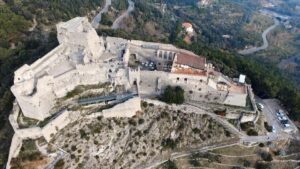
In the heart of Naples, a stone’s throw from the port, Castel Nuovo – better known as Maschio Angioino – houses the Civic Museum, a journey through the city’s art and history. From the magnificent 14th-century Palatine Chapel, the only remaining part of the Angevin royal palace, to the Sala dei Baroni, where in 1486 the conspiracy against Ferrante d’Aragona was hatched, each room tells a piece of the past. The museum displays works by Giotto, Luca Giordano, Mattia Preti, and many others, in a path spanning seven centuries. Here’s what not to miss:
Palatine Chapel: Giotto’s frescoes (almost lost) and Renaissance sculptures by Francesco Laurana.
Sala dei Baroni: majestic hall with a star vault, now home to the city council.
First floor: 17th-century Neapolitan paintings, including *San Nicola in glory* by Luca Giordano.
Second floor: 19th-century painting, with works by Vincenzo Gemito and views from the Posillipo school.
A Dive into Neapolitan History
Entering Castel Nuovo, or Maschio Angioino, is like stepping into a history book. The courtyard welcomes you with the grandeur of the triumphal arch of Alfonso of Aragon, and you immediately understand that here, rulers, artists, and common people have written indelible pages. The atmosphere is a mix of majesty and introspection: within the tufa and piperno walls, the voices of Giotto, Petrarch, and Boccaccio, who frequented the Angevin court, still echo. The Civic Museum housed inside is not just a collection of artworks, but a journey from the medieval era to the 20th century, offering emotions at every step.
A Dive into Neapolitan History
Entering Castel Nuovo, or Maschio Angioino, is like stepping into a history book. The courtyard welcomes you with the grandeur of the triumphal arch of Alfonso of Aragon, and you immediately understand that here, rulers, artists, and common people have written indelible pages. The atmosphere is a mix of majesty and introspection: within the tufa and piperno walls, the voices of Giotto, Petrarch, and Boccaccio, who frequented the Angevin court, still echo. The Civic Museum housed inside is not just a collection of artworks, but a journey from the medieval era to the 20th century, offering emotions at every step.
Historical Overview
Built at the behest of Charles I of Anjou between 1279 and 1282, Castel Nuovo was the political heart of Naples. Today, only the Palatine Chapel remains from the original structure, while the Aragonese rebuilt it in the 15th century as a royal residence, adding the triumphal arch and the Hall of the Barons. It was here in 1486 that Ferdinand I of Aragon arrested the rebel barons. Every dynasty left its mark: from the Angevins to the Bourbons, up to the 20th-century restorations that isolated it from the surrounding buildings. Since 1990, it has housed the Civic Museum.
- 1279-1282: Angevin construction
- 1307: foundation of the Palatine Chapel
- 1442-1458: Aragonese reconstruction and triumphal arch
- 1486: conspiracy of the Barons in the Hall of the Barons
- 1990: opening of the Civic Museum
Historical Overview
Built at the behest of Charles I of Anjou between 1279 and 1282, Castel Nuovo was the political heart of Naples. Today, only the Palatine Chapel remains from the original structure, while the Aragonese rebuilt it in the 15th century as a royal residence, adding the triumphal arch and the Hall of the Barons. It was here in 1486 that Ferdinand I of Aragon arrested the rebel barons. Every dynasty left its mark: from the Angevins to the Bourbons, up to the 20th-century restorations that isolated it from the surrounding buildings. Since 1990, it has housed the Civic Museum.
- 1279-1282: Angevin construction
- 1307: foundation of the Palatine Chapel
- 1442-1458: Aragonese reconstruction and triumphal arch
- 1486: conspiracy of the Barons in the Hall of the Barons
- 1990: opening of the Civic Museum
The Palatine Chapel and Giotto’s Treasures
The Palatine Chapel, dedicated to San Sebastiano or Santa Barbara, is the only surviving evidence of the Angevin castle. It dates back to 1307 and preserves frescoes attributed to Giotto and his workshop, with stories from the Old and New Testament, unfortunately almost completely lost. Admire the Renaissance portal by Andrea dell’Aquila and Francesco Laurana, topped by a rose window by Matteo Forcimanya. Inside, two Madonna Enthroned by Francesco Laurana stand out, including the famous ‘Madonna del Passero’, and the ciborium by Iacopo della Pila. A corner of pure Neapolitan Renaissance.
The Palatine Chapel and Giotto’s Treasures
The Palatine Chapel, dedicated to San Sebastiano or Santa Barbara, is the only surviving evidence of the Angevin castle. It dates back to 1307 and preserves frescoes attributed to Giotto and his workshop, with stories from the Old and New Testament, unfortunately almost completely lost. Admire the Renaissance portal by Andrea dell’Aquila and Francesco Laurana, topped by a rose window by Matteo Forcimanya. Inside, two Madonna Enthroned by Francesco Laurana stand out, including the famous ‘Madonna del Passero’, and the ciborium by Iacopo della Pila. A corner of pure Neapolitan Renaissance.
17th-Century Paintings: From Luca Giordano to Caracciolo
On the first floor of the museum, the tour dedicated to the 17th-18th centuries is a triumph of masterpieces. Luca Giordano’s San Nicola in Gloria (1658) dominates the room with its Baroque light. Next to it, Battistello Caracciolo’s Crocifissione, intense and Caravaggesque, and Francesco Solimena’s Miracolo di San Giovanni di Dio. Works by Mattia Preti and Domenichino are also on display, reflecting the fervent religious patronage of Naples. Each canvas is a plunge into the theatricality of the 17th century, with saints, angels, and drama.
17th-Century Paintings: From Luca Giordano to Caracciolo
On the first floor of the museum, the tour dedicated to the 17th-18th centuries is a triumph of masterpieces. Luca Giordano’s San Nicola in Gloria (1658) dominates the room with its Baroque light. Next to it, Battistello Caracciolo’s Crocifissione, intense and Caravaggesque, and Francesco Solimena’s Miracolo di San Giovanni di Dio. Works by Mattia Preti and Domenichino are also on display, reflecting the fervent religious patronage of Naples. Each canvas is a plunge into the theatricality of the 17th century, with saints, angels, and drama.
Why Visit It
Three good reasons to include Castel Nuovo in your itinerary:
1. A museum that doesn’t bore: the tour is varied, with sculptures, paintings, and historic rooms like the Hall of the Barons with its star vault. It’s not a dusty museum, but an exciting journey.
2. Breathtaking views: from the terraces and walkways, your gaze sweeps over the Gulf of Naples and Mount Vesuvius. A panorama worth the climb alone.
3. A dive into living history: walking where kings, artists, and commanders walked is a unique experience. The castle is still the seat of the city council today, a perfect blend of past and present.
Why Visit It
Three good reasons to include Castel Nuovo in your itinerary:
1. A museum that doesn’t bore: the tour is varied, with sculptures, paintings, and historic rooms like the Hall of the Barons with its star vault. It’s not a dusty museum, but an exciting journey.
2. Breathtaking views: from the terraces and walkways, your gaze sweeps over the Gulf of Naples and Mount Vesuvius. A panorama worth the climb alone.
3. A dive into living history: walking where kings, artists, and commanders walked is a unique experience. The castle is still the seat of the city council today, a perfect blend of past and present.
When to Go
The best time? Early morning, right when it opens (9 AM), when the castle is still quiet and the low light kisses the triumphal arch. Avoid the midday hours in summer; the heat is intense and the stone stairs can be a bit tiring. In autumn or spring, the golden light of late afternoon creates magical atmospheres, especially from the terraces. Mondays are often less crowded than Saturdays.
When to Go
The best time? Early morning, right when it opens (9 AM), when the castle is still quiet and the low light kisses the triumphal arch. Avoid the midday hours in summer; the heat is intense and the stone stairs can be a bit tiring. In autumn or spring, the golden light of late afternoon creates magical atmospheres, especially from the terraces. Mondays are often less crowded than Saturdays.
Nearby
Just steps from Castel Nuovo, I suggest two stops:
Teatro San Carlo: the oldest active opera house in Europe. Even if you don’t attend a show, a guided tour is worth it to admire the Bourbon splendor.
Galleria Umberto I: a few minutes’ walk away, this elegant covered salon of iron and glass is perfect for a coffee break or to admire the architecture. It blends beauty with Neapolitan daily life.
Nearby
Just steps from Castel Nuovo, I suggest two stops:
Teatro San Carlo: the oldest active opera house in Europe. Even if you don’t attend a show, a guided tour is worth it to admire the Bourbon splendor.
Galleria Umberto I: a few minutes’ walk away, this elegant covered salon of iron and glass is perfect for a coffee break or to admire the architecture. It blends beauty with Neapolitan daily life.