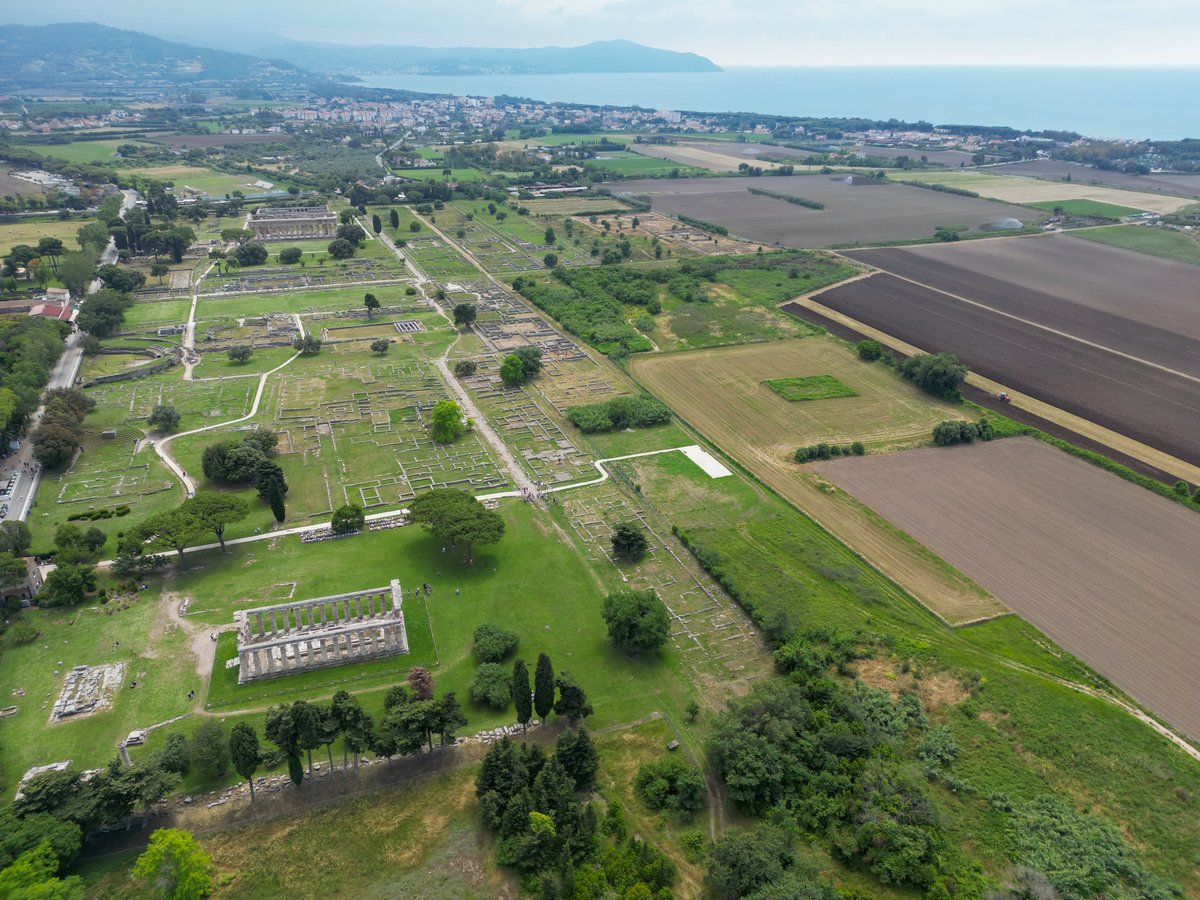
Paestum, the ancient Poseidonia founded by the Greeks in the 6th century BC, is one of the most important archaeological sites of Magna Graecia and a UNESCO World Heritage site. Its three Doric temples, surrounded by 5 km long walls, are among the best preserved in the world. Must-sees:
– Temple of Neptune: the largest and most perfect example of 5th-century BC Doric architecture.
– Temple of Hera (Basilica): the oldest, with 50 columns and a solemn atmosphere.
– Archaeological Museum: home to the Tomb of the Diver, a masterpiece of Greek painting from 480 BC.
– Roman Amphitheater and Forum: remains of public life in Roman times.
Introduction
Paestum is one of those places that leave you breathless. Three Doric temples, huge and perfect, rise from the green fields as if time had stood still. Here, in Capaccio Paestum, ancient Greek Poseidonia tells a story that spans from the 6th century BC to the Romans. And then there’s the Tomb of the Diver, a unique masterpiece of ancient Greek painting housed in the museum. It’s not just archaeology: it’s a direct dive into the past.
Introduction
Paestum is one of those places that leave you breathless. Three Doric temples, huge and perfect, rise from the green fields as if time had stood still. Here, in Capaccio Paestum, ancient Greek Poseidonia tells a story that spans from the 6th century BC to the Romans. And then there’s the Tomb of the Diver, a unique masterpiece of ancient Greek painting housed in the museum. It’s not just archaeology: it’s a direct dive into the past.
Historical Notes
Founded by the Greeks of Sybaris around 600 BC, the city was called Poseidonia in honor of the sea god. Conquered by the Lucanians in the 5th century BC, it became a Roman colony in 273 BC under the name of Paestum. Decayed due to marshland and raids, it was abandoned in the 8th century. Rediscovered in the 18th century during the Grand Tour, today it is a UNESCO site. Here are the key moments:
- 600 BC – Foundation of Poseidonia
- 5th century BC – Construction of the three main temples
- 273 BC – Roman conquest
- 8th century – Abandonment of the city
- 1998 – UNESCO designation
Historical Notes
Founded by the Greeks of Sybaris around 600 BC, the city was called Poseidonia in honor of the sea god. Conquered by the Lucanians in the 5th century BC, it became a Roman colony in 273 BC under the name of Paestum. Decayed due to marshland and raids, it was abandoned in the 8th century. Rediscovered in the 18th century during the Grand Tour, today it is a UNESCO site. Here are the key moments:
- 600 BC – Foundation of Poseidonia
- 5th century BC – Construction of the three main temples
- 273 BC – Roman conquest
- 8th century – Abandonment of the city
- 1998 – UNESCO designation
The Three Doric Temples
The heart of the park are the three temples: the Temple of Hera (called Basilica), the oldest (550 BC), with 50 columns; the Temple of Neptune (460 BC), the largest and best preserved, with columns 8 meters high; and the Temple of Athena (510 BC), the smallest, with an Ionic pronaos. Observing them up close is exciting: the golden limestone at sunset, the perfection of proportions. You cannot enter, but you walk around and remain enchanted.
The Three Doric Temples
The heart of the park are the three temples: the Temple of Hera (called Basilica), the oldest (550 BC), with 50 columns; the Temple of Neptune (460 BC), the largest and best preserved, with columns 8 meters high; and the Temple of Athena (510 BC), the smallest, with an Ionic pronaos. Observing them up close is exciting: the golden limestone at sunset, the perfection of proportions. You cannot enter, but you walk around and remain enchanted.
The Tomb of the Diver and the Museum
In the National Archaeological Museum, just outside the walls, lies the famous Tomb of the Diver (480 BC): the only non-vase Greek painting to have survived intact. It depicts a young man diving into a symbolic sea, perhaps the passage from life to death. The museum also displays the archaic metopes from the Heraion, Lucanian painted tombs, and Roman artifacts. Don’t miss the visits to the storerooms during the “Friday of the Storerooms”.
The Tomb of the Diver and the Museum
In the National Archaeological Museum, just outside the walls, lies the famous Tomb of the Diver (480 BC): the only non-vase Greek painting to have survived intact. It depicts a young man diving into a symbolic sea, perhaps the passage from life to death. The museum also displays the archaic metopes from the Heraion, Lucanian painted tombs, and Roman artifacts. Don’t miss the visits to the storerooms during the “Friday of the Storerooms”.
Why Visit It
Three good reasons: first, the temples are among the best preserved in Magna Graecia – better than Agrigento or Segesta. Second, the Tomb of the Diver is a masterpiece you won’t find anywhere else. Third, the site combines Greek and Roman remains (amphitheater, forum, baths) in a single route, and the combined ticket with Velia is truly worth it. Plus, the park is less crowded compared to Pompeii.
Why Visit It
Three good reasons: first, the temples are among the best preserved in Magna Graecia – better than Agrigento or Segesta. Second, the Tomb of the Diver is a masterpiece you won’t find anywhere else. Third, the site combines Greek and Roman remains (amphitheater, forum, baths) in a single route, and the combined ticket with Velia is truly worth it. Plus, the park is less crowded compared to Pompeii.
When to Go
The best time? Spring and autumn, when the weather is mild and the colors of the meadows enhance the temples. But winter has its charm too: few people, low light, and an almost mystical atmosphere. Avoid summer if you can, because the sun beats down hard and there’s no shade. My advice: arrive at opening time at 8:30 or in the late afternoon, so you can see the temples in the warm light of sunset.
When to Go
The best time? Spring and autumn, when the weather is mild and the colors of the meadows enhance the temples. But winter has its charm too: few people, low light, and an almost mystical atmosphere. Avoid summer if you can, because the sun beats down hard and there’s no shade. My advice: arrive at opening time at 8:30 or in the late afternoon, so you can see the temples in the warm light of sunset.
Nearby
A few kilometers away, near the mouth of the Sele River, lies the Heraion, the sanctuary of Hera with remains of the temple and ancient metopes (now in the museum). Alternatively, immerse yourself in the nature of the Cilento National Park, which also includes the site of Velia, another Greek city famous for its philosophical school. If you love the sea, the beaches of Paestum are close by, but for me, archaeology beats everything.
Nearby
A few kilometers away, near the mouth of the Sele River, lies the Heraion, the sanctuary of Hera with remains of the temple and ancient metopes (now in the museum). Alternatively, immerse yourself in the nature of the Cilento National Park, which also includes the site of Velia, another Greek city famous for its philosophical school. If you love the sea, the beaches of Paestum are close by, but for me, archaeology beats everything.