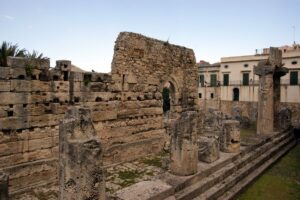
The Temple of Apollo, on Ortigia island, is the oldest stone Doric temple in Sicily and the Greek West, dating back to the early 6th century BC. Today, two columns and remains of the crepidoma are visible, but its millenary history can be read in the layers: it was a Byzantine church, an Islamic mosque, and a Spanish barracks. The inscription on the stylobate is unique in Greek architecture.
– Oldest stone Doric temple in the West, built between 565 and 550 BC.
– Located at the entrance to Ortigia, the historic heart of Syracuse.
– Dedicatory inscription on the eastern step, an absolute rarity.
– The 46 monolithic sandstone columns, transported by sea, testify to the exceptional nature of the feat.
Introduction
As soon as you set foot on Ortigia, right at the entrance to the island, you come across a corner of history that leaves you breathless. The Temple of Apollo, with its two surviving columns standing out against the sky, is the oldest Doric stone temple in the Greek West. It is not one of those perfectly preserved monuments: it is a ruin, but precisely for this reason it is powerful. We are around 565-550 BC, and already here they built with stone blocks, marking the transition from wood to stone. The feeling is that of touching archaic architecture with your own hands, with all its uncertainties and audacity. A dive into the 6th century BC, a stone’s throw from the sea.
Introduction
As soon as you set foot on Ortigia, right at the entrance to the island, you come across a corner of history that leaves you breathless. The Temple of Apollo, with its two surviving columns standing out against the sky, is the oldest Doric stone temple in the Greek West. It is not one of those perfectly preserved monuments: it is a ruin, but precisely for this reason it is powerful. We are around 565-550 BC, and already here they built with stone blocks, marking the transition from wood to stone. The feeling is that of touching archaic architecture with your own hands, with all its uncertainties and audacity. A dive into the 6th century BC, a stone’s throw from the sea.
Historical Background
Built in the early 6th century BC, the Temple of Apollo has lived a thousand lives. It was a Byzantine church, then an Islamic mosque (an Arabic inscription remains), then a Norman church of the Savior, and finally a Spanish barracks in the 16th century. Rediscovered around 1860 inside a barracks, it was freed from its superstructures in the early 20th century. Today it is part of the UNESCO site “Syracuse and the Rocky Necropolis of Pantalica”. A quick timeline:
- 6th century BC: construction of the temple
- Byzantine era: conversion into a church
- Arab period: mosque
- 16th century: Spanish barracks
- 1860: rediscovery
- 2005: UNESCO
Historical Background
Built in the early 6th century BC, the Temple of Apollo has lived a thousand lives. It was a Byzantine church, then an Islamic mosque (an Arabic inscription remains), then a Norman church of the Savior, and finally a Spanish barracks in the 16th century. Rediscovered around 1860 inside a barracks, it was freed from its superstructures in the early 20th century. Today it is part of the UNESCO site “Syracuse and the Rocky Necropolis of Pantalica”. A quick timeline:
- 6th century BC: construction of the temple
- Byzantine era: conversion into a church
- Arab period: mosque
- 16th century: Spanish barracks
- 1860: rediscovery
- 2005: UNESCO
Proto-Doric Architecture
This temple is an open-air laboratory of Archaic Greek architecture. The monolithic columns (46 originally) are squat and closely spaced, with irregular intercolumnia. The architrave is 2.15 meters high and has an L-shaped cross-section that concealed a wooden core. On the eastern front there was a double colonnade, with the central intercolumnium wider to emphasize the entrance. The cella was divided into three aisles by two rows of internal columns, and at the rear an adyton typical of Sicilian temples. A unique inscription on the stylobate reads: “Kleomede made for Apollo (the temple), the son of Knidieidas, and raised the colonnades, beautiful works.” No other Greek temple bears such a signature.
Proto-Doric Architecture
This temple is an open-air laboratory of Archaic Greek architecture. The monolithic columns (46 originally) are squat and closely spaced, with irregular intercolumnia. The architrave is 2.15 meters high and has an L-shaped cross-section that concealed a wooden core. On the eastern front there was a double colonnade, with the central intercolumnium wider to emphasize the entrance. The cella was divided into three aisles by two rows of internal columns, and at the rear an adyton typical of Sicilian temples. A unique inscription on the stylobate reads: “Kleomede made for Apollo (the temple), the son of Knidieidas, and raised the colonnades, beautiful works.” No other Greek temple bears such a signature.
An open-air museum
Today, only two complete columns, part of the crepidoma, wall fragments, and the inscription remain of the temple. It is visible from a panoramic balcony because the street level is elevated. You cannot enter, but it can be admired perfectly from the outside. The most beautiful architectural pieces – terracottas, sima, acroteria – are preserved in the Paolo Orsi Regional Archaeological Museum, which I highly recommend visiting to get an idea of the original colors. There is also a reconstruction of the temple there. It is exciting to compare the actual remains with the fragments in the museum, and imagine what it was like when it was all painted and decorated.
An open-air museum
Today, only two complete columns, part of the crepidoma, wall fragments, and the inscription remain of the temple. It is visible from a panoramic balcony because the street level is elevated. You cannot enter, but it can be admired perfectly from the outside. The most beautiful architectural pieces – terracottas, sima, acroteria – are preserved in the Paolo Orsi Regional Archaeological Museum, which I highly recommend visiting to get an idea of the original colors. There is also a reconstruction of the temple there. It is exciting to compare the actual remains with the fragments in the museum, and imagine what it was like when it was all painted and decorated.
Why Visit It
Two good reasons: 1) It is the oldest Doric stone temple in the West. A fundamental piece of architectural history, worth seeing at least once. 2) The unique inscription mentioning the architect Kleomede: a rare example of a signature in antiquity. Plus, it’s free and located in a strategic spot: as you arrive in Ortigia, the ruins of the Apollonion immediately welcome you. Perfect for a historical selfie. And if you are an archaeology enthusiast, it’s the right place to ask yourself a few questions about how things were built 2500 years ago.
Why Visit It
Two good reasons: 1) It is the oldest Doric stone temple in the West. A fundamental piece of architectural history, worth seeing at least once. 2) The unique inscription mentioning the architect Kleomede: a rare example of a signature in antiquity. Plus, it’s free and located in a strategic spot: as you arrive in Ortigia, the ruins of the Apollonion immediately welcome you. Perfect for a historical selfie. And if you are an archaeology enthusiast, it’s the right place to ask yourself a few questions about how things were built 2500 years ago.
When to Go
The temple is outdoors and always visible, but the best time is late afternoon, when the warm sunlight illuminates the columns and makes them stand out against the blue sky. Avoid the central hours of the day in summer, because the sun is strong and shadows are flat. Spring and autumn are the ideal seasons: mild temperatures and fewer crowds. If you pass through Syracuse in winter, the low rays of the sun create an almost mystical atmosphere. In short, stop for a moment, look and breathe: time has stopped here.
When to Go
The temple is outdoors and always visible, but the best time is late afternoon, when the warm sunlight illuminates the columns and makes them stand out against the blue sky. Avoid the central hours of the day in summer, because the sun is strong and shadows are flat. Spring and autumn are the ideal seasons: mild temperatures and fewer crowds. If you pass through Syracuse in winter, the low rays of the sun create an almost mystical atmosphere. In short, stop for a moment, look and breathe: time has stopped here.
Nearby
Just a few steps away, still on Ortigia, you’ll find Syracuse Cathedral, built on the Temple of Athena (5th century BC). The Baroque facade hides Doric columns inside: another incredible layering. Then, the Paolo Orsi Archaeological Museum (about 1 km away, on Viale Teocrito) is unmissable: it houses the temple’s artifacts and a reconstruction. If you have time, wander through Ortigia’s alleys and make your way to the Fonte Aretusa, an oasis of papyrus in the heart of the island. Everything is close, everything speaks of history.
Nearby
Just a few steps away, still on Ortigia, you’ll find Syracuse Cathedral, built on the Temple of Athena (5th century BC). The Baroque facade hides Doric columns inside: another incredible layering. Then, the Paolo Orsi Archaeological Museum (about 1 km away, on Viale Teocrito) is unmissable: it houses the temple’s artifacts and a reconstruction. If you have time, wander through Ortigia’s alleys and make your way to the Fonte Aretusa, an oasis of papyrus in the heart of the island. Everything is close, everything speaks of history.