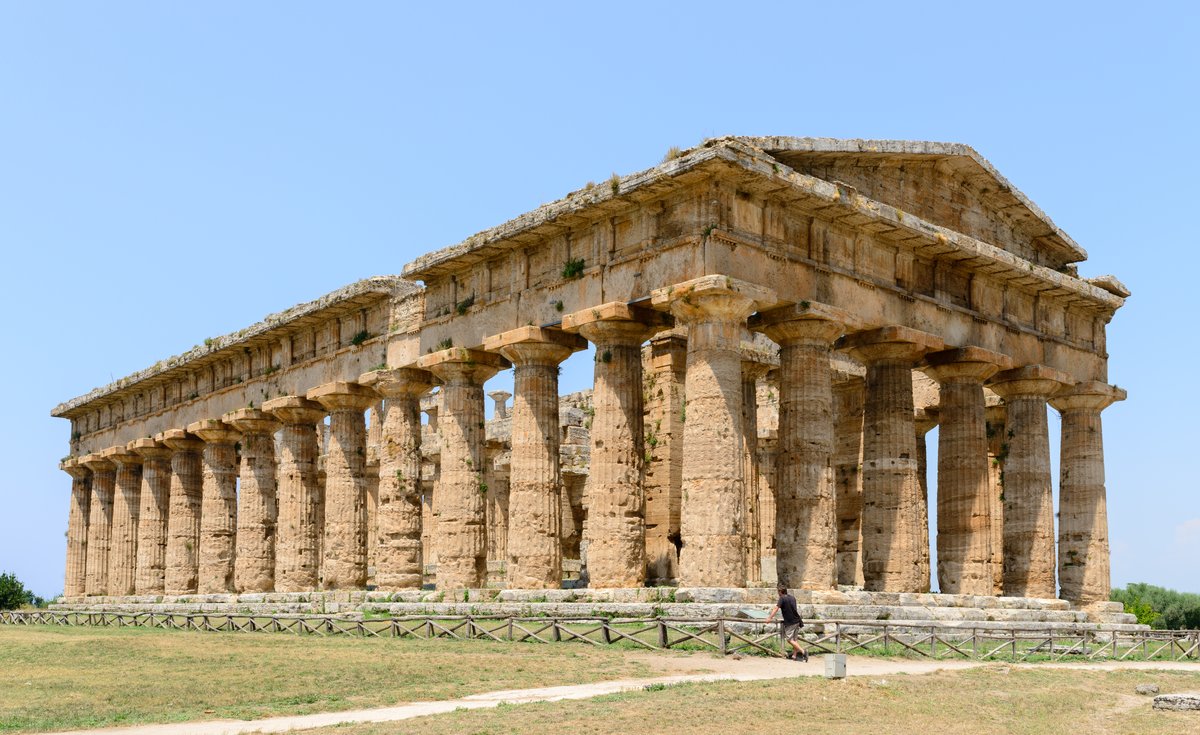
The Temple of Hera II, also known as the Temple of Neptune, is the largest and best-preserved of the temples at Paestum. Constructed around 460 BC in local travertine, this peripteral Doric temple with 6×14 columns is a masterpiece of harmony and proportions. The inner cella, divided into three aisles by columns on two levels, is the best preserved in the site. In front, two altars testify to ancient rituals. The temple is part of the Paestum Archaeological Park, a UNESCO World Heritage Site since 1998. Here’s what makes it unmissable:
– Perfect preservation: among the best preserved Greek temples in the world.
– Architectural details: optical corrections such as the convexity of the stylobate.
– Unique atmosphere: the golden light of the travertine changes throughout the day.
– Historical context: in the southern sanctuary, near the Temple of Hera I and the Archaeological Museum.
Introduction
Walking through the Archaeological Park of Paestum and coming face to face with the Temple of Hera II is a breathtaking experience. It is the most intact Doric temple in the world, with mighty columns that defy the centuries. It is not just a monument: it is a journey into Magna Graecia. The proportions are so harmonious that it seems to have come straight out of an architecture manual. The golden patina of the travertine, under the sun, evokes unique emotions. Here you understand why the Grand Tour was a mandatory rite: every detail tells a story of history and ingenuity.
Introduction
Walking through the Archaeological Park of Paestum and coming face to face with the Temple of Hera II is a breathtaking experience. It is the most intact Doric temple in the world, with mighty columns that defy the centuries. It is not just a monument: it is a journey into Magna Graecia. The proportions are so harmonious that it seems to have come straight out of an architecture manual. The golden patina of the travertine, under the sun, evokes unique emotions. Here you understand why the Grand Tour was a mandatory rite: every detail tells a story of history and ingenuity.
Historical Background
The temple was built by Greek colonists from Sybaris who founded Poseidonia (later Paestum) around the mid-5th century BC. Dedicated to Hera, goddess of fertility, it was mistakenly called the Temple of Neptune by 18th-century scholars. After Lucanian and Roman rule, the site was abandoned for centuries due to marshland and malaria, which miraculously preserved it. Rediscovered during the Grand Tour, it has been a UNESCO World Heritage site since 1998.
Historical Background
The temple was built by Greek colonists from Sybaris who founded Poseidonia (later Paestum) around the mid-5th century BC. Dedicated to Hera, goddess of fertility, it was mistakenly called the Temple of Neptune by 18th-century scholars. After Lucanian and Roman rule, the site was abandoned for centuries due to marshland and malaria, which miraculously preserved it. Rediscovered during the Grand Tour, it has been a UNESCO World Heritage site since 1998.
Architecture and Optical Corrections
The temple is a peripteral hexastyle with 6 columns on the front and 14 on the long sides. The columns, almost 9 meters high, have 24 flutes (instead of the usual 20) to reduce heaviness. The builders used sophisticated optical corrections: the stylobate is slightly convex, the columns are inclined inward, and the entablature is curved downward. All to create perfect harmony for the human eye. Inside, the cella is divided into three naves by two rows of seven columns on two orders.
Architecture and Optical Corrections
The temple is a peripteral hexastyle with 6 columns on the front and 14 on the long sides. The columns, almost 9 meters high, have 24 flutes (instead of the usual 20) to reduce heaviness. The builders used sophisticated optical corrections: the stylobate is slightly convex, the columns are inclined inward, and the entablature is curved downward. All to create perfect harmony for the human eye. Inside, the cella is divided into three naves by two rows of seven columns on two orders.
The Mystery of the Dedication
Why is it called the Temple of Neptune? It’s a historical mistake: 18th-century scholars attributed it to Poseidon, but excavations have yielded thousands of terracotta statuettes depicting Hera, suggesting it was dedicated to the goddess of motherhood. Some scholars hypothesize Zeus or Apollo, but the cult of Hera remains the most likely. The terracotta effigy of the goddess, once housed in the temple, is now on display at the Archaeological Museum and confirms the connection to Hera.
The Mystery of the Dedication
Why is it called the Temple of Neptune? It’s a historical mistake: 18th-century scholars attributed it to Poseidon, but excavations have yielded thousands of terracotta statuettes depicting Hera, suggesting it was dedicated to the goddess of motherhood. Some scholars hypothesize Zeus or Apollo, but the cult of Hera remains the most likely. The terracotta effigy of the goddess, once housed in the temple, is now on display at the Archaeological Museum and confirms the connection to Hera.
Why Visit It
Three reasons not to miss it. First: the state of preservation. It is one of the most intact Greek temples in the world, with the cella almost completely intact. Second: the optical corrections. Seeing how the Greeks tricked the eye with curves and inclinations is fascinating. Third: the atmosphere. At sunset, the travertine glows in warm tones and the silence envelops you. Plus, the ticket is valid for 3 days and includes the nearby Museum and the Velia area.
Why Visit It
Three reasons not to miss it. First: the state of preservation. It is one of the most intact Greek temples in the world, with the cella almost completely intact. Second: the optical corrections. Seeing how the Greeks tricked the eye with curves and inclinations is fascinating. Third: the atmosphere. At sunset, the travertine glows in warm tones and the silence envelops you. Plus, the ticket is valid for 3 days and includes the nearby Museum and the Velia area.
When to Go
The best time? Early morning, just when it opens, or late afternoon, when the raking light enhances the fluting and the golden patina. In spring and autumn the weather is ideal and there are fewer visitors. Avoid the summer months if you don’t like heat and crowds. Personally, I found the sunset hour magical: the temple seems to come alive.
When to Go
The best time? Early morning, just when it opens, or late afternoon, when the raking light enhances the fluting and the golden patina. In spring and autumn the weather is ideal and there are fewer visitors. Avoid the summer months if you don’t like heat and crowds. Personally, I found the sunset hour magical: the temple seems to come alive.
Nearby
Just a few steps away stands the Temple of Hera I, also known as the Basilica, older (550 BC) but equally impressive. Also not to be missed is the Archaeological Museum of Paestum, which houses the statue of Hera, the slabs from Lucanian tombs, and artifacts from votive deposits. Together, these places offer you a complete immersion into Magna Graecia.
Nearby
Just a few steps away stands the Temple of Hera I, also known as the Basilica, older (550 BC) but equally impressive. Also not to be missed is the Archaeological Museum of Paestum, which houses the statue of Hera, the slabs from Lucanian tombs, and artifacts from votive deposits. Together, these places offer you a complete immersion into Magna Graecia.