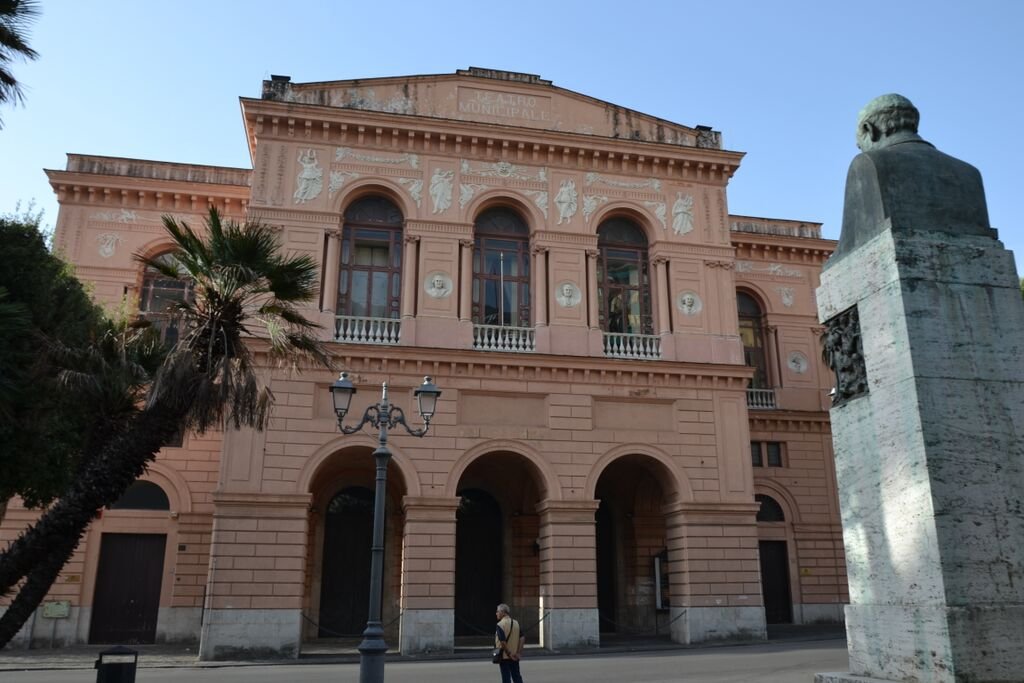
The Giuseppe Verdi Theatre in Salerno is a 19th-century gem, inaugurated in 1872 with Rigoletto. It preserves its original wooden structure and horseshoe-shaped layout, with 71 boxes and 610 seats. Today it hosts a vibrant opera and theatre season. Guided tours allow visitors to admire the original decorations and Morelli’s curtain.
– The curtain ‘The Expulsion of the Saracens’ by Domenico Morelli
– The four tiers of boxes and the gallery
– The statue of the ‘Dying Pergolesi’ in the foyer
– Guided tours on Monday, Wednesday, and Friday from 11 am to 1 pm (cost: €4 adults, €2 students)
Introduction
When you think of Salerno, the Teatro Verdi is a stop you cannot miss. Inaugurated in 1872 with Rigoletto, this Italian-style theatre is a jewel of wood and stucco, with a capacity of 610 seats. As soon as you enter, you’ll feel like you’ve stepped back in time: the horseshoe layout, the four tiers of boxes, the ceiling decorated with scenes from Rossini’s operas. It’s a living place, where music is not only remembered but still played today.
Introduction
When you think of Salerno, the Teatro Verdi is a stop you cannot miss. Inaugurated in 1872 with Rigoletto, this Italian-style theatre is a jewel of wood and stucco, with a capacity of 610 seats. As soon as you enter, you’ll feel like you’ve stepped back in time: the horseshoe layout, the four tiers of boxes, the ceiling decorated with scenes from Rossini’s operas. It’s a living place, where music is not only remembered but still played today.
Historical Highlights
The history of the Teatro Verdi begins in 1863, when Mayor Matteo Luciani pushes for its construction. Work starts on 1 April 1864 based on a design by
Antonino D’Amora and
Giuseppe Menichini. The inauguration takes place on 15 April 1872 with Rigoletto. After Verdi’s death, in 1901 it is named after him. The 1980 earthquake severely damages it, and it remains closed for 14 years. It reopens on 6 July 1994, precisely for the 50th anniversary of Salerno as Capital. Since 1997 it has hosted a permanent opera season, and since 2013 it is among the Italian theatres of tradition. Here are the key moments:
- 1863: Municipal resolution for the new theatre
- 1864: Start of works
- 1872: Inauguration with Rigoletto
- 1901: Naming after Verdi
- 1980: Closure due to earthquake
- 1994: Reopening
- 1997: First modern opera season
- 2013: Recognition as a theatre of tradition
Historical Highlights
The history of the Teatro Verdi begins in 1863, when Mayor Matteo Luciani pushes for its construction. Work starts on 1 April 1864 based on a design by
Antonino D’Amora and
Giuseppe Menichini. The inauguration takes place on 15 April 1872 with Rigoletto. After Verdi’s death, in 1901 it is named after him. The 1980 earthquake severely damages it, and it remains closed for 14 years. It reopens on 6 July 1994, precisely for the 50th anniversary of Salerno as Capital. Since 1997 it has hosted a permanent opera season, and since 2013 it is among the Italian theatres of tradition. Here are the key moments:
- 1863: Municipal resolution for the new theatre
- 1864: Start of works
- 1872: Inauguration with Rigoletto
- 1901: Naming after Verdi
- 1980: Closure due to earthquake
- 1994: Reopening
- 1997: First modern opera season
- 2013: Recognition as a theatre of tradition
Architecture and Decorations
The building is 65 meters long and 36 meters wide, with a neoclassical façade and a three-arched portico. The horseshoe-shaped floor plan is inspired by the Teatro San Carlo in Naples, but more elongated. The interior is entirely made of wood, a rarity for the time. The decorations were overseen by Gaetano D’Agostino and artists such as Domenico Morelli. The main curtain, The Expulsion of the Saracens, painted by Morelli, recounts the defense of Salerno in 871. The ceiling depicts Rossini surrounded by muses, while the balcony railings feature medallions with composers and poets. Don’t miss the statue of the Dying Pergolesi by Amendola in the foyer.
Architecture and Decorations
The building is 65 meters long and 36 meters wide, with a neoclassical façade and a three-arched portico. The horseshoe-shaped floor plan is inspired by the Teatro San Carlo in Naples, but more elongated. The interior is entirely made of wood, a rarity for the time. The decorations were overseen by Gaetano D’Agostino and artists such as Domenico Morelli. The main curtain, The Expulsion of the Saracens, painted by Morelli, recounts the defense of Salerno in 871. The ceiling depicts Rossini surrounded by muses, while the balcony railings feature medallions with composers and poets. Don’t miss the statue of the Dying Pergolesi by Amendola in the foyer.
Guided Tours and Performances
The theatre can be visited with a guide on Mondays, Wednesdays, and Fridays from 11:00 AM to 1:00 PM, by reservation. Costs: €2 for students, €4 for adults, €2 for disabled visitors, free for companions. Entrance is at Piazza Matteo Luciani 1. Throughout the year, the theatre hosts an internationally renowned opera season directed by maestro Daniel Oren, as well as concerts, ballet, and plays. The Opera Chorus and the Salernitana Philharmonic Orchestra are based here. Tip: check the calendar on the official website and book a visit to admire the details of the ceiling and Morelli’s curtain.
Guided Tours and Performances
The theatre can be visited with a guide on Mondays, Wednesdays, and Fridays from 11:00 AM to 1:00 PM, by reservation. Costs: €2 for students, €4 for adults, €2 for disabled visitors, free for companions. Entrance is at Piazza Matteo Luciani 1. Throughout the year, the theatre hosts an internationally renowned opera season directed by maestro Daniel Oren, as well as concerts, ballet, and plays. The Opera Chorus and the Salernitana Philharmonic Orchestra are based here. Tip: check the calendar on the official website and book a visit to admire the details of the ceiling and Morelli’s curtain.
Why Visit It
Three good reasons: first, it is one of the few Italian theaters with original wooden structure from the 19th century, perfectly preserved. Second, the Morelli curtain is a masterpiece that tells a piece of Salerno’s history. Third, the guided tours at a modest price (only €4) allow you to discover hidden corners and anecdotes. If you love opera, the season directed by Oren is of international level. In short, a dive into culture that will not make you regret the time spent.
Why Visit It
Three good reasons: first, it is one of the few Italian theaters with original wooden structure from the 19th century, perfectly preserved. Second, the Morelli curtain is a masterpiece that tells a piece of Salerno’s history. Third, the guided tours at a modest price (only €4) allow you to discover hidden corners and anecdotes. If you love opera, the season directed by Oren is of international level. In short, a dive into culture that will not make you regret the time spent.
When to Go
The beauty of the Teatro Verdi is that you can visit it all year round with morning guided tours. But if you want the full atmosphere, plan your visit during the opera season, which usually runs from October to December. On those evenings, the hall lights up with lights and music, and the theater comes to life again as in 1872. Spring is also lovely: with the Villa Comunale in bloom in front, the theater is even more evocative.
When to Go
The beauty of the Teatro Verdi is that you can visit it all year round with morning guided tours. But if you want the full atmosphere, plan your visit during the opera season, which usually runs from October to December. On those evenings, the hall lights up with lights and music, and the theater comes to life again as in 1872. Spring is also lovely: with the Villa Comunale in bloom in front, the theater is even more evocative.
Around the Area
The theater overlooks Piazza Matteo Luciani, right next to the Villa Comunale, a historic park with fountains and palm trees. A walk to Lungomare Trieste is a must: from there you can enjoy a spectacular view of the Gulf of Salerno. If you have time, visit Salerno Cathedral (a 10-minute walk away), with its Byzantine doors and frescoed crypt. Two stops that enrich your cultural day.
Around the Area
The theater overlooks Piazza Matteo Luciani, right next to the Villa Comunale, a historic park with fountains and palm trees. A walk to Lungomare Trieste is a must: from there you can enjoy a spectacular view of the Gulf of Salerno. If you have time, visit Salerno Cathedral (a 10-minute walk away), with its Byzantine doors and frescoed crypt. Two stops that enrich your cultural day.