
Maniace Castle dominates the extreme tip of Ortigia, offering one of the most spectacular views of the Grand Harbour of Syracuse. Built by Frederick II between 1232 and 1240, it is a masterpiece of medieval military architecture with a square plan of 51 meters per side and four cylindrical towers. Inside, the great hypostyle hall with 24 ribbed cross vaults tells the power of the Swabian emperor.
Why visit it:
- Frederick’s hypostyle hall: a unique example of a hall without a central courtyard, with columns and ogival vaults.
- Millenary history: from royal residence to prison, up to the damage of the 1704 explosion.
- Breathtaking panoramas: from the terrace, embrace the crystal-clear sea and the harbour.
- Access bridge: walk the stone bridge that replaced the ancient drawbridge.
Events nearby


Imposing Frederick’s fortress on the tip of Ortigia in Syracuse. Visit the hypostyle hall, admire the Grand Harbour, and discover the millenary history of this Swabian symbol.
- Via Gaetano Abela, Siracusa (SR)
- Open in Google Maps
- View on Google Images Castello Maniace a Siracusa
Good to know
Introduction: A Dive into History on the Sea of Ortigia
Arriving at Castello Maniace is like stepping back in time. Perched on the southernmost tip of Ortigia, it overlooks the Grand Harbor with a breathtaking view. Walking across the stone bridge that replaced the ancient drawbridge gives you a first taste of what awaits: a square, imposing fortress that seems to tell the story of centuries of dominations and battles that shaped it. The salty air, the sound of the sea, and the seagulls circling overhead make you feel immediately part of a living chapter of history.
Introduction: A Dive into History on the Sea of Ortigia
Arriving at Castello Maniace is like stepping back in time. Perched on the southernmost tip of Ortigia, it overlooks the Grand Harbor with a breathtaking view. Walking across the stone bridge that replaced the ancient drawbridge gives you a first taste of what awaits: a square, imposing fortress that seems to tell the story of centuries of dominations and battles that shaped it. The salty air, the sound of the sea, and the seagulls circling overhead make you feel immediately part of a living chapter of history.
Historical Background: From the Swabian Era to the Present
Castello Maniace was built between 1232 and 1240 by order of Frederick II of Swabia, designed by architect Riccardo da Lentini. The name recalls the Byzantine general George Maniakes, who recaptured the city in 1038. In 1288 it hosted Peter III of Aragon and his family, and in 1321 the Sicilian Parliament met here. After serving as a residence for queens (the Camera Reginale) and a prison, in 1704 an explosion in the gunpowder magazine severely damaged the building. During the Bourbon and Savoy periods, it remained in military use until World War II. Restored and reopened to the public, today it hosts cultural events.
Historical Background: From the Swabian Era to the Present
Castello Maniace was built between 1232 and 1240 by order of Frederick II of Swabia, designed by architect Riccardo da Lentini. The name recalls the Byzantine general George Maniakes, who recaptured the city in 1038. In 1288 it hosted Peter III of Aragon and his family, and in 1321 the Sicilian Parliament met here. After serving as a residence for queens (the Camera Reginale) and a prison, in 1704 an explosion in the gunpowder magazine severely damaged the building. During the Bourbon and Savoy periods, it remained in military use until World War II. Restored and reopened to the public, today it hosts cultural events.
The Great Hypostyle Hall and Its Architecture
Entering the hypostyle hall is a unique experience: 24 ribbed vaults resting on 16 columns and half-columns, with perimeter walls 3.60 meters thick. There is no central courtyard here, but a covered bay emphasized by four clustered pillars. A masterpiece of medieval engineering blending military functionality and aesthetic refinement. The west entrance portal, with a pointed arch and the coat of arms of Charles V, is surmounted by the double-headed eagle. On the sides, once stood the two Hellenistic bronze rams brought by Maniace (now one is in the Museum of Palermo).
The Great Hypostyle Hall and Its Architecture
Entering the hypostyle hall is a unique experience: 24 ribbed vaults resting on 16 columns and half-columns, with perimeter walls 3.60 meters thick. There is no central courtyard here, but a covered bay emphasized by four clustered pillars. A masterpiece of medieval engineering blending military functionality and aesthetic refinement. The west entrance portal, with a pointed arch and the coat of arms of Charles V, is surmounted by the double-headed eagle. On the sides, once stood the two Hellenistic bronze rams brought by Maniace (now one is in the Museum of Palermo).
The Queen’s Bath and Other Curiosities
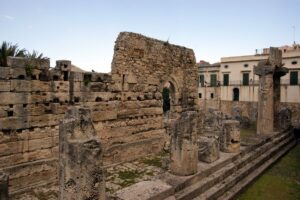
Next to the west tower there is a small room carved into the rock: the so-called ‘Queen’s Bath’. In reality, it is a freshwater source that makes use of Ortigia’s natural springs. Legend or truth? Unknown, but it is a charming spot. Other curiosities: the castle has been interpreted by some as a possible Frederickian mosque, but today the prevailing hypothesis is that it was a hypostyle hall without a courtyard. In 2018, a Stauferstele was placed in memory of Frederick II. And since 2015, the Antiquarium has hosted Greek and Roman artifacts found on the site.
The Queen’s Bath and Other Curiosities
Next to the west tower there is a small room carved into the rock: the so-called ‘Queen’s Bath’. In reality, it is a freshwater source that makes use of Ortigia’s natural springs. Legend or truth? Unknown, but it is a charming spot. Other curiosities: the castle has been interpreted by some as a possible Frederickian mosque, but today the prevailing hypothesis is that it was a hypostyle hall without a courtyard. In 2018, a Stauferstele was placed in memory of Frederick II. And since 2015, the Antiquarium has hosted Greek and Roman artifacts found on the site.
Why Visit: Three Good Reasons
1. Breathtaking view of the Grand Harbor and the sea: perfect for sunset photos. 2. A masterpiece of Swabian architecture: the hypostyle hall is unique, with its 24 cross vaults that seem to float. 3. Layered history: in every stone you can read the passage of the Byzantines, Normans, Swabians, Spaniards, and Bourbons. And if you’re a fan of Frederick II, here you’ll find a key piece of his defensive system. Moreover, the castle is barrier-free, so accessible to all.
Why Visit: Three Good Reasons
1. Breathtaking view of the Grand Harbor and the sea: perfect for sunset photos. 2. A masterpiece of Swabian architecture: the hypostyle hall is unique, with its 24 cross vaults that seem to float. 3. Layered history: in every stone you can read the passage of the Byzantines, Normans, Swabians, Spaniards, and Bourbons. And if you’re a fan of Frederick II, here you’ll find a key piece of his defensive system. Moreover, the castle is barrier-free, so accessible to all.
When to Go: The Right Time
Castello Maniace is beautiful in every season, but my advice is to visit it early in the morning, when the slanting light hits the walls and the sea is calm. Or in the late afternoon, before closing, to enjoy the sun setting over the Porto Grande. Avoid the midday hours in summer, when the heat is intense (there isn’t much shade). Spring and autumn are ideal for mild temperatures and fewer crowds. And if you can, choose the first Sunday of the month: free entry!
When to Go: The Right Time
Castello Maniace is beautiful in every season, but my advice is to visit it early in the morning, when the slanting light hits the walls and the sea is calm. Or in the late afternoon, before closing, to enjoy the sun setting over the Porto Grande. Avoid the midday hours in summer, when the heat is intense (there isn’t much shade). Spring and autumn are ideal for mild temperatures and fewer crowds. And if you can, choose the first Sunday of the month: free entry!
Nearby: What to See Next
After your visit, take advantage of the location: the castle is just a stone’s throw from Ortigia’s center. Stroll to Piazza Duomo with its Cathedral, or head to the Fonte Aretusa, a freshwater spring overlooking the sea. If you have more time, don’t miss the Neapolis Archaeological Park in Syracuse (Ear of Dionysius, Greek Theatre). Another nearby gem is the Paolo Orsi Archaeological Museum, full of artifacts. All these places are easily reachable on foot or by public transport.
Nearby: What to See Next
After your visit, take advantage of the location: the castle is just a stone’s throw from Ortigia’s center. Stroll to Piazza Duomo with its Cathedral, or head to the Fonte Aretusa, a freshwater spring overlooking the sea. If you have more time, don’t miss the Neapolis Archaeological Park in Syracuse (Ear of Dionysius, Greek Theatre). Another nearby gem is the Paolo Orsi Archaeological Museum, full of artifacts. All these places are easily reachable on foot or by public transport.
Itineraries nearby


💡 Did You Know…?
A curiosity: at the entrance, two Hellenistic bronze rams were displayed, brought by the Byzantine general George Maniakes. Today, one is at the Archaeological Museum of Palermo, the other is lost. Also, the small room called ‘Queen’s Bath’ was not a bath, but a freshwater spring that exploits the natural seepage of Ortigia.