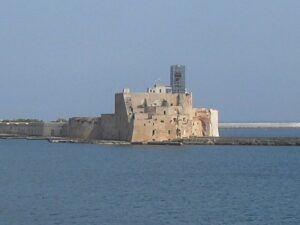
The Swabian Castle of Trani is one of the best-preserved fortresses of Frederick II, built from 1233 on a rocky outcrop overlooking the sea. Today it is open to visitors and houses the Castle Museum with stone artifacts and the Queen Margherita Collection, with works from the 19th and 20th centuries. Here’s what not to miss:
– Walk along the patrol walkways opened in 2021
– The Castle Museum on the ground floor of the northeast bastion
– The Queen Margherita Collection on the second floor of the casemates
– The towers and the moat that once communicated with the sea
Introduction
You stand before one of Italy’s most captivating fortresses. The Swabian Castle of Trani rises on a rocky outcrop, lapped by the Adriatic Sea, directly opposite the cathedral. It is imposing, solid, with its four towers seeming to defy time. The light stone of Trani shines under the sun, and the contrast with the blue sea is pure poetry. Entering here means stepping back almost eight hundred years, among emperors, battles, and stories of imprisonment. It is not just a castle: it is a piece of history that still breathes.
Historical Background
Construction began in June 1233 under the supervision of Filippo Cinardo and Stefano di Romoaldo. Frederick II wanted a fortress to defend the Kingdom of Sicily and chose a strategic location: in the center of the roadstead, protected by shallow waters. In 1237, he had Pietro Tiepolo, son of the Doge of Venice, hanged from a tower. In 1259, his son Manfred married Elena Ducas here. After the Hohenstaufen, the castle passed to the Angevins, then to the Aragonese, and in the 16th century Charles V modified it to withstand firearms. From 1832 to 1974, it served as a prison. After restoration, it opened to the public in 1998. Here are the key moments:
Architecture and Atmosphere
Enter the central courtyard and be amazed by the tall, massive pillars of the medieval loggias. The layout is square, with sides of about 48 meters, and the four corner towers: two taller ones facing the sea (30 meters) and two shorter ones inland, lowered in the 16th century. Walk along the outer defensive wall that creates three outer courtyards, and look out over the moat, 18-20 meters wide, once connected to the sea. Climbing the wall walks (open since 2021), the view stretches over the port and the cathedral. The atmosphere is a mix of power and lightness, with the sea breeze caressing the rusticated stones.
The Museum and the Queen’s Collection
On the ground floor of the northeast bastion is the Castle Museum, featuring stone and ceramic artifacts uncovered during restoration. But the real gem is on the second floor of the casemates: since 2022 it houses the Queen Margherita Collection. These are works of art donated in 1928 by Victor Emmanuel III, showcasing Italian artistic trends between the 19th and 20th centuries. Paintings, sculptures, precious objects: a dive into the elegance of an era. The contrast between the medieval walls and these works is fascinating, almost surreal.
Why Visit It
Three good reasons to add it to your itinerary. First: it is one of the best-preserved Hohenstaufen castles, with a unique seaside location. Second: you can combine the visit with Castel del Monte (combined ticket at €15) and create a Swabian itinerary. Third: Queen Margherita’s collection is a little-known bonus, one more reason not to limit yourself to the exterior. Moreover, the staff is knowledgeable and audioguides are available.
When to Visit
The best time? Early morning, right when it opens (8:30). The low light caresses the stone, and the sea is calm. In spring or autumn, when crowds are thinner, you can enjoy the walkways almost in solitude. Avoid the midday hours in summer: the heat builds up between the walls. But if you come to Trani in any season, it’s always worth it. Even in winter, with a gray sky and choppy sea, the castle has a dark, powerful charm.
Nearby
Just a stone’s throw away is the Cathedral of Trani, dedicated to St. Nicholas the Pilgrim, a Romanesque masterpiece worth visiting. Then get lost in the historic center: white alleys, artisan shops, and the smell of freshly baked bread. If you fancy a dip, a bit further on is Colonna beach with crystal-clear waters. But the real plus? The port of Trani, with its seafood restaurants, where you can enjoy raw seafood while gazing at the illuminated castle.