The Cassibile Necropolis is one of the largest archaeological sites in Sicily, with about 2,000 chamber tombs carved into the limestone rock between 1000 and 800 BC. It lies within the Cavagrande del Cassibile Reserve, in the municipalities of Avola and Noto, and reaching it is an adventure for experienced hikers: 7 km off-trail with 175 m of elevation gain. Admission is free and the site is always open.
What you’ll find:
– 2,000 chamber tombs, some with multiple notch decorations.
– The fortress of Cugno Mola, mentioned by Thucydides in the Peloponnesian War.
– The Brigands’ Cave and the Ddieri, underground chambers reused in Byzantine times.
– Views of Mount Etna and the Cavagrande canyon.
Evocative Introduction
Tucked away in the Iblei Mountains, the Necropolis of Cassibile is a sleeping giant of Sicilian history. With its two thousand rock-cut tombs, it is one of the largest archaeological sites on the island, yet also one of the least known. Here, in the Cavagrande Nature Reserve, silence is broken only by the wind and the rustle of Mediterranean scrub. And then, suddenly, the view: Mount Etna smoking on the horizon. A place that speaks of ancient peoples, wars, and life, all waiting to be discovered with your own eyes.
Evocative Introduction
Tucked away in the Iblei Mountains, the Necropolis of Cassibile is a sleeping giant of Sicilian history. With its two thousand rock-cut tombs, it is one of the largest archaeological sites on the island, yet also one of the least known. Here, in the Cavagrande Nature Reserve, silence is broken only by the wind and the rustle of Mediterranean scrub. And then, suddenly, the view: Mount Etna smoking on the horizon. A place that speaks of ancient peoples, wars, and life, all waiting to be discovered with your own eyes.
Historical Background
The necropolis was built by the
Siculi between 1000 and 800 BC, during the period known as the ‘Second Facies of Pantalica’ or ‘Cassibile Facies’. The grotticella tombs testify to a refined civilization in contact with the Phoenicians. They were reused in the Byzantine era; some still have arcosolia. Opposite, the
Cugno Mola hill is the fortress from which the Syracusans kept watch over the fleeing Athenians after the defeat of 413 BC, as recounted by Thucydides. Artifacts such as fibulae and ceramics are in the Paolo Orsi Museum in Syracuse.
- 1000-800 BC: Sicilian tombs
- 413 BC: Peloponnesian War
- Byzantine era: reuse of tombs
Historical Background
The necropolis was built by the
Siculi between 1000 and 800 BC, during the period known as the ‘Second Facies of Pantalica’ or ‘Cassibile Facies’. The grotticella tombs testify to a refined civilization in contact with the Phoenicians. They were reused in the Byzantine era; some still have arcosolia. Opposite, the
Cugno Mola hill is the fortress from which the Syracusans kept watch over the fleeing Athenians after the defeat of 413 BC, as recounted by Thucydides. Artifacts such as fibulae and ceramics are in the Paolo Orsi Museum in Syracuse.
- 1000-800 BC: Sicilian tombs
- 413 BC: Peloponnesian War
- Byzantine era: reuse of tombs
A Dive into History: Tombs and Views
The tombs are arranged on multiple levels, with simple entrances or decorated with concentric grooves. Some have side chambers and square doors. The oxidized limestone has preserved everything for millennia. But it’s not just archaeology: from the necropolis you enjoy a breathtaking view. The canyon of Cava Sant’Anna plunges green, and down there, in the distance, Etna stands white with snow. A rare mix of history and nature that makes the effort of the hike more than worthwhile.
A Dive into History: Tombs and Views
The tombs are arranged on multiple levels, with simple entrances or decorated with concentric grooves. Some have side chambers and square doors. The oxidized limestone has preserved everything for millennia. But it’s not just archaeology: from the necropolis you enjoy a breathtaking view. The canyon of Cava Sant’Anna plunges green, and down there, in the distance, Etna stands white with snow. A rare mix of history and nature that makes the effort of the hike more than worthwhile.
Cugno Mola and the Peloponnesian War
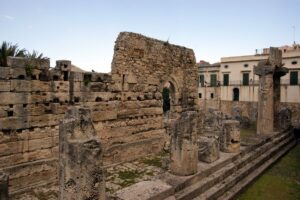
Facing the necropolis, a pyramidal hill called Cugno Mola holds a secret: Thucydides mentions it as the fortress from which the Syracusans blocked the escape of the Athenians after their defeat in 413 BC. Here also lie the remains of a Greek prostyle Doric temple, evidence of a later settlement. A little further on, the Grotta dei Briganti: a rock-cut dwelling with twenty rooms, used in Byzantine and Arab times as a tannery. Every stone here tells a story.
Cugno Mola and the Peloponnesian War
Facing the necropolis, a pyramidal hill called Cugno Mola holds a secret: Thucydides mentions it as the fortress from which the Syracusans blocked the escape of the Athenians after their defeat in 413 BC. Here also lie the remains of a Greek prostyle Doric temple, evidence of a later settlement. A little further on, the Grotta dei Briganti: a rock-cut dwelling with twenty rooms, used in Byzantine and Arab times as a tannery. Every stone here tells a story.
Why Visit It
If you’re looking for an alternative to Pantalica, less traveled but equally fascinating, Cassibile is for you. It’s an authentic site, unspoiled by mass tourism. For trekking enthusiasts, the 7 km route with 175 m elevation gain offers a genuine experience, among dry stone walls and the scents of aromatic herbs. And then the history: touching the traces of the Peloponnesian War gives you chills. An extra reason? Entry is free.
Why Visit It
If you’re looking for an alternative to Pantalica, less traveled but equally fascinating, Cassibile is for you. It’s an authentic site, unspoiled by mass tourism. For trekking enthusiasts, the 7 km route with 175 m elevation gain offers a genuine experience, among dry stone walls and the scents of aromatic herbs. And then the history: touching the traces of the Peloponnesian War gives you chills. An extra reason? Entry is free.
When to Go
The best time? Late spring or autumn, when the heat isn’t too intense and the Mediterranean scrub is in bloom. Avoid summer: the Cava Sant’Anna becomes an oven and the stream dries up, but if you do come, start at dawn. In winter, after rain, the trails get slippery. I’d choose a clear day in May, when Mount Etna is sharply visible and the air smells of oregano.
When to Go
The best time? Late spring or autumn, when the heat isn’t too intense and the Mediterranean scrub is in bloom. Avoid summer: the Cava Sant’Anna becomes an oven and the stream dries up, but if you do come, start at dawn. In winter, after rain, the trails get slippery. I’d choose a clear day in May, when Mount Etna is sharply visible and the air smells of oregano.
In the Vicinity
Just a stone’s throw away, the Cavagrande del Cassibile Nature Reserve offers a breathtaking canyon with small lakes where you can swim (in summer, if there’s water). Not far away, the village of Avola Antica is worth a stop: ruins of an ancient Sicilian and Greek settlement, with a spectacular sea view. If you love food, in Noto don’t miss the arancini with ragù: the reward after all that effort.
In the Vicinity
Just a stone’s throw away, the Cavagrande del Cassibile Nature Reserve offers a breathtaking canyon with small lakes where you can swim (in summer, if there’s water). Not far away, the village of Avola Antica is worth a stop: ruins of an ancient Sicilian and Greek settlement, with a spectacular sea view. If you love food, in Noto don’t miss the arancini with ragù: the reward after all that effort.