The Archaeological Area of Akrai, in Palazzolo Acreide, is a jewel of Greek Sicily. Founded in 664 BC, it offers a journey through time among theatre, bouleuterion, and stone quarries. Here’s what not to miss:
– Greek Theatre from the 3rd century BC, with views of Mount Etna
– Rock Reliefs: 12 rock-cut reliefs dedicated to Cybele
– Intagliata and Intagliatella Quarries with Byzantine tombs
– Bouleuterion and Aphrodision, temple of Aphrodite
Introduction
If you think Greek Sicily is only about Syracuse or Agrigento, get ready to change your mind. In Palazzolo Acreide, the Akrai Archaeological Area offers you an intimate and powerful experience. Here, among olive trees and the scents of the Mediterranean maquis, the ruins of a city founded in 664 BC emerge. The Greek theater carved into the rock is small but evocative, with a view of Mount Etna. And then there are the Santoni of Cybele, twelve rock-cut sculptures that seem to protect the place. Walking through the quarries and the paleochristian catacombs is like taking a plunge into time, far from the chaos. A place to be savored slowly, letting yourself be surprised.
Introduction
If you think Greek Sicily is only about Syracuse or Agrigento, get ready to change your mind. In Palazzolo Acreide, the Akrai Archaeological Area offers you an intimate and powerful experience. Here, among olive trees and the scents of the Mediterranean maquis, the ruins of a city founded in 664 BC emerge. The Greek theater carved into the rock is small but evocative, with a view of Mount Etna. And then there are the Santoni of Cybele, twelve rock-cut sculptures that seem to protect the place. Walking through the quarries and the paleochristian catacombs is like taking a plunge into time, far from the chaos. A place to be savored slowly, letting yourself be surprised.
Historical Background
Akrai was founded by the Syracusans in 664/663 BC to control the Hyblaean Mountains. It reached its peak under
Hiero II (3rd century BC), who built the theater and the bouleuterion. After the fall of Syracuse in 211 BC, it passed to the Romans and flourished in Byzantine times until its destruction by the Arabs in 827. The site was rediscovered in the 16th century by the friar
Tommaso Fazello, but the first real excavations began with Baron Gabriele Judica in the 19th century. Today it is part of the Syracuse Archaeological Park and the Val di Noto UNESCO site.
- 664 BC: Foundation of Akrai
- 3rd cent. BC: Theater and bouleuterion
- 211 BC: Roman domination
- 827: Arab destruction
- 19th cent.: Judica’s excavations
Historical Background
Akrai was founded by the Syracusans in 664/663 BC to control the Hyblaean Mountains. It reached its peak under
Hiero II (3rd century BC), who built the theater and the bouleuterion. After the fall of Syracuse in 211 BC, it passed to the Romans and flourished in Byzantine times until its destruction by the Arabs in 827. The site was rediscovered in the 16th century by the friar
Tommaso Fazello, but the first real excavations began with Baron Gabriele Judica in the 19th century. Today it is part of the Syracuse Archaeological Park and the Val di Noto UNESCO site.
- 664 BC: Foundation of Akrai
- 3rd cent. BC: Theater and bouleuterion
- 211 BC: Roman domination
- 827: Arab destruction
- 19th cent.: Judica’s excavations
Greek Theatre and Bouleuterion
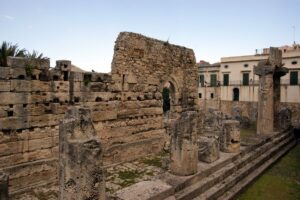
The Greek theatre is the jewel of Akrai. Carved into the limestone rock, it dates back to the second half of the 3rd century BC. It seats around 600-700 people, with 12 rows of seats divided into 9 wedges. The orchestra is semicircular, and a stage was added in Roman times. Today it is used for a youth classical theatre festival. Nearby is the bouleuterion, the city council chamber: small, with 6 rows of steps and only 100 seats. Surrounding it are remains of baths and a Greek water system. Climbing the theatre’s steps, the view stretches all the way to Mount Etna: a breathtaking spectacle.
Greek Theatre and Bouleuterion
The Greek theatre is the jewel of Akrai. Carved into the limestone rock, it dates back to the second half of the 3rd century BC. It seats around 600-700 people, with 12 rows of seats divided into 9 wedges. The orchestra is semicircular, and a stage was added in Roman times. Today it is used for a youth classical theatre festival. Nearby is the bouleuterion, the city council chamber: small, with 6 rows of steps and only 100 seats. Surrounding it are remains of baths and a Greek water system. Climbing the theatre’s steps, the view stretches all the way to Mount Etna: a breathtaking spectacle.
The Santoni of Cybele and the Latomies
The most mysterious part of the site are the Santoni: twelve large rock reliefs dedicated to the goddess Cybele, carved between the late 4th and 3rd century BC. The goddess is depicted seated with lions, sometimes accompanied by Corybants. It is the largest complex of the cult of Cybele in the ancient world. Pity they are damaged by time and vandals. The latomies (stone quarries) are another highlight: the Intagliata and the Intagliatella, transformed in Byzantine times into catacombs and dwellings. In the latter, do not miss the bas-relief known as the “banquet of the heroes,” with a warrior at the center. A place that combines archaeology and spirituality.
The Santoni of Cybele and the Latomies
The most mysterious part of the site are the Santoni: twelve large rock reliefs dedicated to the goddess Cybele, carved between the late 4th and 3rd century BC. The goddess is depicted seated with lions, sometimes accompanied by Corybants. It is the largest complex of the cult of Cybele in the ancient world. Pity they are damaged by time and vandals. The latomies (stone quarries) are another highlight: the Intagliata and the Intagliatella, transformed in Byzantine times into catacombs and dwellings. In the latter, do not miss the bas-relief known as the “banquet of the heroes,” with a warrior at the center. A place that combines archaeology and spirituality.
Why Visit It
Akrai isn’t as famous as other sites, and perhaps that’s for the best. First: authenticity – no crowds, you can breathe in an intimate and genuine atmosphere. Second: variety – in one hour you see a theater, bouleuterion, latomie, santoni, and temple remains. Third: pairing with Palazzolo – after the visit, the town awaits with its UNESCO Baroque churches and a good farm-to-table lunch. Plus, the ticket costs only 4 euros. Wear comfortable shoes and bring plenty of curiosity.
Why Visit It
Akrai isn’t as famous as other sites, and perhaps that’s for the best. First: authenticity – no crowds, you can breathe in an intimate and genuine atmosphere. Second: variety – in one hour you see a theater, bouleuterion, latomie, santoni, and temple remains. Third: pairing with Palazzolo – after the visit, the town awaits with its UNESCO Baroque churches and a good farm-to-table lunch. Plus, the ticket costs only 4 euros. Wear comfortable shoes and bring plenty of curiosity.
When to Go
The best time is spring or autumn, when temperatures are mild and the light is soft. The site is outdoors, on a hill, and in summer the sun beats down. If you come in spring, wildflowers color the ruins. Early morning or late afternoon, the low light enhances the reliefs of the Santoni. In October, hours are reduced (until 5:30 PM), but it’s quieter. Bring a bottle of water, especially if you visit in hot weather.
When to Go
The best time is spring or autumn, when temperatures are mild and the light is soft. The site is outdoors, on a hill, and in summer the sun beats down. If you come in spring, wildflowers color the ruins. Early morning or late afternoon, the low light enhances the reliefs of the Santoni. In October, hours are reduced (until 5:30 PM), but it’s quieter. Bring a bottle of water, especially if you visit in hot weather.
Nearby
A few steps away, the center of Palazzolo Acreide is a Baroque gem declared a UNESCO World Heritage site. Get lost among Piazza del Popolo and the churches of San Paolo and San Sebastiano. Not far, the Necropolis of Pantalica offers millennia of history in a spectacular natural park, with thousands of rock-cut tombs and trails along the Anapo River. Another idea: the Cava d’Ispica, a long ravine with caves and rock-cut churches. All places that continue the journey into ancient Sicily.
Nearby
A few steps away, the center of Palazzolo Acreide is a Baroque gem declared a UNESCO World Heritage site. Get lost among Piazza del Popolo and the churches of San Paolo and San Sebastiano. Not far, the Necropolis of Pantalica offers millennia of history in a spectacular natural park, with thousands of rock-cut tombs and trails along the Anapo River. Another idea: the Cava d’Ispica, a long ravine with caves and rock-cut churches. All places that continue the journey into ancient Sicily.