Introduction
Walking among the tombs of Tuvixeddu is like diving into Cagliari’s most ancient past. This hill, which today looks like an ordinary park, holds the largest Punic necropolis in the Mediterranean, with over 1,100 burials carved into the limestone rock. It’s a place that surprises you: suddenly you find yourself on suspended walkways above wells up to 11 meters deep, with tombs decorated by unique frescoes in Sardinia. It’s not a cold museum, but a living site where nature has reclaimed its space among agaves and shrubs. Yet, if you listen closely, you can still hear the echo of a Phoenician, Roman, and even medieval past. A visit that leaves a mark.
Introduction
Walking among the tombs of Tuvixeddu is like diving into Cagliari’s most ancient past. This hill, which today looks like an ordinary park, holds the largest Punic necropolis in the Mediterranean, with over 1,100 burials carved into the limestone rock. It’s a place that surprises you: suddenly you find yourself on suspended walkways above wells up to 11 meters deep, with tombs decorated by unique frescoes in Sardinia. It’s not a cold museum, but a living site where nature has reclaimed its space among agaves and shrubs. Yet, if you listen closely, you can still hear the echo of a Phoenician, Roman, and even medieval past. A visit that leaves a mark.
Historical Overview
The history of Tuvixeddu begins in the
6th century BC, when the Carthaginians chose this hill as their main cemetery. The shaft tombs were used until the 3rd century BC and then reused by the Romans until the 1st century BC, who added the evocative
Grotta della Vipera (Viper’s Cave). During World War II, the cavities served as air-raid shelters. In the 20th century, the hill was
devastated by the quarries of a cement plant, which destroyed many tombs. Only in 2014, after decades of neglect and a legal battle against a building project, the park was reopened to the public. Today it is being expanded and enhanced with new paths and digital technologies.
- 6th-3rd cent. BC: Punic necropolis in use
- 2nd cent. AD: construction of Viper’s Cave
- 20th cent.: quarrying and degradation
- 2014: reopened to the public
- Ongoing: expansion and digitalization
Historical Overview
The history of Tuvixeddu begins in the
6th century BC, when the Carthaginians chose this hill as their main cemetery. The shaft tombs were used until the 3rd century BC and then reused by the Romans until the 1st century BC, who added the evocative
Grotta della Vipera (Viper’s Cave). During World War II, the cavities served as air-raid shelters. In the 20th century, the hill was
devastated by the quarries of a cement plant, which destroyed many tombs. Only in 2014, after decades of neglect and a legal battle against a building project, the park was reopened to the public. Today it is being expanded and enhanced with new paths and digital technologies.
- 6th-3rd cent. BC: Punic necropolis in use
- 2nd cent. AD: construction of Viper’s Cave
- 20th cent.: quarrying and degradation
- 2014: reopened to the public
- Ongoing: expansion and digitalization
The Painted Tombs
Among the hundreds of tombs, two stand out for their painted decoration. The Tomba dell’Ureo (4th century BC) features a fresco with a winged serpent, lotus flowers, and Gorgon masks: a unique find in Sardinia. The Tomba di Sid (4th-3rd century BC) depicts a bearded warrior with a spear, perhaps the Phoenician god Sid. Unfortunately, both are currently closed to the public for protection, but they can be admired up close during special guided tours. The paintings, in red ochre, have survived thanks to the limestone rock that has preserved them for centuries. A true archaeological treasure that tells the rites and beliefs of a lost civilization.
The Painted Tombs
Among the hundreds of tombs, two stand out for their painted decoration. The Tomba dell’Ureo (4th century BC) features a fresco with a winged serpent, lotus flowers, and Gorgon masks: a unique find in Sardinia. The Tomba di Sid (4th-3rd century BC) depicts a bearded warrior with a spear, perhaps the Phoenician god Sid. Unfortunately, both are currently closed to the public for protection, but they can be admired up close during special guided tours. The paintings, in red ochre, have survived thanks to the limestone rock that has preserved them for centuries. A true archaeological treasure that tells the rites and beliefs of a lost civilization.
A Park Reborn
Tuvixeddu is not just archaeology, but also an example of urban rebirth. After being an abandoned quarry and a shantytown after the war, today it is a public park of 5 hectares (soon 18). The contrast is stark: on one side, the ruins of Villa Mulas-Mameli, an elegant Liberty-style building in a state of neglect; on the other, wheelchair-accessible paths and new educational signs. As you walk, you notice the ancient tomb cuts and, at the top, a spectacular view of the Santa Gilla lagoon. It is an imperfect place, still evolving, but precisely for this reason authentic. The ongoing works (funded with 953,000 euros) promise to restore dignity to this forgotten gem.
A Park Reborn
Tuvixeddu is not just archaeology, but also an example of urban rebirth. After being an abandoned quarry and a shantytown after the war, today it is a public park of 5 hectares (soon 18). The contrast is stark: on one side, the ruins of Villa Mulas-Mameli, an elegant Liberty-style building in a state of neglect; on the other, wheelchair-accessible paths and new educational signs. As you walk, you notice the ancient tomb cuts and, at the top, a spectacular view of the Santa Gilla lagoon. It is an imperfect place, still evolving, but precisely for this reason authentic. The ongoing works (funded with 953,000 euros) promise to restore dignity to this forgotten gem.
Why Visit
1. A unique thrill: walking on walkways suspended above tombs 11 meters deep makes you feel like an explorer. 2. Free and accessible: free entry, the park is open every day and there are accessible paths. 3. Living history: here you can touch three thousand years of history, from the Phoenicians to the Romans to wartime shelters. It’s not a museum site: it’s a park where nature and archaeology coexist in a wild and fascinating way. Wear comfortable shoes and, if possible, book a guided tour to see tombs closed to the public.
Why Visit
1. A unique thrill: walking on walkways suspended above tombs 11 meters deep makes you feel like an explorer. 2. Free and accessible: free entry, the park is open every day and there are accessible paths. 3. Living history: here you can touch three thousand years of history, from the Phoenicians to the Romans to wartime shelters. It’s not a museum site: it’s a park where nature and archaeology coexist in a wild and fascinating way. Wear comfortable shoes and, if possible, book a guided tour to see tombs closed to the public.
When to Go
The best time? Early morning in spring or autumn. With the low light, the colors of the limestone rock and the paintings (where visible) stand out. In summer the heat can be intense, but the park opens at 5:30 AM and closes at 10:30 PM, so go at sunset: the sun setting over the Santa Gilla lagoon is a spectacle. Avoid the central hours, even though summer hours are long. In winter, the park is more deserted and the atmosphere almost mystical, with low vegetation and silence broken only by the wind. Whatever season you choose, Tuvixeddu offers a timeless visit.
When to Go
The best time? Early morning in spring or autumn. With the low light, the colors of the limestone rock and the paintings (where visible) stand out. In summer the heat can be intense, but the park opens at 5:30 AM and closes at 10:30 PM, so go at sunset: the sun setting over the Santa Gilla lagoon is a spectacle. Avoid the central hours, even though summer hours are long. In winter, the park is more deserted and the atmosphere almost mystical, with low vegetation and silence broken only by the wind. Whatever season you choose, Tuvixeddu offers a timeless visit.
Nearby
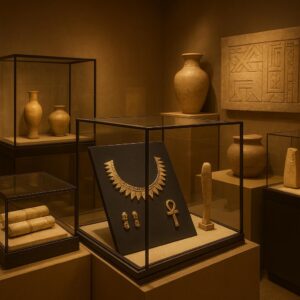
Just a short walk away, on the opposite side of the hill, is the Grotta della Vipera, a Roman tomb from the 2nd century AD with a poetic inscription. Also in the area, the Stagno di Santa Gilla is worth a visit—a lagoon teeming with flamingos and migratory birds, perfect for a sunset stroll. And then, of course, the Museo Archeologico Nazionale di Cagliari, which houses artifacts from the tombs (jewelry, pottery, amulets). A tip: combine your visit to Tuvixeddu with a stop at the museum to get the full picture of Cagliari’s Punic history.
Nearby
Just a short walk away, on the opposite side of the hill, is the Grotta della Vipera, a Roman tomb from the 2nd century AD with a poetic inscription. Also in the area, the Stagno di Santa Gilla is worth a visit—a lagoon teeming with flamingos and migratory birds, perfect for a sunset stroll. And then, of course, the Museo Archeologico Nazionale di Cagliari, which houses artifacts from the tombs (jewelry, pottery, amulets). A tip: combine your visit to Tuvixeddu with a stop at the museum to get the full picture of Cagliari’s Punic history.