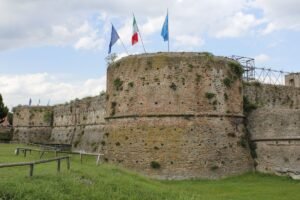
In the heart of Varsi, a village in the Parma Apennines in Valceno, Varsi Castle preserves three imposing stone towers that tell ten centuries of history. From the bishops of Piacenza to the Scotti family, up to the nineteenth-century demolition to make room for the square, the manor today is a striking complex of ruins viewable from the outside, with a tower housing the Pro Loco. A nature trail also starts here, reaching the Rio Golotta waterfalls, perfect for combining culture and walking.
– Corner towers and traces of the fifteenth-century city walls
– View over the village of Varsi and the Valceno valley
– Hiking trail to the Rio Golotta waterfalls
– Information point in the north tower (Pro Loco office)
Varsi Castle: Medieval Towers and Trails in Valceno
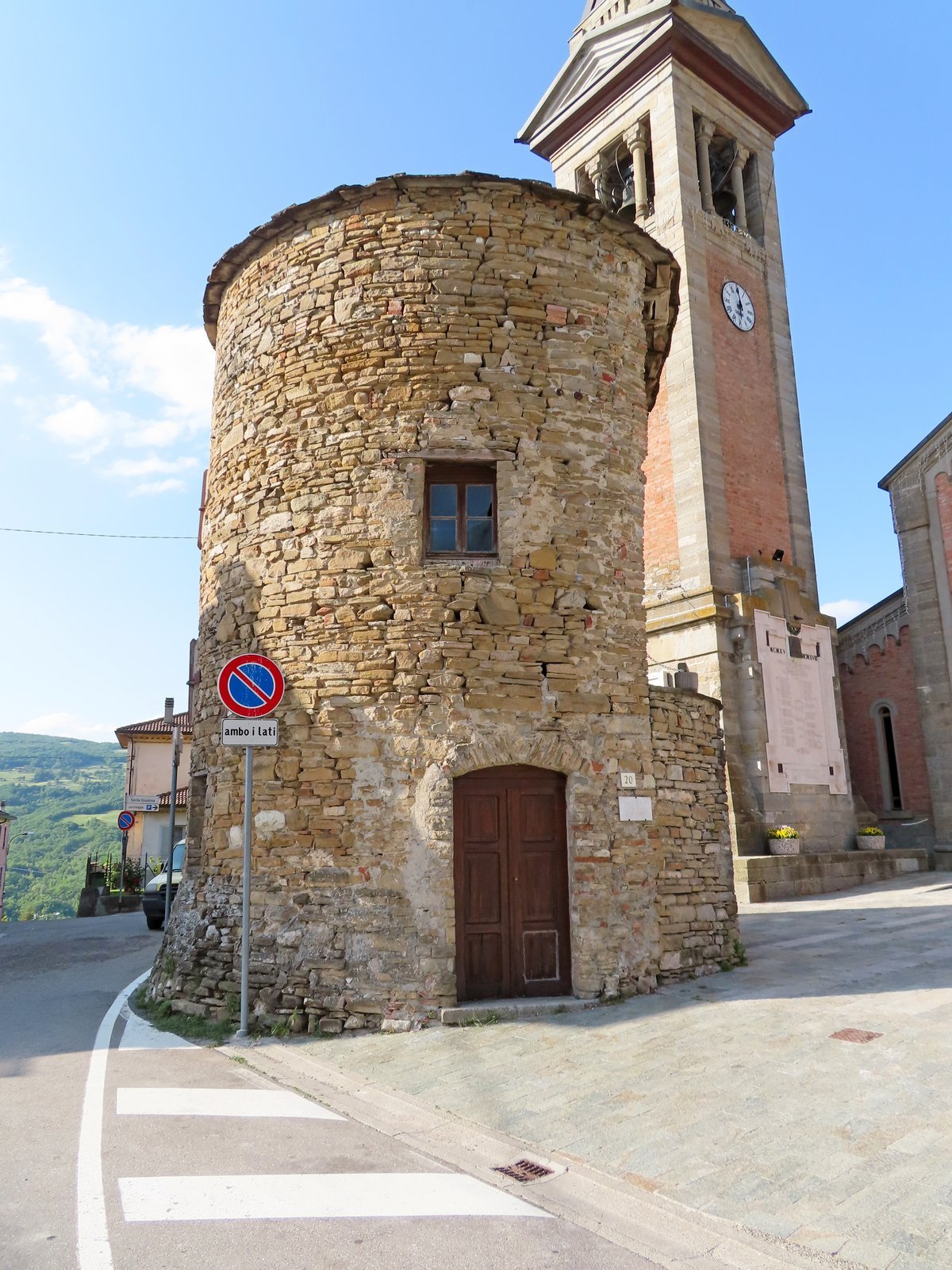
Remains of the medieval castle of Varsi: three stone towers, a mountain village, and a path to the Rio Golotta waterfalls. The Varsi Castle, in Valceno, is one of those unexpected places: there is no great fortress dominating, but a village living alongside ancient ruins. In Piazza Monumento, next to the Church of San Pietro Apostolo, the surviving towers stand out against the sky. The stone surfaces, marked by centuries, tell of a past made of sieges and noble families. And then there’s nature: the trail descending to the Rio Golotta waterfalls adds a wild touch. It’s a destination to discover without haste, perhaps after a walk. A corner of the Apennines where history and landscape merge.
Historical notes
The origins of the castle are lost in time: the territory of Varsi is already mentioned in Lombard documents, and perhaps a first fortification existed in the early Middle Ages. The documented construction dates back to the 10th century, commissioned by the Diocese of Piacenza. In 1206, the fortress hosted some conspirators against the consul Bartolomeo Tuna: after a 15-day siege, it returned to Piacenza. Passed to the Malaspina, it was reconquered by the bishops. In 1303, Bishop Ugo ceded it to Giovanni Scotti, who rebuilt it on a quadrangular plan with circular corner towers. Centuries of disputes followed, until the ruling of Galeazzo Sforza in 1469. At the end of the 19th century, to create Piazza Monumento, most of the castle was demolished.
Essential Timeline
- 10th century – probable construction by the diocese of Piacenza
- 1206 – siege and recovery by Piacenza
- 1303 – transfer to Giovanni Scotti, who rebuilt the fortress
- 1445-1469 – dispute between the Fieschi/Malaspina and Scotti families, resolved by Galeazzo Sforza
- Late 19th century – partial demolition for the new square
The Three Towers That Remain
Today, of the manor, only three corner towers in stone remain, mutilated and with few openings. The west tower is isolated; the south tower leans against a stretch of the encircling wall and is the best preserved, with traces of plaster and an eighteenth-century cornice. The north tower, leaning against the church of San Pietro, was used for years as a bell tower and today houses the Pro Loco. Strolling in Piazza Monumento, one notices the signs of transformations: an eighteenth-century arched portal, walls incorporated into recent buildings. The interior is not open to visitors, but the atmosphere can be felt entirely from outside. It is a castle to be read with the eyes, piece by piece.
The Trail to the Rio Golotta Waterfalls
Valceno is not just history: from near the castle, a path leads to the Rio Golotta waterfalls. A simple itinerary through the woods, where the sound of water accompanies the walk. The waterfalls, surrounded by greenery, are an ideal destination for those seeking some coolness. In spring, with more abundant water, the spectacle is even more beautiful. The loop offers views of the valley and glimpses of the village from above. Bring comfortable shoes and a desire to walk: here time flows more slowly.
Why Visit
Three good reasons to stop in Varsi. First: the medieval towers are a rare example of fortified architecture surviving in a mountain village, and you can admire them up close for free. Second: the path to the Rio Golotta waterfalls turns the visit into a mini nature hike. Third: the town retains an authentic atmosphere, far from mass tourism, and the Pro Loco in one of the towers is a reference point for practical information.
When to go
The most evocative moment is the late afternoon, when the raking light illuminates the stones of the towers and the square glows with warm colors. Early in the morning, instead, you can enjoy the silence and the scent of the woods coming from Valceno. If you are planning the walk to the waterfalls, choose a sunny day after a period of rain: the water will be more abundant and the spectacle more beautiful. There is no need to chase the perfect season, every moment has its own charm.
In the Surroundings
In the area, don’t miss the Church of San Pietro Apostolo with its neo-Gothic façade, rebuilt in the 17th century and expanded in the 1930s. A little further on, the trail to the Rio Golotta waterfalls is the ideal nature experience to combine. If you love abandoned places, look for traces of the Pessola or dell’Agnellina Castle, now vanished: the ground that rumbles underfoot still speaks of ancient underground chambers.