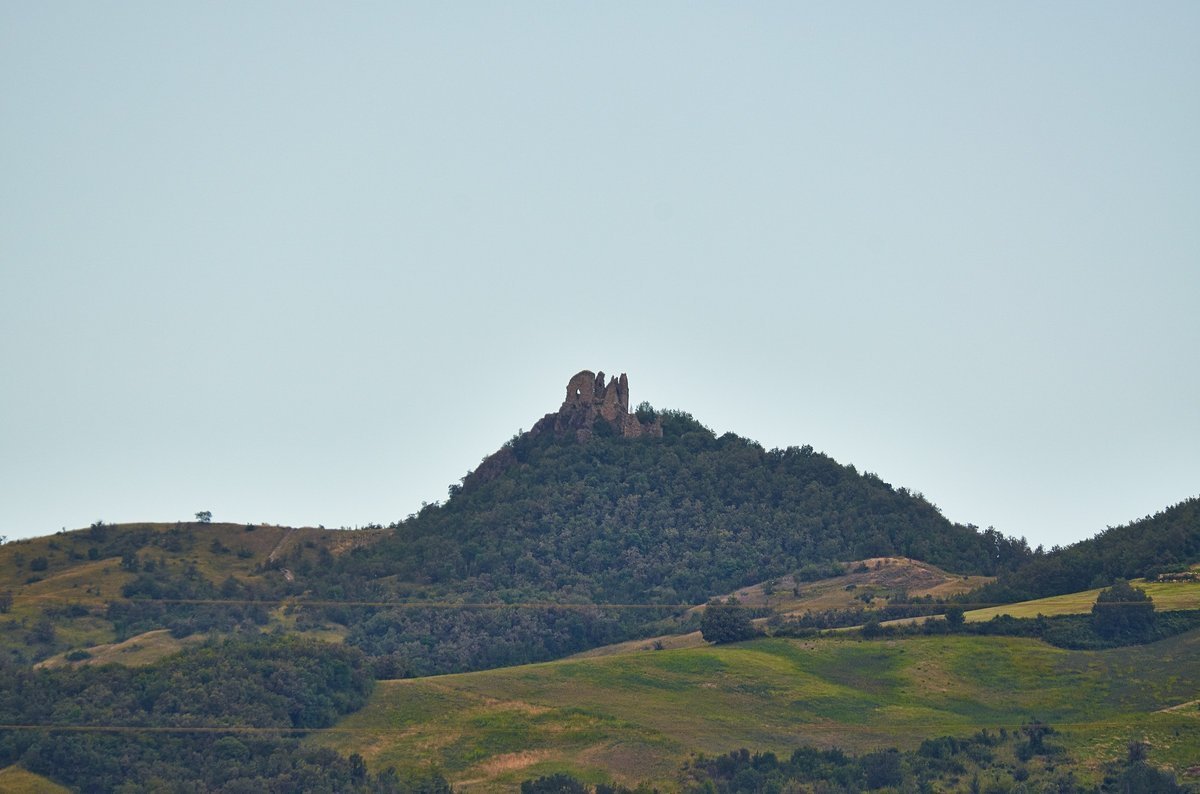
The Roccalanzona Castle, also known as Rocha Leone, stands on an ophiolitic spur between the Ceno and Dordone valleys. Mentioned in 1028 and linked to the Rossi family, it was considered impregnable and preserves the ruins of the keep, walls, and a vaulted room. Today it can be visited with guides from the Rocha Leone APS Association along the Maria Longa road, a variant of the Via Francigena.
• Historic ruins on ophiolitic rock with views over the Po Valley.
• Maria Longa road, an ancient Lombard ridge route and today a hiking trail.
• Pietra Corva and the calanchi badlands, amid legends and views over the Ceno Valley.
• Guided tours and cultural events organized by the Rocha Leone APS Association.
Introduction
Roccalanzona Castle is not your classic postcard-perfect manor. It is a handful of ruins on an ophiolitic rock spur, on the border between the Ceno Valley and the Dordone Valley, between Medesano and Varano de’ Melegari. Reaching it means following the Maria Longa ridge road, a variant of the Via Francigena, and coming upon remains scattered over a wide area: the rectangular keep, the wall bases full of arrow slits, a room with a vaulted ceiling and a crossbow slit. The view is the first thing that strikes you: from up here your gaze sweeps across the Ceno Valley and the Po Plain. Don’t expect a ticket office and perfect information panels. Here the charm lies in the silence, the rock, and a name that has the ring of battle: Rocha Leone. A place that deserves a walk, not a quick stop.
Historical Background
The castle first appears on
4 July 1028 in a deed of sale by Ildegarda, wife of the Lombard nobleman Odone: the document mentions
Rocha Petraluizoni, with a chapel near the manor. In 1043 the properties passed to the monastery of San Savino in Piacenza. Centuries of disputes between the Pallavicino and the Vinciguerra di Varano de’ Melegari followed. In
1418, the will of Giacomo de’ Rossi opened the way for the Rossi family; the castle became a fief of
Pier Maria I, who called it Rocha Leone. In 1464 Pier Maria II assigned it to his son Guido, who in 1482 defended it from attacks by Niccolò Pallavicino and
Sforza Secondo Sforza: the bombards were not enough.
- 1028 – first mention in a deed of sale by Ildegarda
- 1043 – donation to the monastery of San Savino in Piacenza
- 1418 – Giacomo de’ Rossi’s will opens the way for the Rossi family
- 1464 – Pier Maria II assigns the castle to his son Guido
- 1482 – attacks by Pallavicino and Sforza II: Roccalanzona holds out
- 1502 – on Bertrando’s death the fiefs pass to Troilo
- 1635 – Odoardo I Farnese confiscates the lands of Troilo IV de’ Rossi
- 1666 – Scipione I cedes the castle, already ruinous, to the Ducal Chamber
- 1692 – passes to the Ercolani of Senigallia
- 1804-1805 – only a few ruins remain; the fief is abolished
The Architecture That Remains
The castle was an example of military architecture for its rationality and simplicity: everything revolved around the keep, the donjon, where the final battle was fought. Today, the remains of the great rectangular keep survive, with the bases of walls full of arrow slits extending from it. An interior room, covered by a vaulted ceiling, is partially intact, facing outward through a crossbow slit. The ruins are scattered over a rather vast area, and the walls visible along the Maria Longa date back to the mid-15th century, under Pier Maria Rossi. Older residents of the area also remember a Marian fresco in a room, though no trace of it is thought to remain. The castle’s church, already mentioned in 1028, was demolished in 1739. The property is private, owned by the Community of Bethany, and since February 2024 it has been loaned for use to the Rocha Leone APS Association.
The Maria Longa and the Trails
Viazzano, an ancient village, is the classic starting point for reaching the castle along the ridge route known as Maria Longa. It is not just any trail: this ridge road held strategic importance as early as the Lombard era, and along it an inscription from the first Jubilee, in 1300 was found. Today it is a variant of the Via Francigena popular with hikers. The site is a stop on the Roccalanzona Castle Trail, route 802, and on a loop that begins at the castle itself. Hikes here let you read the landscape: hills, woods, and the badlands sculpted by the elements. If you are only after the ruin, just arrive. If you walk, you will understand why this spot was contested by Pallavicino, Vinciguerra, and Rossi. The ruins can be visited with a guide: by the first walls, an archaeologist from the Rocha Leone APS Association gives a multimedia presentation on the history of the manor.
Pietra Corva and the Legends
Not far from this story stands Pietra Corva, an ophiolitic crag with views stretching over the Ceno Valley and the Po Plain. The place is tied to the area’s most famous legend: the daughter of the Count of Roccalanzona fell in love with a young shepherd from Gallicchiano, near Riviano, who grazed his sheep by the crag. She was one of the Rossi of San Secondo, he one of the rival Pallavicino. To avoid being separated, the two threw themselves from the crag. On full-moon nights, it is said, two snow-white cloaks hover in the sky above Pietra Corva before vanishing. Other stories also swirl around the castle: underground tunnels used during sieges, a hidden golden calf, a Pozzo del Taglio well about forty metres deep. No trace has ever been found, but no one has ever truly looked.
Underground Legends
Here the official history ends and the tales passed down begin. It is said that beneath the castle ran a complex of underground tunnels, lined with stone blocks and lit by fixed torches, used during sieges to receive supplies or escape. It is also said that in those passages was hidden a golden calf, worshipped as a deity, lost when the manor was destroyed. Among the ruined walls, a slight circular depression can be seen: according to some, it is the mouth of the well of the cut, about forty metres deep, with sharp blades at the bottom and on its walls. No one has ever found traces of the underground structures, and no one has ever seriously searched for them. The beauty, perhaps, is precisely this: walking among the ruins and continuing to imagine.
Why visit it
Three concrete reasons. First: it is the only castle of Pier Maria Rossi never to have been conquered, not even by the bombards of Sforza Secondo Sforza. Walking within those walls means touching a record, not a reenactment. Second: trekking here has meaning, because Trail 802 and the loop from the castle cross a genuine landscape of ridges, woods and gullies, with the Maria Longa as a variant of the Via Francigena. Third: the site is in full recovery. Since February 2024 it has been entrusted under a free loan agreement to the Rocha Leone APS Association, which organizes guided tours, events and a multimedia presentation at the first walls. The castle has been voted several times in the FAI I Luoghi del Cuore census. It is not a ready-made museum: it is a memory in progress, and visiting it now has a different flavor.
When to go
The rule is simple: go when the vegetation isn’t covering the walls. After the periodic clearing carried out by volunteers, under the guidelines of the Forest Guard, the remains of the buildings are much easier to make out. The most beautiful light is the raking light, when shadows trace the arrow slits of the keep and the view over Val Ceno changes color. Early morning or late afternoon makes all the difference. Full-moon nights, on the other hand, are the right moment to think about the legend of Pietra Corva and the two snow-white cloaks. Sturdy shoes, water, and no hurry: the ophiolitic spur does not forgive smooth soles, and you can feel the wind on the ridge.
Nearby
Close by is the Pallavicino Castle in Varano de’ Melegari: from its tower it was once possible to see Roccalanzona, and today it is the stop that completes the picture. Then there is the village of Viazzano, the classic starting point for the climb along the Maria Longa: before setting off, it is worth pausing among its houses. Also in the area are the calanchi carved by the weather and the ophiolitic crag of Pietra Corva, with views over the Val Ceno and the Po Valley. If you have time, Gallicchiano near Riviano is the place of the shepherd from the legend. In short: it is not an isolated destination, but the hub of a land full of stories and stones that speak.