The Sant’Evasio Cathedral is the oldest monument in Casale Monferrato and an example of Lombard Romanesque in Piedmont. At the entrance, visitors are struck by the 12th-century narthex, with a nine-compartment vault unique in Italy; inside, five naves open up, along with the Baroque Chapel of Sant’Evasio and the large wooden crucifix covered in silver. At Largo Angrisani, step-free entrance and opening hours 8:30-12:00 and 15:00-18:30, suspended during services; the Sacrestia Aperta museum opens on Saturdays and Sundays from 15:00 to 18:00.
– Narthex: nine-compartment vault, extremely rare in Italy.
– Chapel of Sant’Evasio: polychrome marbles and relics of the patron saint.
– Museum: mosaics, goldwork and the Treasury; closed in January, February and August.
– Attic spaces: guided tour on the second Sunday of the month, €5 for adults.
Cathedral of Sant’Evasio: narthex and five naves
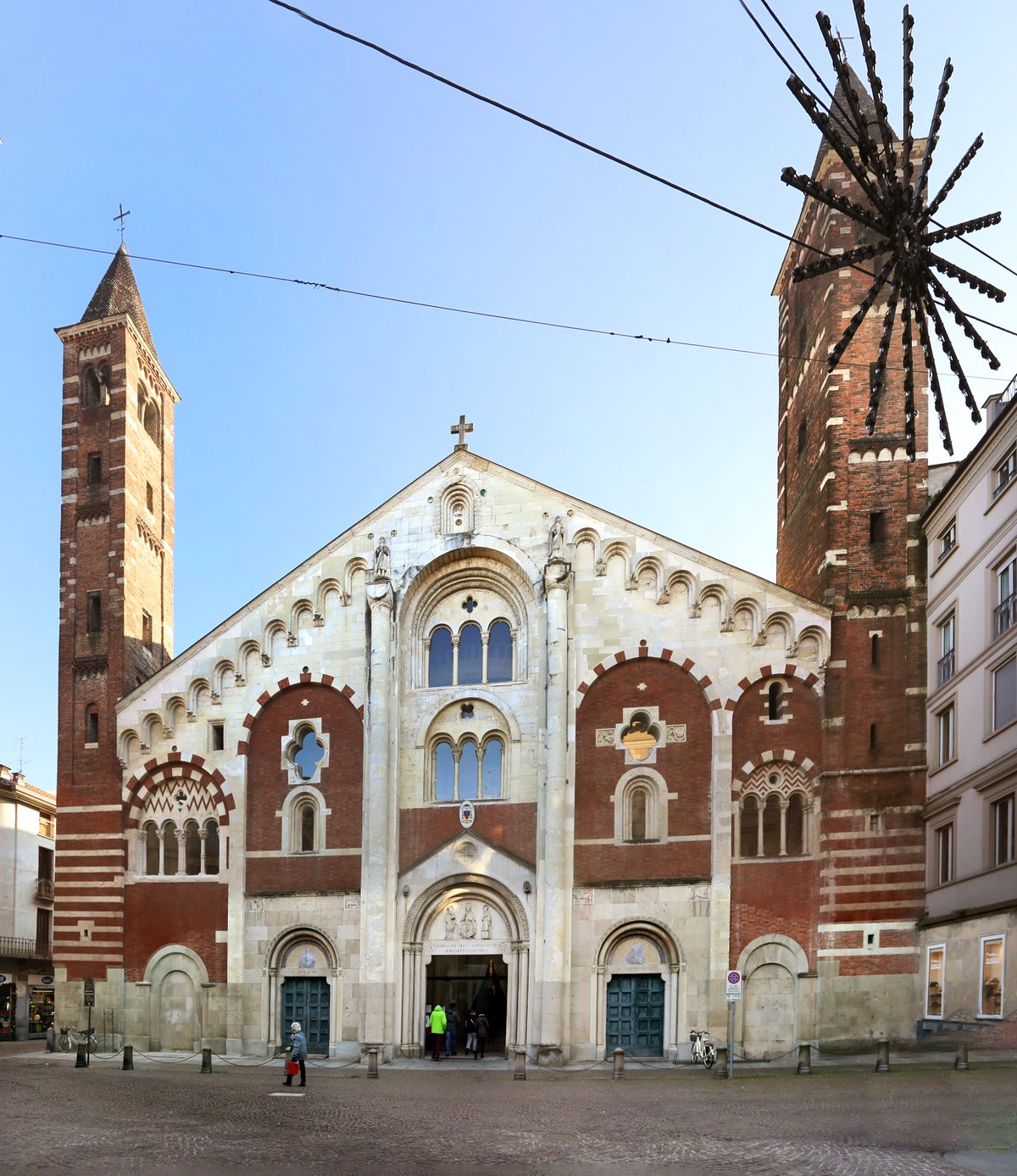
The Cathedral of Sant’Evasio and San Lorenzo is Casale Monferrato’s oldest monument and one of the finest examples of Lombard Romanesque architecture in Piedmont. You see it as you arrive from Largo Angrisani: an asymmetrical gabled façade, two bell towers flanking it, and an entrance that promises something different. Once through the door, the 12th-century narthex welcomes you with a nine-compartment vault: it is unique in Italy, with echoes of Armenian and Islamic architecture. Inside, the five narrow naves retain their 12th-century layout, while the elliptical Baroque Chapel of Sant’Evasio shifts the mood entirely. This is not a cathedral to see only in passing: the museum, the sacristy and the roof-space route are worth taking time for. What struck me was the contrast between the Romanesque solidity and the polychrome marbles of the chapel. Step-free access, with no architectural barriers.
Historical background
Its foundation dates to the first half of the 8th century: King Liutprand enlarged a church dedicated to San Lorenzo and rededicated it to Sant’Evasio. First documented mention: 974. Consecration: 1107–1108. In 1159 Frederick I confirmed the canonry’s properties and rights; the destruction of Casale in 1215 led to the theft of the relics, which were returned in 1403 by Facino Cane. In 1474 the church became a cathedral with the new diocese. The Chapel of Sant’Evasio was redesigned by Benedetto Alfieri in 1764 and completed in 1808. Its present appearance owes much to the restoration by Edoardo Arborio Mella (1857–1861), who cleared the facade of the canons’ houses.
- 8th century: Liutprand enlarges San Lorenzo
- 974: first mention
- 1107–1108: consecration
- 1215: destruction and relics stolen
- 1403: relics returned
- 1474: cathedral
- 1764: Chapel of Sant’Evasio
- 1857–1861: Mella restoration
The Narthex: An Entrance Without Equal in Italy
The narthex is perhaps the most surprising part. It is a rectangular room from the 12th century, built over the old cemetery, with a powerful vault divided into nine compartments by four stone arch ribs. The structure is unique in Italy and shows similarities with Armenian and Islamic architecture: it does not feel like the atrium of just any church; it seems almost a space in its own right. Outside, the gabled façade is framed by triple-ring hanging arches and by two spired bell towers of different heights; the two-tone stone and brick is especially noticeable in raking light. The façade we see today is, however, largely the result of Edoardo Arborio Mella’s restoration between 1859 and 1861, which removed the adjoining canons’ houses and freed the large supporting arches. I like to look at it before going in: the narthex is already a taste of what is to come, but it is also the reason this cathedral does not resemble the others.
Five naves, the octagonal lantern and the Baroque ellipse
Inside, the cathedral retains its 12th-century Romanesque layout: five narrow naves, cruciform pillars and ribbed groin vaults. At the centre rises a vaulted octagonal lantern, flanked by a pseudo-transept; the presbytery area is raised by five steps and enclosed by a balustrade. The view changes when you reach the Chapel of Sant’Evasio in the right transept: it is elliptical, Baroque, rich in polychrome marble and designed by Benedetto Alfieri. Here the saint’s relics are kept in a silver and crystal urn behind the altar; the chapel was completed in 1808. Also worth noting are the wooden crucifix covered in silver leaf, of Romanesque school, and the apse vault frescoed by Costantino Sereno with angels, saints and Christ blessing. It is an interior that surprises through contrasts: sober and monumental, then suddenly theatrical.
Museum, sacristy and attics: the cathedral from above
The cathedral museum opened in 2003 in the rooms of the monumental complex and unfolds across eight halls, with works from the 4th to the 21st century. It begins in the ambulatory, a corridor dating from around 1670, with sandstone statues, a bas-relief of the Crucifixion and fragments of 12th-century mosaics. The monumental sacristy, consecrated in 1642 and enlarged in 1788, houses Cardinal Teodoro Paleologo’s processional cross and an altar with statues and bas-reliefs. In the bell tower is the Treasury, with Gaudenzio Ferrari’s Baptism of Christ and reliquaries. The real bonus is the attics: since 2013, a metal walkway suspended over the vaults allows visitors to observe corbel arches, two-light windows and medieval structures, all the way to the matronea of the atrium. Guided tours are held on the second Sunday of the month, with a fee of €5 for adults and €4 for under-12s and over-60s. The museum is closed in January, February and August.
Why visit it
Three concrete reasons. First: the nine-bay narthex, unique in Italy and with Armenian and Islamic influences, is worth the trip on its own. Second: within a few metres you move from the Romanesque of the five naves to the Baroque of the Chapel of Sant’Evasio, with polychrome marbles and silver relics; it is a contrast you only understand once you step inside. Third: the museum and the attic route add a vertical visit, among mosaics, goldsmithing, textiles and walkways suspended over the vaults. What is more, access is level, with no architectural barriers, and the entrance is from Largo Monsignor Giuseppe Angrisani. Do not expect a church isolated in the middle of nowhere: it is in the centre of Casale Monferrato, so it combines well with an urban walk. If you are short on time, do not skip the narthex and the chapel; if you have more, book the attics.
When to Go
The two-tone façade gains a great deal from raking light: a weekday morning is best, when the city is quiet and services do not interfere with your visit. Late afternoon has a warmer atmosphere, but always check that visits are not suspended during celebrations. Avoid the middle hours of the busiest Sundays if you want to move calmly through the nave. A mild mid-season day is perhaps ideal: neither cold enough to make you retreat at once nor hot enough to send you looking only for shade. If you can, choose a day when the museum and attic tours are scheduled to open: it makes a big difference to how you read the cathedral. And don’t plan everything to the minute: the beauty here is in stopping beneath the narthex and looking up.
Nearby
While staying in the city, a natural detour is the Castello dei Paleologi, which tells the story of Casale’s medieval and aristocratic past; it is an easy way to complete the picture after the cathedral. If you have time and want a change of pace, head to the Sacro Monte di Crea, a UNESCO World Heritage Site: chapels set among greenery and views over the Monferrato hills that convey the character of the area. These are not places to squeeze in hurriedly, but to keep as an extension of your visit. The Sacro Monte in particular has an intimate atmosphere that pairs well with the narthex and relics of Saint Evasius. Back in the city, if you still have energy, a stroll through the historic centre among palazzi and squares is a fine way to end the day.