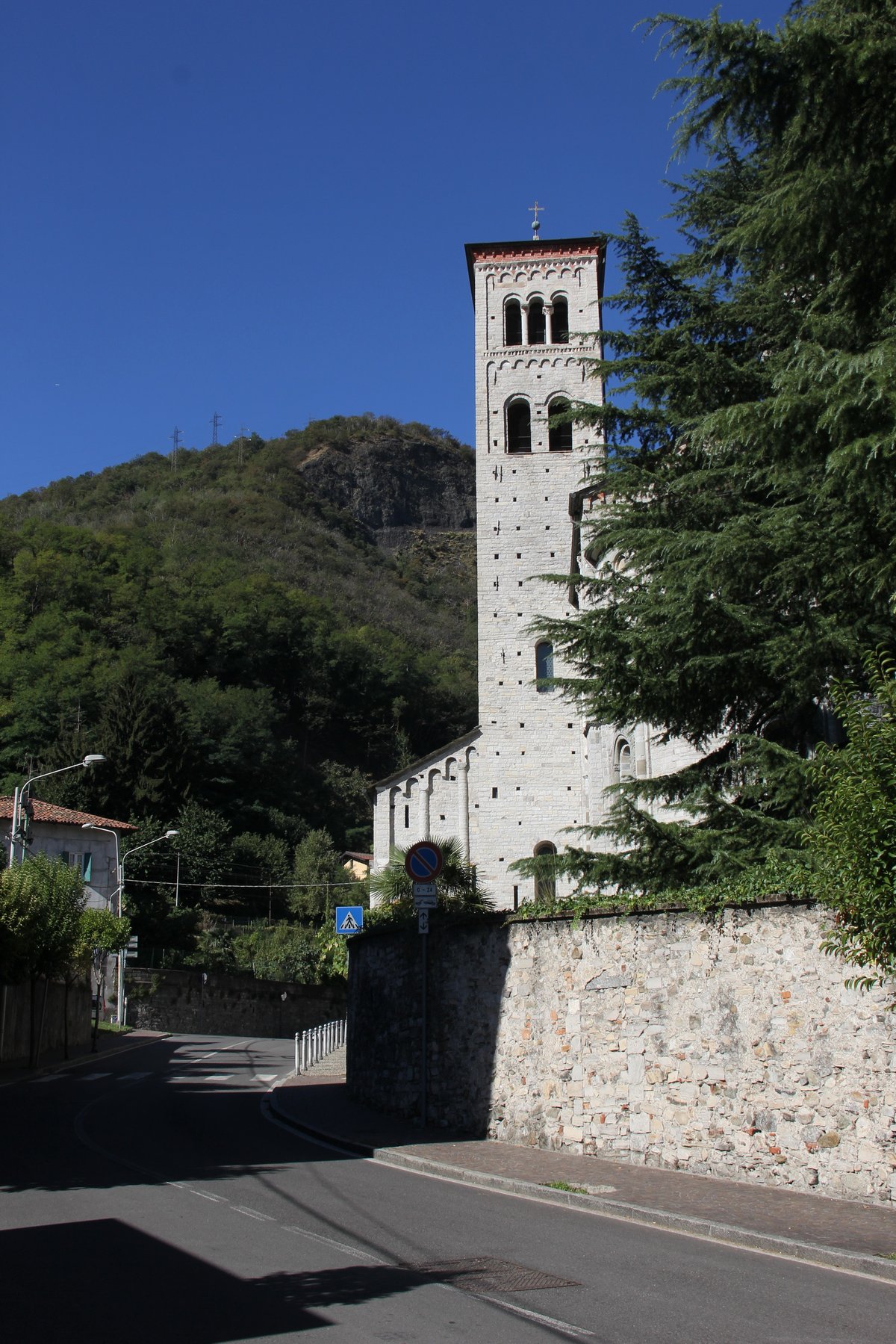
The Basilica di Sant’Abbondio is one of the oldest Romanesque churches on Lake Como, built in grey Moltrasio stone between 1050 and 1085 over a 5th-century early Christian basilica and consecrated in 1095 by Pope Urban II. It served as the city’s cathedral until 1013 and stands out for its five naves, two twin bell towers with Rhenish influence, and its cycle of 14th-century frescoes. It lies just outside the centre, along Via Regina Teodolinda, and is visited together with the Benedictine monastery that today houses the University of Insubria.
– Austere facade with four half-columns, the remains of a lost portico
– Two twin bell towers, a rare solution in Italy
– Apse frescoed with twenty scenes from the life of Christ
– Tombs of the bishops of Como and the statue of Sant’Abbondio by Rodari
Basilica of Sant’Abbondio: A Romanesque Masterpiece in Como
The Basilica of Sant’Abbondio is one of those surprises that Como keeps outside the city centre, beyond the Cosia and the ancient walls. You arrive and immediately understand that this is no ordinary church: the austere façade in grey Moltrasio stone, the twin bell towers framing the apse, the slender profile that seems to look toward the Alps and Romanesque Europe. Inside, the five naves envelop you with granite pillars and columns, capitals each different from the next, and light that changes from hour to hour. Then you look up toward the apse and find the cycle by the Master of Sant’Abbondio: twenty scenes from the life of Christ, the Deesis, the starry sky painted with lapis lazuli powder. Outside, the monastery cloister now houses the University of Insubria: a rare way of bringing together prayer, study and memory. It is a place to visit slowly, perhaps alone, to feel how essential and powerful Como’s Romanesque architecture can be.
Historical Notes
Here, history begins in the 5th century, when Amanzio, third bishop of Como, built an Early Christian basilica dedicated to Saints Peter and Paul, to house relics that had arrived from Rome. In 818, the church became a cathedral and was dedicated to Sant’Abbondio, fourth bishop of Como, who had been buried four centuries earlier. It remained an episcopal see until 1013, then passed to the Benedictine monks. In 1010, the community began its reconstruction: the Early Christian structure was demolished and, between 1050 and 1095, the present Romanesque basilica was built. The consecration took place on June 3, 1095, with Pope Urban II passing through on his way to Clermont-Ferrand. In the following centuries, there were alterations, particularly in the 16th century; in 1863, Serafino Balestra restored the building to its Romanesque forms. In the 20th century, restorations were added, along with a new altar consecrated by Bishop Alessandro Macchi. Timeline: 5th century Early Christian basilica; 818 cathedral and dedication to Sant’Abbondio; 1010-1095 Romanesque reconstruction; June 3, 1095 consecration; 1013 end of episcopal see; 1863 Balestra restoration; 2003 latest intervention.
Two Bell Towers and a Facade Facing North
The exterior is what stays with you. The basilica is built of grey Moltrasio stone, with a plain facade divided into five sections by pilasters that mirror the five internal naves. Four half-columns recall a portico that has since disappeared, added between the 12th and 14th centuries and later removed. The portal has refined bas-reliefs: two corner eagles with spread wings, a dove, a feline head, and plant motifs. But its most original feature is the pair of twin bell towers framing the central apse: a common solution in the Rhineland, exceptional in Italy. The towers are lightened by two- and three-light windows, with zoomorphic, floral, and geometric decorations. The southern tower is original; the northern one is the result of rebuilding after a collapse in 1784 and a faithful reconstruction. Along the south side, single-light windows and small arches are visible, with blocks of Moltrasio stone and tuff creating a two-tone effect. The semi-cylindrical apse is lined with columns and small arches.
The Master of Sant’Abbondio and the Color of the Trecento
Inside, the surprise is the painted cycle of the presbytery and apse. Its author is an anonymous Master of Sant’Abbondio, active between 1315 and 1324, during the episcopate of Leone Lambertenghi. The narrative begins on the triumphal arch with the Annunciation and saints; in the vault of the first bay there remain traces of a starry sky and four thrones for the Doctors of the Church. On the apse arch is Christ blessing between two archangels, with eight roundels of Patriarchs, Prophets and saints. The apse conch features a Deesis, Christ between Mary and John the Baptist, with Saint Peter and Saint Paul. On the apse wall, divided into five bands, run twenty episodes from the life of Jesus: the Nativity above, the Passion below, then the Crucifixion, Apostles and Tetramorph. The style combines a calm rhythm and naturalistic attention to details of clothing. The vault of the choir has a starry sky painted with lapis lazuli powder. Lombard motifs and Tuscan influences blend, offering an insight into the customs of the time.
Five naves, bishops’ tombs and the Insubria cloister
The interior has five naves, with massive pillars and granite columns, a narthex supported by large pillars and capitals that move from cubic to Corinthian forms, with free decorations. Along the central nave are the tomb monuments of the bishops of Como, including that of Cardinal Angelo Maria Durini (1725-1796); the basilica has a funerary vocation and also houses the tombs of Felice Bonomini and Teresio Ferraroni. Beneath the high altar are preserved the relics of the patron saint. Beside the altar is a statue of Saint Abbondio attributed to Tommaso Rodari, late 15th century, restored in 2021. At the sides of the portal are two 17th-century canvases: the Assumption of Mary by Giovan Battista Crespi, known as il Cerano, and Saint Abbondio with a Child by Giovan Battista Recchi. Adjacent is the monastery with cloister, once the diocesan seminary and today the seat of the University of Insubria, with the faculties of Law, Tourism Sciences and Linguistic Mediation.
Why You Should Visit
First reason: it is one of the masterpieces of European Romanesque architecture in Lombardy, with a five-aisled plan and twin bell towers that you won’t easily find elsewhere in Italy. Second: the cycle by the Master of Sant’Abbondio is an uncrowded treasure, to be viewed calmly, without queues and with light that makes it feel almost private. Third: the complex brings together a church, a monastery, and the University of Insubria, so a visit works on two levels, spiritual and cultural. What’s more, it is easy to reach from Como but remains off the main tourist circuit: you can give it real time, sit in an aisle, study the capitals, and then stroll through the cloister. If you happen to be there on 31 August for the Feast of Sant’Abbondio, you’ll find religious events and a livestock fair with food and wine stalls. It is a perfect stop for lovers of Romanesque art, 14th-century painting, and places that don’t shout.
When to Go
There’s no need for a particular season: the basilica lives year-round. For me, the best time is early morning, when the gray Moltrasio stone is lit by low light and the interior is still silent. Or in the late afternoon, with the sun coming in at an angle and bringing out the frescoes by the Master of Sant’Abbondio. In autumn, with Lake Como nearby, the atmosphere is even more intimate. If you want a festive moment, on August 31 for Sant’Abbondio the area comes alive with religious events and a livestock fair. In winter, if you find the basilica empty, the starry ceiling of the choir and the lapis lazuli take on an almost nocturnal tone. Avoid the middle hours of festive Sundays if you seek quiet, but if you’re interested in the local community, that’s the right time.
Around the area
The basilica stands outside the ancient city walls, along Via Regina, the old hillside road on the western shore of Lake Como. From here you can combine your visit with a walk toward central Como, following the course of the Cosia river and then entering the walled city. Another idea is to spend time in the cloister and complex of the University of Insubria, which are part of the same monastery: an unusual stop, somewhere between archaeology and student life. If you are interested in Romanesque art, there are other examples around Como, but Sant’Abbondio remains the ideal starting point. For those who love villages and the lake, Via Regina is also a good excuse to explore the western shore away from the most popular routes. In the same complex, don’t miss the small church of Saints Cosmas and Damian, with fourteenth-century frescoes and a cycle from the early sixteenth century.