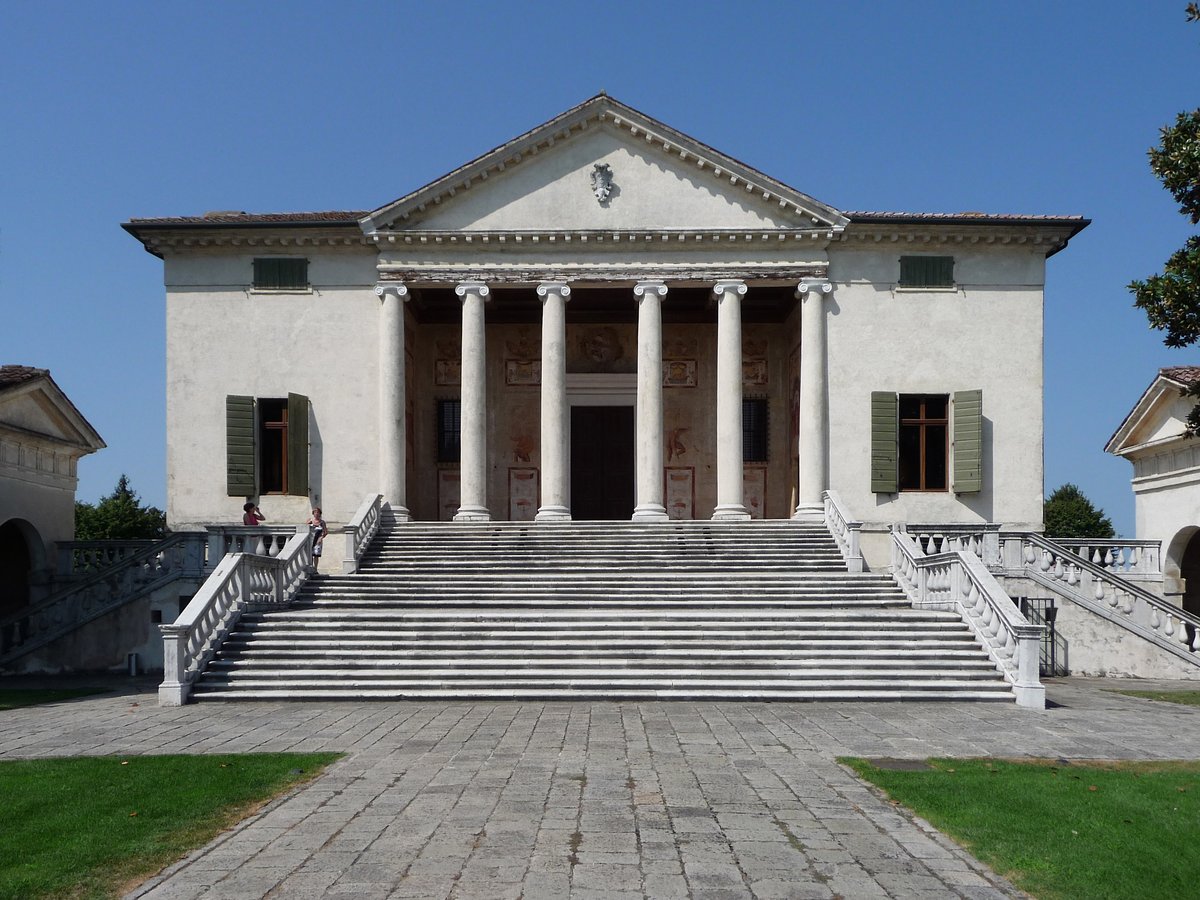
Villa Badoer, designed by Andrea Palladio in 1556 for Francesco Badoer, is a Renaissance gem in the heart of the Polesine. Declared a UNESCO World Heritage Site in 1996, the villa stands out for its unique curved barchesse and frescoes by Giallo Fiorentino. Today it houses the National Archaeological Museum with Bronze Age artifacts.
Highlights:
– Palladian architecture: facade with Ionic pronaos, monumental staircase, and semicircular barchesse.
– Renaissance frescoes: mythological scenes and grotesques by Giallo Fiorentino.
– Archaeological Museum: in the north barchessa, with artifacts from the Frattesina village.
– Guided tours: every Saturday and Sunday at 11:00 AM and 4:00 PM.
Introduction
You arrive in Fratta Polesine and find yourself in front of one of the most iconic villas in Veneto. Villa Badoer, nicknamed ‘la Badoera’, stands on a stone base, dominating the landscape with its façade that recalls a Greek temple. The Ionic colonnade, the triangular pediment, and the curved barchesse opening like welcoming arms immediately make you feel Palladio’s genius. It is a place where architecture and nature dialogue perfectly, with a canal that was once navigable separating the garden from the town. Entering here is like stepping back into the Renaissance, among frescoes and stories of Venetian nobles.
Historical Notes
Villa Badoer was designed by Andrea Palladio around 1554–1555 for the Venetian nobleman Francesco Badoer and completed by 1556. It stands on the site of an ancient medieval castle, whose base was reused to protect the villa from floods. The villa appears in the ‘Four Books on Architecture’ from 1570. In the 18th century, the barchesse were extended into a semicircle, and the Moncenigo coat of arms replaced that of the Badoer family. Since 1996, it has been part of the UNESCO World Heritage Sites. Today it is owned by the Province of Rovigo and hosts cultural events, exhibitions, and the National Archaeological Museum.
Unique Architecture: The Curvilinear Barchesse
The most striking feature of Villa Badoer is the semicircular barchesse on the sides, a unique element among Palladian villas. Palladio designed them inspired by the exedrae of Roman temples, with Tuscan columns creating a welcoming effect. These curved wings border the lawn in front and connect to the central body via a scenic three-flight staircase. The main façade is dominated by an Ionic pronaos and a dentiled tympanum bearing the family crest. The interior follows the typical scheme: services on the ground floor, living quarters on the piano nobile, and a granary in the attic. Every detail, from proportions to light, is designed to astonish.
Frescoes and Archaeological Museum
The piano nobile and the pronaos are decorated with frescoes by Giallo Fiorentino, a late 16th-century painter who depicted mythological, pastoral, and grotesque scenes. The vivid colors and symbolic details tell stories linked to the territory and the Badoer family. Don’t miss the northern barchessa: it houses the National Archaeological Museum of Fratta Polesine, with Bronze Age artifacts from the nearby village of Frattesina (12th-10th century BC). Here you’ll find tools for working amber, bone, and metals, as well as a multimedia reconstruction of funeral rites. It’s a dive into the prehistory of the Polesine area, unexpected and fascinating.
Why Visit It
First: it’s the only Palladian villa in the entire Polesine region, and the curved barchesse are an architectural masterpiece you won’t find anywhere else. Second: the ticket costs just €5, and with the FrattaCard (€12) you can also visit the Archaeological Museum and the Casa Museo Matteotti. Third: the frescoes of Giallo Fiorentino are a little-known gem of Venetian Renaissance art. In short, it’s a place that combines art, history, and archaeology in a single visit, without the tourist crowds.
When to Visit
The best time is late spring or early autumn, when the weather is mild and the afternoon light illuminates the white façade, making the green lawn and the barchesse stand out. If you can, choose a Saturday morning: arrive early, enjoy the villa almost to yourself, then join the guided tour at 11:00 AM. The front and rear park are perfect for a relaxing walk. Avoid Easter weekend or long weekends, because Fratta Polesine is small and parking is limited.
Nearby
Just a few kilometers away, don’t miss Badia Polesine, an ancient river town with its abbey and the boat bridge over the Canale Bianco. Or, for a nature escape, visit Sacca degli Scardovari in the Po Delta, where you can take boat excursions among fishing valleys and flamingos. If you love villas, in Fratta itself you’ll find Villa Molin-Avezzù and the Casa Museo Giacomo Matteotti, both included in the FrattaCard. A perfect itinerary for a day of culture and landscape.