
The Remains of Ponte Apollosa offer an authentic Roman archaeology experience in Samnium, away from tourist crowds. The limestone arches, built in the 1st century AD for the Via Appia Traiana, blend with the natural landscape along the Calore River.
- 1st-century AD Roman arches with perfectly squared limestone blocks
- Opus quadratum construction technique still visible in the surviving structures
- Evocative natural setting along the Calore River with riparian vegetation
- Authentic and tranquil location ideal for photography and relaxing walks
Events nearby


1st-century AD Roman stone arches along the Calore River, perfect for peaceful walks and evocative photography. Discover the opus quadratum construction technique and the natural setting of the Vitulanese Valley.
- Via Taverna, Benevento (BN)
- Open in Google Maps
- View on Google Images Resti di Ponte Apollosa a Benevento
Good to know
Introduction
The Remains of Ponte Apollosa emerge as an indelible imprint of history along the banks of the Calore River. Don’t expect an intact bridge, but rather a fragment of archaeology that speaks of distant eras. The partially preserved stone arches stand out against the rural landscape of the Vitulanese Valley, creating a powerful contrast between ancient and modern. Walking here means feeling the weight of centuries beneath your feet, while water flows slowly at the base of the Roman structures. It’s a place that doesn’t reveal its full majesty at once, but unveils its essence to those who know how to observe with patience.
Historical Overview
The Roman bridge of Apollosa dates back to the 1st century AD, built to facilitate travel along the Via Appia Traiana which connected Benevento to Brindisi. It served as a crucial crossing over the Calore Irpino River, facilitating trade and military movements. During the Middle Ages, it was partially damaged by floods and earthquakes, but some arches continued to be used until the 18th century. Today it represents one of the most significant archaeological testimonies of the Benevento Sannio region, studied for its Roman construction techniques in opus quadratum.
- 1st century AD: Construction of the Roman bridge
- Middle Ages: Damage and partial abandonment
- 18th century: Last documented uses
- Today: Protected archaeological site
Surviving Architecture
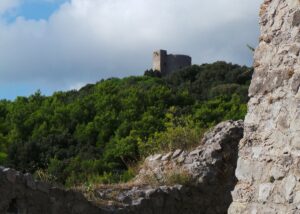
What stands out about the remains is the Roman construction technique still visible in the few remaining arches. The blocks of local limestone, perfectly squared, interlock without mortar, demonstrating the engineering mastery of the era. The main arch, about 4 meters high, still preserves its original impost, while the bridge abutments show the holes from the scaffolding used during construction. Looking closely, you can see the signs of river erosion on the base stones, silent witnesses to the Calore River floods that have shaped this place for centuries.
The Naturalistic Context
The bridge remains should not be observed in isolation, but in their dialogue with the surrounding environment. Here, the Calore River forms a tranquil bend, where riparian vegetation creates a habitat for herons and kingfishers. In the spring months, the riverbanks are colored with yellow irises and water mint, while Lombardy poplars form a natural backdrop to the ancient stones. It is precisely this balance between archaeology and nature that makes the site particularly evocative, offering unique photographic perspectives especially at dawn, when the raking light illuminates the textures of the Roman stone.
Why Visit
Visiting the Remains of Ponte Apollosa means touching Roman history in Samnium with your own hands without having to face crowds of tourists. It’s an authentic place where archaeology blends with the rural landscape. For photographers, it offers suggestive angles all year round, with light plays that change with the seasons. Moreover, it represents an ideal stop for those who want to discover a lesser-known Italy, away from the more beaten paths, but equally rich in important historical testimonies.
When to Go
The best time to visit is in the early morning hours, when the grazing light enhances the textures of the Roman stone and the Calore River reflects the colors of dawn. In the autumn months, with the first mists enveloping the valley, the site takes on a particularly evocative atmosphere, while in spring the lush vegetation creates a vibrant contrast with the ancient structure.
In the Surroundings
Complete your experience with a visit to the Sannio Museum in Benevento, which houses Roman artifacts from the area, including inscriptions mentioning the ancient road system. A few kilometers away, the Borgo di Montesarchio offers a fascinating medieval castle with panoramic views over the Caudina Valley, perfect for understanding the territorial context in which the Roman bridge was situated.
Itineraries nearby

💡 Did You Know…?
According to local research, the bridge was part of the ancient Via Appia Traiana and served to connect Benevento with the inland areas of Sannio. The remains still show Roman construction techniques, with perfectly squared blocks of local limestone. The location along the Calore River makes the site particularly evocative at sunset, when the golden light illuminates the ancient stones.