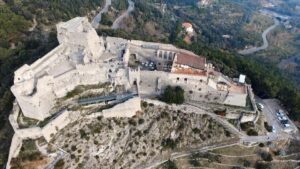
Discover the most fascinating Avellino villages castles itinerary in Irpinia! In 3 days, I'll take you through perfectly preserved Norman castles and medieval villages, from Caudina Valley to Upper Irpinia. We'll visit Ariano Irpino with its imposing Norman castle, the medieval village of Gesualdo dominated by the Carafa castle, and Zungoli, one of Italy's Most Beautiful Villages. You'll discover where to taste Irpinia's DOC cheeses and Aglianico wines in historic cellars. An authentic journey away from mass tourism, perfect for those seeking history, great food, and breathtaking landscapes.
🗺️ Your trip at a glance
Three days among perfectly preserved Norman castles and medieval villages of Irpinia, from the Caudina Valley to Upper Irpinia. An authentic route away from mass tourism, with historical stops and captivating landscapes.
- Ideal for travelers seeking authentic medieval history and Norman architecture in less-traveled places.
- Highlights: 9 stops in 3 days among 11th-century castles, a Roman amphitheatre, and unique sites like La Mefite.
- Perfect for those who appreciate Irpinian landscapes, intact medieval structures, and desire a structured itinerary with maps.
Itinerary stops
Day 1 - Stop no. 1
Pignatelli della Leonessa Castle
 The Pignatelli della Leonessa Castle in San Martino Valle Caudina marks the perfect beginning of our Irpinian itinerary. This 11th-century Norman fortress stands imposingly on a hill that dominates the entire valley, offering a unique perspective on the territory. The structure preserves original architectural elements such as the cylindrical towers and perimeter walls, witnesses to the defensive function it served during Saracen invasions. Today the castle, privately owned but visitable on special occasions, represents an exceptional example of medieval military architecture perfectly integrated into the Caudino landscape. Its strategic position along the ancient Via Appia Traiana explains its historical importance in controlling traffic between Benevento and Avellino.
- Via Pignatelli Della Leonessa, San Martino Valle Caudina (AV)
- https://www.museodeicastelli.it/castelli/san-martino-valle-caudina-castello-pignatelli-della-leonessa/
- Open in Google Maps
- View on Google Images

You should go if...
Day 1 - Stop no. 2
Roman Amphitheatre of Avella
 The Roman Amphitheatre of Avella, located on Via Madonna del Carmine, represents one of the most significant testimonies of the Roman era in Irpinia. Built in the 1st century AD, this monument could accommodate up to 10,000 spectators for gladiatorial games and wild beast hunts. The structure, built in opus reticulatum and brickwork, preserves parts of the seating tiers, the arena, and the underground chambers. The amphitheatre integrates perfectly into Avella's urban landscape, offering an immediate vision of how Roman antiquity shaped the territory. Visitors can observe the remains of the vomitoria and service corridors, elements that demonstrate the advanced engineering of the era. The strategic location along the ancient Appian Way underscores its importance as a social and cultural gathering centre in the Caudina Valley.
- Via Madonna del Carmine, Avella (AV)
- Open in Google Maps
- View on Google Images
You should go if...
Day 1 - Stop no. 3
Remains of Ponte Tufaro
 Leaving behind the grandeur of Avella's Roman amphitheater, the journey to the Remains of Ponte Tufaro marks a change of scenery in the Caudina Valley. This medieval bridge, located in Tufara Valle along the ancient route, preserves the local stone architecture typical of the Norman era. The partially collapsed structure still displays the pointed arches and construction techniques of the 12th century, when it served as a strategic connection between the Irpinian villages. The isolated location among wooded hills enhances the timeless atmosphere, offering unique photographic perspectives. Visitors can closely observe the materials used and imagine the passage of pilgrims and merchants who traveled these routes.
- Ponte Tufaro, Tufara Valle (AV)
- http://www.s-line.de/homepages/cv/rom/01IT/F/F01IT228.HTM
- Open in Google Maps
- View on Google Images
You should go if...
Day 2 - Stop no. 1
Gesualdo Castle
 The second day of the "Irpinia's Villages and Castles" itinerary begins with Gesualdo Castle, located in Piazza Umberto I. This 11th-century Norman manor preserves intact its cylindrical towers and crenellated walls that characterize the military architecture of the period. The structure, built on a previous Lombard settlement, dominates the entire town of Gesualdo from its strategic position. Inside, visitors can admire the noble halls with cross-vaulted ceilings and the prisons carved into the rock. The castle is linked to the figure of Prince Carlo Gesualdo, the famous Renaissance composer who lived here and composed some of his most renowned works. The visit allows for an understanding of the evolution of defensive techniques from the Norman era to the Renaissance.
- Go to the page: Gesualdo Castle: Frescoed Halls, Dungeons, and Prince Carlo's Madrigals
- Piazza Umberto I, Gesualdo (AV)
- Open in Google Maps
- View on Google Images
You should go if...
Day 2 - Stop no. 2
Monumental Fountain
 The Monumental Fountain of Torella dei Lombardi, located on Via Giovanni Palatucci, represents a significant example of eighteenth-century public architecture in Irpinia. Built in 1765 at the behest of the local feudal lord, this structure made of local stone features three superimposed basins with zoomorphic masks that drip fresh spring water. The most distinctive element is the broken pediment crown that houses the coat of arms of the owning family. The fountain was not only a water supply point for the community but also a place of socialization where women gathered to do laundry and travelers refreshed themselves while transporting goods along ancient trade routes. Its strategic location in the town center still makes it a visual and functional landmark today.
- Via Giovanni Palatucci, Torella dei Lombardi (AV)
- Open in Google Maps
- View on Google Images
You should go if...
Day 2 - Stop no. 3
Candriano Castle
 Candriano Castle rises imposingly on a rocky spur along Via Camillo Ruspoli, dominating the landscape of Torella dei Lombardi. Built in the 11th century by the Normans as a defensive outpost, the structure still features the characteristic square towers typical of Norman military architecture and walls over two meters thick. Over the centuries, it has undergone significant transformations, evolving from fortress to noble residence under the Candriano family's rule. Particularly noteworthy is the internal family chapel, dedicated to Saint Michael the Archangel, which preserves 14th-century frescoes from the Giotto school. The castle offers exceptional views of the Ofanto Valley and the Irpinian Apennines, allowing visitors to understand the strategic importance of this site in controlling communication routes between Campania and Puglia.
- Via Camillo Ruspoli, Torella dei Lombardi (AV)
- Open in Google Maps
- View on Google Images
You should go if...
Day 3 - Stop no. 1
Rocca San Felice Castle
 The third day of the 'Irpinia Villages and Castles' itinerary begins with Rocca San Felice Castle, located on Via Ospedale. This 11th-century Norman fortress stands on a rocky spur offering exceptional views of the Ansanto Valley and the natural phenomenon of the Mefite, a unique area of sulfur gas emissions in Italy. The structure preserves distinctive architectural elements such as the cylindrical towers added during the Angevin period and perimeter walls that follow the natural contours of the rock. Unlike Candriano Castle visited the previous day, here one observes the evolution from military outpost to feudal residence, with interior spaces showing traces of 14th-century frescoes. The strategic position allowed control of transit routes between inner Irpinia and Apulia.
- Via Ospedale, Rocca San Felice (AV)
- Open in Google Maps
- View on Google Images
You should go if...
Day 3 - Stop no. 2
The Mephitis
 The Mephitis of Rocca San Felice represents one of the most singular natural phenomena in Irpinia, where the ground constantly emits carbon dioxide and sulfur vapors that create an almost lunar atmosphere. This site, located along the Road of the Mephitis, has been for centuries an object of worship and fear, associated in mythology with the goddess Mephitis who presided over poisonous exhalations. Today it appears as a vast depression with yellowish soil, devoid of vegetation, where gases concentrate at ground level making the area inhospitable for most life forms. Access is free and unrestricted, but it's advisable to visit during the central hours of the day when ventilation is greater. The contrast between this desolate landscape and the surrounding green woods of Alta Irpinia creates an effect of extraordinary visual impact.
- Go to the page: The Mefite of Rocca San Felice: Sulfurous Ponds and Volcanic Vapors in Irpinia
- Strada delle Mefite, Rocca San Felice (AV)
- Open in Google Maps
- View on Google Images
You should go if...
Day 3 - Stop no. 3
Goleto Abbey
 Goleto Abbey, located in Sant'Angelo dei Lombardi along Via San Guglielmo, represents one of the most significant examples of medieval monastic architecture in Irpinia. Founded in 1133 by Saint William of Vercelli, the complex develops on multiple levels with the Febronia Tower dominating the panorama of Upper Irpinia. The structures preserve Romanesque and Gothic elements, including the lower church with fourteenth-century frescoes and the thirteenth-century cloister. Abandoned after the Napoleonic suppressions, it is now managed by the Community of the Little Brothers of Jesus Caritas, who oversee its maintenance and visits. Access is permitted during established hours with a voluntary contribution, offering an experience of silence and contemplation away from the main tourist flows.
- Via San Guglielmo, Sant'Angelo dei Lombardi (AV)
- Open in Google Maps
- View on Google Images
You should go if...