
Vignola Fortress, a 10th-century stronghold converted into a residence in the 15th century, offers a journey through time between military architecture and Renaissance art. The frescoed halls and panoramic towers tell stories of power and culture, while its location in the historic center allows visitors to combine the tour with local traditions.
- Frescoed halls on the noble floor with Renaissance painting cycles
- Towers like the Torre di Nonantola offering 360° views over the Panaro Valley
- Inner courtyards and quadrangular layout with corner towers
- Located in the heart of Vignola, near Lambrusco wineries and cherry orchards
Events nearby

A medieval fortress transformed into a noble residence with frescoed halls, panoramic towers, and courtyards. Discover the history of the Contrari family, admire the painting cycles, and enjoy the view over the Panaro Valley.
- https://www.roccadivignola.it/
- Piazza dei Contrari 4, Modena (MO)
- Open in Google Maps
- View on Google Images Rocca di Vignola a Modena
Good to know
Introduction
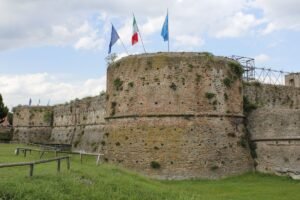
As soon as you arrive in Vignola, the Rocca immediately strikes you: an imposing medieval fortress that dominates the historic center with its crenellated towers and massive walls. It’s not just a monument, but a true symbol of the city, visible from afar as you approach along the Panaro valley. Its quadrangular structure with corner towers immediately gives you a sense of the military power it represented. The view from the top of the towers is spectacular: it embraces the entire town and the Modenese countryside, with cherry trees in bloom in spring creating a poetic contrast with the severity of the stone. Entering the inner courtyard, the atmosphere changes: here you breathe history, but also the Renaissance elegance that has been superimposed on the original defensive function.
Historical Overview
The Rocca di Vignola has a history dating back to the 11th century, when it began as a simple fortification controlling the communication route along the Panaro River. Its peak of splendour arrived with the Contrari family in the 15th century, who transformed it into a noble residence enriched with fresco cycles. It then passed to the Este family in the 16th century, becoming part of the Duchy of Modena. During the Napoleonic period it underwent transformations, until the 20th-century restoration that returned it to the public. Today it is owned by the Vignola Foundation and completely open to visitors.
- 11th century: first fortifications
- 15th century: transformation into Contrari residence
- 16th century: transfer to the Este family
- 20th century: restoration and opening to the public
The Renaissance Frescoes
One of the Rocca’s most delightful surprises are the frescoed halls on the noble floor, where the painting cycles commissioned by the Contrari family transport you directly into the Emilian Renaissance. In the Hall of Lions, heraldic animals blend with geometric decorations of rare elegance, while in the Hall of Doves, floral motifs and family symbols create a harmonious ensemble. These spaces, once private, reveal how the fortress also served as a place of representation and courtly life. The quality of the frescoes, well-preserved despite the centuries, testifies to Vignola’s artistic importance in the regional context, often underestimated compared to more famous centers like Modena or Bologna.
The Towers and Defenses
Climbing the towers of the Rocca is an experience that immediately makes you understand the strategic function of this fortress. The Nonantola Tower, the tallest one, offers a 360-degree view over the Panaro Valley and the first hills of the Apennines. From the arrow slits and murder holes, you can grasp the defensive system, while the patrol walkways allow you to ideally follow the path of the guards. The structure clearly shows the evolution of military techniques: from primitive medieval defenses to subsequent adaptations to withstand new firearms. Each tower has different characteristics; studying these differences is like reading a living manual of fortified architecture.
Why Visit It
Three concrete reasons not to miss the Rocca: first, total accessibility – you can freely explore courtyards, halls, and towers without fixed routes. Second, the unique combination of military and residential function that shows you two sides of Emilian history in a single building. Third, the location in the heart of Vignola allows you to combine your visit with a stop at local pastry shops to taste the famous Barozzi cake, created right here in the late 19th century. It’s a perfect example of how a monument can be both spectacular and integrated into the daily life of the town.
When to Visit
The best time to appreciate the Rocca is on an early autumn afternoon, when the low-angled light enhances the stone volumes and the foliage of the surrounding hills creates a spectacular backdrop. During these hours, less crowded than the morning, you can leisurely enjoy the play of light streaming through the Gothic windows and illuminating the frescoes. Late April spring days are also ideal, when the area’s cherry blossoms – Vignola is the cherry capital – provide a unique chromatic contrast with the fortress’s gray stone. Avoid cherry festival weekends due to the crowds, but the period remains magical.
In the Surroundings
Complete your experience with a visit to the Vignola Cherry Museum, which tells the story and varieties of the fruit symbolizing the region, including the rare Black Durone cherry of Vignola. Just a few minutes away, the Abbey of Nonantola is also worth a stop—one of the most important monastic complexes in Emilia-Romagna, featuring its Romanesque crypt and abbey treasure. If you wish to continue exploring fortifications, Levizzano Rangone Castle, perched on the first hills, offers another well-preserved example of medieval military architecture with a different yet equally breathtaking panoramic view over the valley.
Itineraries nearby

💡 Did You Know…?
Legend has it that a treasure belonging to the Contrari family, never found, is hidden in the fortress well. In the Hall of Doves, the frescoes depict birds with golden rings around their necks, symbolizing marital fidelity. During restoration work, traces of an ancient secret passage connecting the fortress to the nearby Panaro River emerged, used for emergency escapes.