Discover Piacenza in a day with this walking itinerary through the historic center. Nine stops among elegant palaces, ancient churches, and squares steeped in history await you. Follow the map to stay on track: start at Piazza Cavalli, the city’s heart, then Palazzo Gotico, the Duomo, the Basilica of Sant’Antonino, and much more. Each stop is a dive into Emilia’s art and culture. With the downloadable map, you won’t get lost among alleys and squares. The route is flat and suitable for everyone, with stops for coffee and gelato. It also includes visits to the Museo Civico at Palazzo Farnese and the Galleria d’Arte Moderna. Get ready to fall in love with this Emilian gem. Piacenza Historic Center on Foot: a one-day itinerary perfect for those who love walking and exploring.
🗺️ Your trip at a glance
In just a few hours, this itinerary reveals the soul of Piacenza, between art and history. An easy route full of surprises.
- Ideal for: city-breakers and art and history enthusiasts.
- Highlights: nine well-distributed stops, map included, flat route.
- Perfect for: day trips and time-pressed travelers.
Itinerary stops
Stop no. 1
Palazzo Farnese: The Unfinished Palace
 First stop on our itinerary is the majestic Palazzo Farnese, symbol of the Farnese family’s power. Construction began in 1558 by order of Margaret of Austria and Duke Ottavio Farnese, designed by Jacopo Barozzi known as Vignola. But the palace was never completed: today we see only half of the ambitious project, a gigantic unfinished structure that houses the Civic Museums. Inside, don’t miss the famous Botticelli’s Tondo, the bronze Etruscan Liver, and the collection of historic carriages in the former underground kitchens. The courtyard, with its loggias and wrought iron gate decorated with lilies, hosts summer events. A visit that can take half a day: the 9 museum sections range from archaeology to the Risorgimento. Full ticket costs €10 and the first Sunday of the month only €1. The palace is closed on Mondays. We start from here to discover Piacenza!
- Via Campo della Fiera, Piacenza (PC)
- https://www.palazzofarnese.piacenza.it/it
- Open in Google Maps
- View on Google Images

You should go if…
Stop no. 2
San Sisto
 The second stop on our itinerary, the Church of San Sisto is a true treasure trove of art. Entering through the portal on Via San Sisto, you find yourself in a large sixteenth-century cloister, an oasis of tranquility. The church, rebuilt between 1499 and 1511 under the design of Piacenza architect Alessio Tramello, stands on the foundations of a female Benedictine monastery founded in 874 by Empress Engelberga. Inside, the Latin cross plan with three naves impresses with its Renaissance harmony. Here was housed the famous Raphael’s Sistine Madonna, sold in 1754 and now in Dresden: a copy (perhaps by Pier Antonio Avanzini) occupies its place above the high altar. Don’t miss the inlaid wooden choir, a masterpiece by Giovan Pietro Pambianchi and Bartolomeo Spinelli (1514-1528), with 54 richly decorated stalls. In the right transept, the funerary monument of Margaret of Austria, daughter of Charles V. Free entry, hours 8-18.
- Via Enrico Morselli, Piacenza (PC)
- Open in Google Maps
- View on Google Images
You should go if…
Stop no. 3
Basilica of Santa Maria di Campagna
 Third stop, and we enter another dimension: the Basilica of Santa Maria di Campagna welcomes you with its Greek cross plan, designed by Alessio Tramello in the 16th century to house the miraculous Madonna della Campagnola. As soon as you cross the threshold, your eyes go straight to the dome: a riot of frescoes by Pordenone and Sojaro, with Prophets, Sibyls, and God the Father seeming to rain down on you. A little further on, the Chapel of the Magi and that of Saint Catherine are entirely painted by Pordenone, who also included a self-portrait with his wife and the architect. And then there’s Guercino, Camillo Procaccini, Mochi with his statue of Ranuccio I Farnese… a stratification of art that leaves you breathless. If you’re feeling adventurous, on Saturday or Sunday at 4 or 5 PM you can climb the roughly 100 steps up to the dome: 20 meters high to enjoy the details up close (€10, reservation recommended). The basilica is open daily 7-12 and 3:30-7 PM, free entry. A place that smells of history and genius.
- Via Campagna, Piacenza (PC)
- Open in Google Maps
- View on Google Images
You should go if…
Stop no. 4
Monument to the Pontieri: Homage to the Heroes of the Po
 After the basilica, head towards the Po and you’ll find yourself facing the Monument to the Pontieri, about 16 meters high, dominating Piazzale Milano. Inaugurated on May 27, 1928 by King Vittorio Emanuele III, it was created by Veronese sculptor Mario Salazzari while he was serving in the Pontieri Corps. The light marble structure is adorned with four fasces bearing the coats of arms of Rome, Venice, Piacenza, and Verona. At the base, four bronze groups unfold: towards the river, you see the pontieri rescuing a woman and a child, a symbol of aid; towards the city, they push a barge urged on by Italy as the goddess Roma with a winged Victory. On the sides, two old men pour water from amphorae – they are the Piave and Isonzo rivers, witnesses to wartime feats. Trivia: the monument was commissioned by podestà Barbellini Amidei and paid for with citizen contributions. Today, for those arriving from Lombardy, it’s the first embrace of Piacenza. Stop for a moment: the view of the Po is like a postcard.
- Piazzale Milano, Piacenza (PC)
- Open in Google Maps
- View on Google Images
You should go if…
Stop no. 5
Piacenza Cathedral
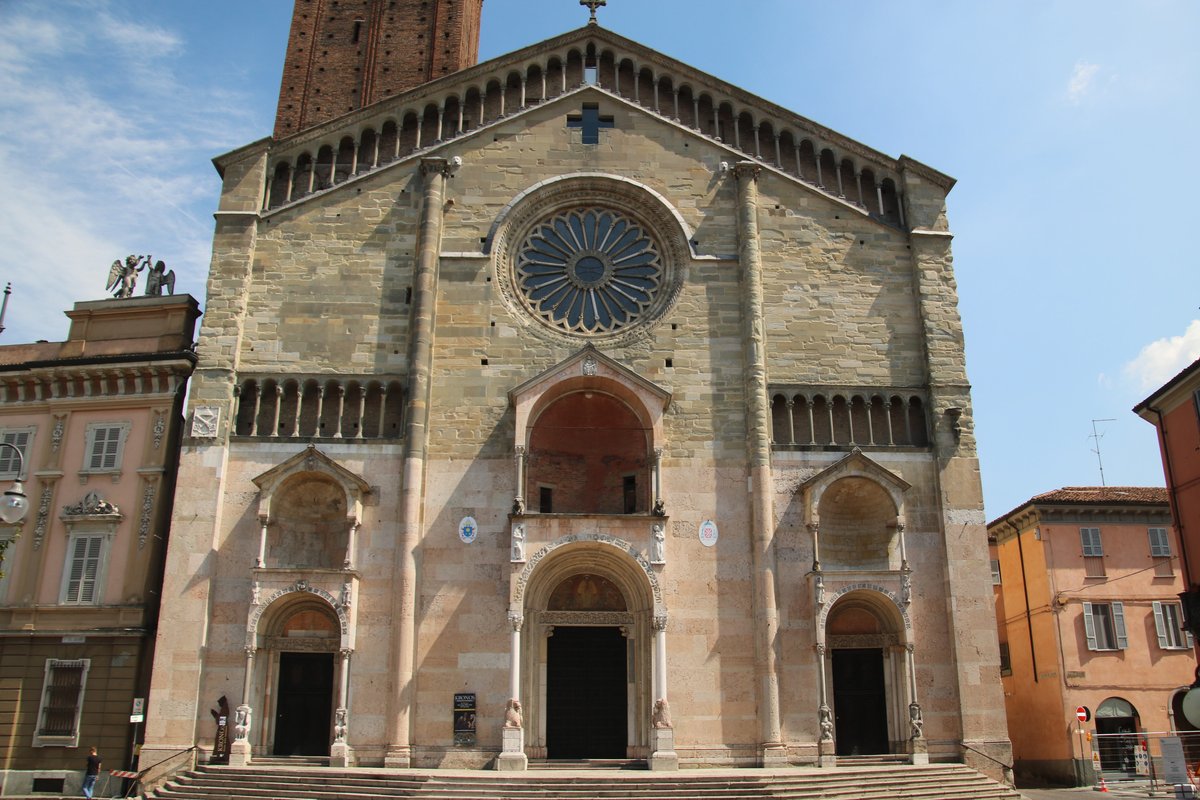 From Piazzale Milano, in a few minutes on foot you reach Piazza Duomo, the religious heart of the city. Here stands the Piacenza Cathedral, dedicated to Saint Mary of the Assumption and Saint Justina, a masterpiece of Po Valley Romanesque architecture. Construction began in 1122, after the earthquake of 1117 destroyed the previous cathedral, and continued until 1233. The gabled façade, made of sandstone and pink Verona marble, is divided by pilasters and arcaded galleries: look closely, because the three portals are decorated with bas-reliefs of the Wiligelmus school. The bell tower, 72.5 meters high, was completed in 1333, and on its spire stands the Angil dal Dom, a gilded copper angel, symbol of the city. Inside, the atmosphere is solemn: twenty-five massive pillars divide the three naves, and on the pillars you find the plaques of the medieval guilds that financed the work. At the center, the octagonal crossing tower houses the frescoes of the dome: two sections are by Morazzone, the other six by Guercino, who between 1626 and 1627 painted prophets, sibyls, and stories of the Virgin. Don’t miss the crypt, the oldest part, with 108 Romanesque columns and the relics of Saint Justina. If you feel like climbing, the 136-step climb takes you to a height of 27 meters (reservation recommended). Admission is free, open daily 8:30–12:30 and 15:30–19:30.
- Go to the page: Piacenza Cathedral: 14th-century frescoes, crypt with 108 columns, and panoramic view
- Piazza Duomo, Piacenza (PC)
- https://cattedralepiacenza.it/
- Open in Google Maps
- View on Google Images
You should go if…
Stop no. 6
Basilica of Saint Antoninus
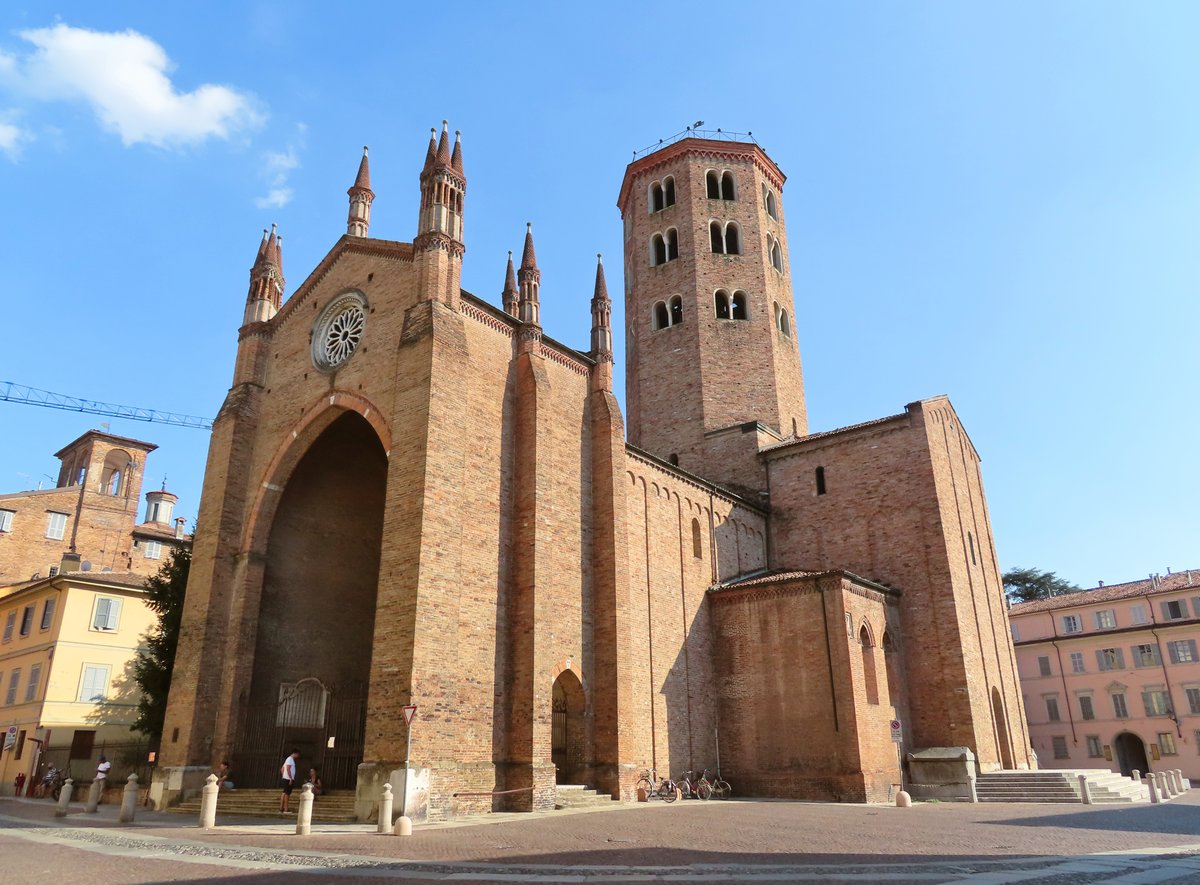 After the Duomo, take Via Scalabrini and in a few steps you’ll reach another gem of Piacenza: the Basilica of Saint Antoninus. Founded between 350 and 375 by the first bishop Vittore, it is one of the oldest churches in the city. Dedicated to the patron saint, a legionary martyred in the Val Trebbia, it has a solemn and intimate air. Outside, what catches the eye is the octagonal tower, with three orders of mullioned windows, a symbol of the basilica. Don’t miss the Atrio del Paradiso, a 14th-century Gothic portal overlooking the Via Francigena. Under this atrium, in 1183, the preliminary talks for the Peace of Constance between Frederick Barbarossa and the Lombard League were held – a plaque commemorates it. Inside, the three-nave interior blends Gothic and Baroque. On the choir vault, the frescoes by Camillo Gavasetti (1622) and the canvases by Robert de Longe with the stories of Saint Antoninus stand out. Under the high altar rest the relics of the saint. If you have time, visit the small Chapter Museum with polyptychs, illuminated codices, and a manuscript from 840. Outside, the 15th-century cloister offers a peaceful corner. Hours: weekdays 8 am–12 pm and 4–6:30 pm, holidays 9 am–12:30 pm and 8–9:30 pm. Free admission.
- Via Gianbattista Scalabrini, Piacenza (PC)
- http://www.sant-antonino.it/default.aspx
- Open in Google Maps
- View on Google Images
You should go if…
Stop no. 7
Ricci Oddi Modern Art Gallery
 Leaving the basilica, in just a few minutes on foot you’ll reach Via San Siro 13, where the Ricci Oddi Modern Art Gallery awaits. Inaugurated in 1931, it originated from the collection of Piacenza nobleman Giuseppe Ricci Oddi, who donated over seven hundred works dating from 1830 to 1930 to the city. The building, designed by Giulio Ulisse Arata, incorporates the structures of the former convent of San Siro and offers nineteen exhibition halls organized by region and artistic movement. Here you’ll find works by Tuscan Macchiaioli, Antonio Fontanesi, and 20th-century masters such as Boccioni, Carrà, Morandi, De Pisis, Boldini, and Pellizza da Volpedo. However, the true star is the Portrait of a Lady by Gustav Klimt, recovered in 2019 after a theft that lasted nearly 22 years – a story that captivated the world. Don’t miss the Ecce Puer by Medardo Rosso and paintings by Hayez and Segantini either. The gallery has recently been renovated (reopening April 2026) with new displays and audio guides. Open Tuesday to Sunday (closed Monday), full ticket €10. An immersion in art that amazes.
- Via San Siro 13, Piacenza (PC)
- https://riccioddi.it
- Open in Google Maps
- View on Google Images
You should go if…
Stop no. 8
Margherita Gardens
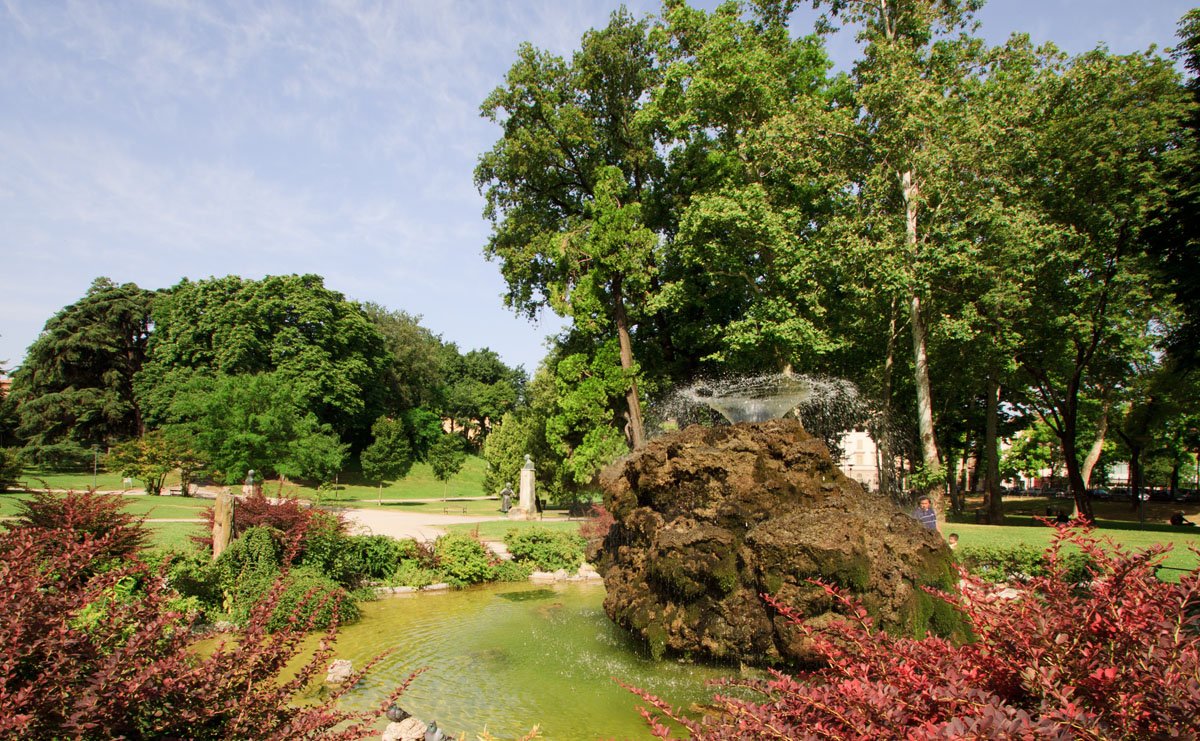 After visiting the Ricci Oddi gallery, in a few minutes on foot you reach the Giardini Margherita, the main park in the historic center, right in front of the station. Originally a private garden of Count Giacomo Costa in the first half of the 19th century, it was designed in Romantic style by Giovanni Motta and later redesigned by the Savoy gardener Giuseppe Roda, who inaugurated it in 1893 naming it after Queen Margherita. Among winding paths, undulating flowerbeds and centuries-old trees – plane trees, cedars of Lebanon, lindens – stand out the Temple of Psyche (which once housed a bust of Mazzini, now in the Museum of the Risorgimento) and the imposing monument to Garibaldi by Enrico Astorri. The park was completely renovated in 2026: gravel paths, new lighting, restored benches, and an irrigation system. In summer it hosts concerts and shows, but it’s beautiful to visit in any season for a refreshing walk. A corner of nature that welcomes those arriving by train and offers an oasis of peace in the heart of the city.
- Piacenza (PC)
- Open in Google Maps
- View on Google Images
You should go if…
Stop no. 9
Basilica of San Savino
 End your day with a visit to the Basilica of San Savino, one of the most fascinating Romanesque churches in Piacenza. After a stroll through the Giardini Margherita, you find yourself in a place that feels suspended in time: the facade is Baroque from 1721, but inside you breathe the Middle Ages. The layout is three naves with sculpted capitals—human and monstrous figures—that make you look up. But the true treasure is under your feet: in the presbytery, a 12th-century mosaic shows Time personified holding a sphere, surrounded by virtues and battles. Then go down to the crypt, where another mosaic depicts the months and zodiac signs on a sea of waves. Don’t miss the 12th-century wooden crucifix above the main altar. The basilica is open daily with free admission—a perfect end to your itinerary.
- Via Giulio Alberoni, Piacenza (PC)
- Open in Google Maps
- View on Google Images
You should go if…