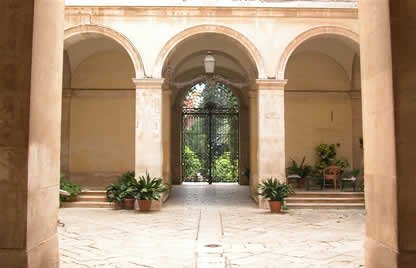
The Jatta National Archaeological Museum is a gem in the historic center of Ruvo di Puglia. Housed in the elegant Palazzo Jatta, built between 1842 and 1844, it preserves over 2,000 archaeological finds, with an extraordinary collection of Attic and Apulian red-figure vases from the 4th century BC. Among the must-see pieces is the famous Talos vase, a masterpiece of Attic pottery.
Key points:
• Unique collection: Greek and Apulian vases in exceptional condition.
• 19th-century display: one of the few examples in Italy of a private collection that remains intact.
• Historic palace: building designed by architect Luigi Castellucci.
• Talos vase: absolute masterpiece displayed in the last room.
A Plunge into the 1800s Among Vases and Myth
Entering the Jatta National Archaeological Museum is like stepping back in time. Not just because of the ancient artifacts, but because of the atmosphere itself: the 19th-century palace, the original display cases, and the red velvet divans welcome you as if you were a guest of an 1800s collector. Here, the history of Peucetia comes to life through over two thousand vases, craters, and amphorae. The highlight? The Vase of Talos, an absolute masterpiece of Attic red-figure pottery. And everything is authentic: the collection remains intact in its original arrangement. A rarity in Italy, it makes you feel part of a bygone era. Prepare to explore four rooms full of wonders, where each object tells a piece of Magna Graecia.
A Plunge into the 1800s Among Vases and Myth
Entering the Jatta National Archaeological Museum is like stepping back in time. Not just because of the ancient artifacts, but because of the atmosphere itself: the 19th-century palace, the original display cases, and the red velvet divans welcome you as if you were a guest of an 1800s collector. Here, the history of Peucetia comes to life through over two thousand vases, craters, and amphorae. The highlight? The Vase of Talos, an absolute masterpiece of Attic red-figure pottery. And everything is authentic: the collection remains intact in its original arrangement. A rarity in Italy, it makes you feel part of a bygone era. Prepare to explore four rooms full of wonders, where each object tells a piece of Magna Graecia.
The Story of the Jatta Brothers
It all began at the start of the 19th century, when brothers Giovanni and Giulio Jatta, driven by their love for their homeland, started gathering treasures from the Ruvo necropolises. Giovanni, a magistrate in Naples, purchased vases already in circulation, while Giulio supervised the excavations. To house the collection, they built Palazzo Jatta between 1842 and 1844, designed by Luigi Castellucci. After their deaths, their nephew Giovanni Jr. organized the museum and published the catalog in 1869. The collection was declared a National Monument in 1881 and transferred to the state in 1991. Following a restoration, it reopened to the public in October 2023, preserving its original atmosphere. Today, you can also take a 360° virtual tour to explore the rooms.
The Story of the Jatta Brothers
It all began at the start of the 19th century, when brothers Giovanni and Giulio Jatta, driven by their love for their homeland, started gathering treasures from the Ruvo necropolises. Giovanni, a magistrate in Naples, purchased vases already in circulation, while Giulio supervised the excavations. To house the collection, they built Palazzo Jatta between 1842 and 1844, designed by Luigi Castellucci. After their deaths, their nephew Giovanni Jr. organized the museum and published the catalog in 1869. The collection was declared a National Monument in 1881 and transferred to the state in 1991. Following a restoration, it reopened to the public in October 2023, preserving its original atmosphere. Today, you can also take a 360° virtual tour to explore the rooms.
The Four Rooms: A Journey Through Ancient Pottery
The museum unfolds across four ground-floor rooms, each with its own character. It begins with the geometric terracottas of the Peucetians (7th–6th century BC). In the second room, around 700 red-figure vases await you, among them an imposing mask crater from the 4th century BC attributed to the Baltimore Painter. The third room holds over 400 pieces and the bust of Giovanni Junior. But it’s the fourth room that steals the show: here, the Talos vase takes center stage with its depiction of the Cretan giant. Everything is arranged in 19th-century taste: the finest objects in the foreground, without chronological order. An exhibition setup that alone is worth the visit, with original furnishings that transport you into a noble salon.
The Four Rooms: A Journey Through Ancient Pottery
The museum unfolds across four ground-floor rooms, each with its own character. It begins with the geometric terracottas of the Peucetians (7th–6th century BC). In the second room, around 700 red-figure vases await you, among them an imposing mask crater from the 4th century BC attributed to the Baltimore Painter. The third room holds over 400 pieces and the bust of Giovanni Junior. But it’s the fourth room that steals the show: here, the Talos vase takes center stage with its depiction of the Cretan giant. Everything is arranged in 19th-century taste: the finest objects in the foreground, without chronological order. An exhibition setup that alone is worth the visit, with original furnishings that transport you into a noble salon.
A Masterpiece to Admire: The Talos Vase
If there’s one piece you can’t miss, it’s the Talos Vase. A red-figure krater from the 5th century BC, considered one of the greatest masterpieces of Attic pottery. It depicts the death of the giant Talos, protector of Crete, killed by Medea through deceit. The details are incredible: the expressions, the folds of clothing, the power of the scene. And it’s not the only gem: the collection also features the krater of the Baltimore Painter and other vases with scenes from mythology and daily life. But the Talos is the undisputed king. Get ready to be amazed by this wonder, which alone justifies the trip to Ruvo di Puglia.
A Masterpiece to Admire: The Talos Vase
If there’s one piece you can’t miss, it’s the Talos Vase. A red-figure krater from the 5th century BC, considered one of the greatest masterpieces of Attic pottery. It depicts the death of the giant Talos, protector of Crete, killed by Medea through deceit. The details are incredible: the expressions, the folds of clothing, the power of the scene. And it’s not the only gem: the collection also features the krater of the Baltimore Painter and other vases with scenes from mythology and daily life. But the Talos is the undisputed king. Get ready to be amazed by this wonder, which alone justifies the trip to Ruvo di Puglia.
Three good reasons to step inside
1. For the unique exhibition: in Italy you won’t find another museum with a 19th-century private collection so perfectly preserved. 2. For the Talos Vase, a masterpiece that alone is worth the ticket (€6 full, €2 reduced). 3. For the small size: you can explore it in an hour, perfect if you’re short on time but want a quality experience. And if you’re passionate about Magna Graecia, here you’ll find artifacts that tell the story of Peucetia, with over 2,000 well-preserved objects. Plus, the museum offers a virtual tour to prepare for your visit or relive it at home.
Three good reasons to step inside
1. For the unique exhibition: in Italy you won’t find another museum with a 19th-century private collection so perfectly preserved. 2. For the Talos Vase, a masterpiece that alone is worth the ticket (€6 full, €2 reduced). 3. For the small size: you can explore it in an hour, perfect if you’re short on time but want a quality experience. And if you’re passionate about Magna Graecia, here you’ll find artifacts that tell the story of Peucetia, with over 2,000 well-preserved objects. Plus, the museum offers a virtual tour to prepare for your visit or relive it at home.
The Best Time to Visit
The museum is small and often quiet, but if you want to avoid the (non-existent) crowds, go on weekdays, preferably in the morning. The midday light best illuminates the vases in the display cases. In autumn or spring, the walk through the historic center of Ruvo di Puglia is delightful. But to be honest, any season is fine: the museum is air-conditioned and the experience is entirely indoors. If you go on Friday or Saturday, the extended hours until 7:45 PM allow you to combine the visit with an aperitivo in the square.
The Best Time to Visit
The museum is small and often quiet, but if you want to avoid the (non-existent) crowds, go on weekdays, preferably in the morning. The midday light best illuminates the vases in the display cases. In autumn or spring, the walk through the historic center of Ruvo di Puglia is delightful. But to be honest, any season is fine: the museum is air-conditioned and the experience is entirely indoors. If you go on Friday or Saturday, the extended hours until 7:45 PM allow you to combine the visit with an aperitivo in the square.
What to See Nearby
After your visit, don’t miss the historic center of Ruvo di Puglia, with its Romanesque Cathedral and white alleys. If you have a bit more time, just a few kilometers away is the Archaeological Park of Cannae (site of the Battle of Cannae, 216 BC), where you can walk among the ruins of an ancient city. Or, for a taste of local flavors, stop at one of the area’s wineries to sample the local Moscato di Trani. But even just a coffee in Piazza Bovio is a lovely way to end the day.
What to See Nearby
After your visit, don’t miss the historic center of Ruvo di Puglia, with its Romanesque Cathedral and white alleys. If you have a bit more time, just a few kilometers away is the Archaeological Park of Cannae (site of the Battle of Cannae, 216 BC), where you can walk among the ruins of an ancient city. Or, for a taste of local flavors, stop at one of the area’s wineries to sample the local Moscato di Trani. But even just a coffee in Piazza Bovio is a lovely way to end the day.