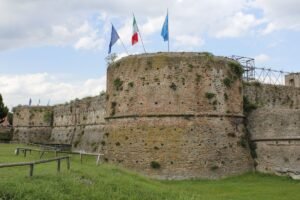
San Leo Fortress: Renaissance stronghold with historical prisons and 360° views

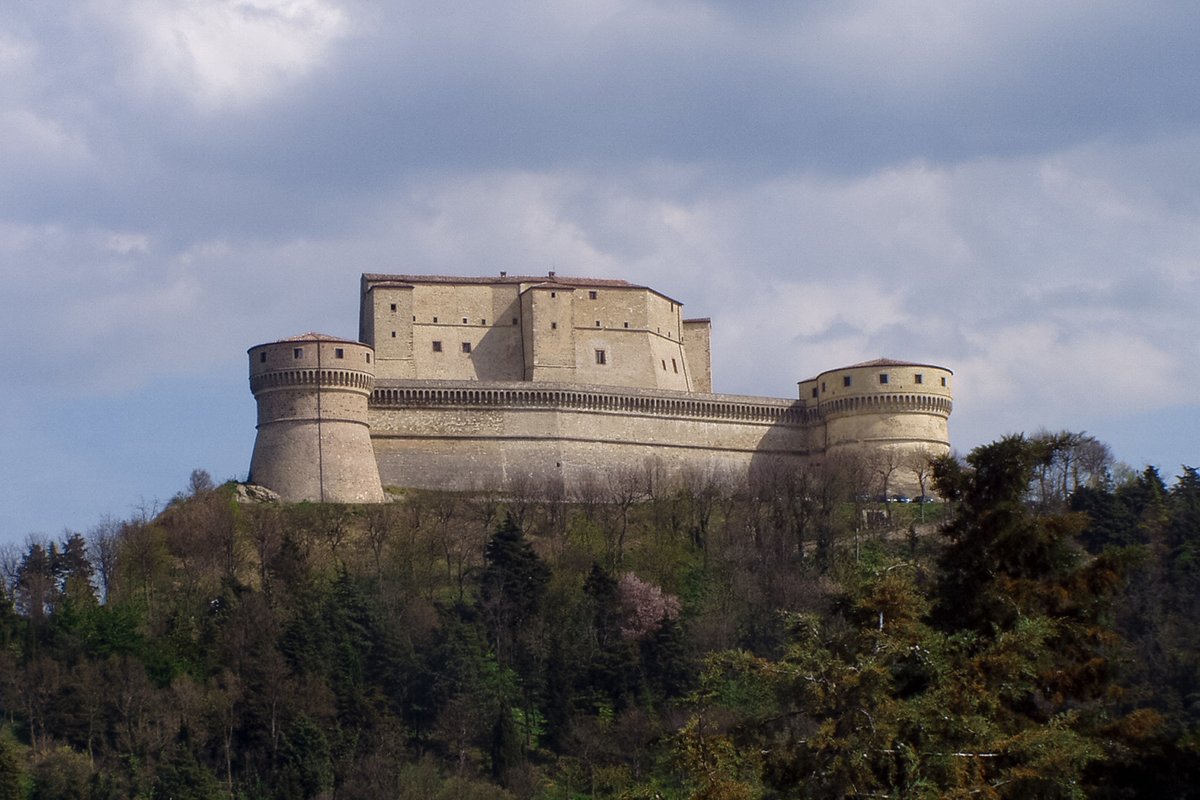
The Rocca di San Leo is a Renaissance fortress built on a rocky spur overlooking the Valmarecchia, designed by engineer Francesco di Giorgio Martini for the Montefeltro family. It offers an immersive experience between military history and breathtaking landscapes.

• 15th-century fortress with mighty walls directly fused into the rock
• Historical prisons where the Count of Cagliostro, a famous alchemist, was imprisoned
• 360-degree panorama over the medieval village of San Leo and the Montefeltro hills
• Interior halls with armor, period furniture, and original patrol walkways


Events nearby

Copertina itinerario San Leo Fortress: Renaissance stronghold with historical prisons and 360° views
15th-century fortress designed by Francesco di Giorgio Martini, featuring the Count of Cagliostro’s prisons, walls fused into the rock, and panoramic views over Montefeltro. Explore the halls with armor and the dungeons.

Good to know


Introduction

The first time you see the Rocca di San Leo, it takes your breath away. It’s not just a fortress; it’s a colossus of stone that seems to sprout from the rock, clinging to a sheer spur overlooking the Marecchia Valley. Approaching from the medieval village below, you feel as if you’re nearing a sleeping giant. Its mass dominates everything, and from afar, you understand why the Montefeltro family chose it as an impregnable stronghold. I visited on a windy day, and watching clouds race past its towers was pure theater. This isn’t a dusty museum; it’s a place that tells stories of sieges, illustrious prisoners, and power, all contained within those mighty walls. The climb to reach it is part of the experience: each turn offers a new perspective until you find yourself there, at its feet, feeling tiny.

Historical Overview

The history of the fortress is a tapestry of power, military engineering, and legend. Its origins trace back to Roman times, but it was under the Montefeltro family in the fifteenth century that it became a true war machine, redesigned by the genius of Francesco di Giorgio Martini. Consider that Duke Federico da Montefeltro deemed it impregnable. In subsequent centuries, under Papal State control, it transformed into a feared maximum-security prison. Its most famous inmate? Giuseppe Balsamo, known as Count Cagliostro, alchemist and adventurer, who died there in 1795 after years of confinement. Walking through its cells, one still senses a somber, almost oppressive atmosphere. Its story is not linear; it consists of overlapping chapters, each leaving an indelible mark on the stone.

  • Prehistory/Romans: Early settlements on the rocky spur.
  • Middle Ages: Fortification of the site by various lordships.
  • 1441: Francesco Sforza conquers the fortress.
  • 1479-1482: Radical renovation commissioned by Federico da Montefeltro, designed by Francesco di Giorgio Martini.
  • 1631: Comes under direct control of the Papal State.
  • 18th-19th Centuries: Used as a state prison. Count Cagliostro is imprisoned and dies here (1795).
  • Today: National monument and museum.

Architecture: A Masterpiece of Military Engineering

What strikes you, beyond its location, is how the fortress is fused with the rock it stands on. It’s not built on top; it’s an integral part of the mountain. Francesco di Giorgio Martini, a Renaissance architect and engineer, worked wonders. The walls follow the irregular shape of the spur, creating an almost organic form. Walking along the patrol walkways, you can appreciate ingenious details: the cross-shaped loopholes for arquebuses, designed for precise shooting; the corbels (those stone projections) that support the upper structures and allowed defenders to pour boiling oil on attackers. Inside, the spaces are surprisingly intricate: courtyards, rooms for the garrison, water cisterns, and, of course, the prisons. It’s not just a simple stone box; it’s a complex organism where every element has a precise function. The feeling is of walking inside an enormous, sophisticated time machine.

The Visiting Experience: Between History and Thrills

Visiting the Fortress is not a passive museum stroll. It’s an immersive experience. You enter and are immediately catapulted into another era. The rooms are furnished with period furniture and armor, but it’s the overall atmosphere that speaks. The stone steps worn by footsteps, the low vaulted ceilings, the light filtering through arrow slits creating plays of shadow. The most intense part is undoubtedly the prison route. Descending into the dungeons, where the air is cooler and the echo amplifies every sound, sends shivers down your spine. Reading the names and stories of prisoners graffiti on the walls is a gut punch. Then, suddenly, you emerge onto a terrace and are faced with a 360-degree panorama of Montefeltro that reconciles you with beauty. It’s this contrast, between the darkness of the prisons and the dazzling light of the landscape, that makes the visit unforgettable. I recommend taking the time to linger, not rush.

Why Visit

For at least three concrete reasons. First, to experience firsthand the Renaissance engineering genius. Seeing how it was adapted to the rock is a living lesson in military architecture. Second, for the narrative power of the place. You don’t need a detailed guide: its walls, cells, and views alone tell centuries of history, wars, and imprisonment. It’s an open book in stone. Third, for the perfect pairing with the village of San Leo. The visit to the fortress gains full meaning only if you then take time to wander through the alleys of the town below, between the Pieve and the Duomo. They are two sides of the same coin, one military and austere, the other civil and intimate. Additionally, for enthusiasts, it’s a natural film set (it has been used in several productions) and a unique geological observation point on the rocky spur.

When to Go

I would avoid the midday hours on the hottest summer days, as the climb and sun exposure on the ramparts can be tiring. My candid advice? Aim for late afternoon, especially in spring or early autumn. The light is warmer, golden, and sculpts the fortress stones, offering spectacular photographs. The low sun highlights every detail of the walls and casts long, dramatic shadows. Moreover, toward closing time, organized groups tend to thin out, allowing for a bit of tranquility. In winter, if you catch a clear day after snowfall, the view is breathtaking, but always check opening hours as weather conditions can sometimes limit access. The atmosphere changes completely with the seasons, and each moment has its own charm.

In the Surroundings

The visit to the Rocca fits perfectly into an itinerary through Montefeltro. Just a short distance away, I highly recommend a stop at San Marino, the Republic atop Mount Titano. The contrast is intriguing: from one medieval fortress-state to another, still sovereign today. For a more intimate and spiritual experience, it’s worth detouring to the Franciscan Sanctuary of La Verna, in the province of Arezzo but less than an hour’s drive away. This is where Saint Francis received the stigmata, nestled in a forest of beech and fir trees of absolute peace. These are two very different proposals: one of power and borders, the other of mysticism and nature. Both complete the picture of a territory, Montefeltro, incredibly rich in history and atmosphere.

Itineraries nearby


💡 Did You Know…?

The cell where Giuseppe Balsamo, known as Cagliostro, was imprisoned is one of the most evocative spots: here the alchemist spent the last years of his life, and his mysterious story adds an aura of legend to the visit. Don’t miss the San Leo well, carved into the living rock and over 60 meters deep, an extraordinary hydraulic work for its time. According to tradition, the patron saint Leone performed miracles right in this place, giving the village its name. Climbing the towers, on clear days you can even glimpse the Adriatic Sea on the horizon.