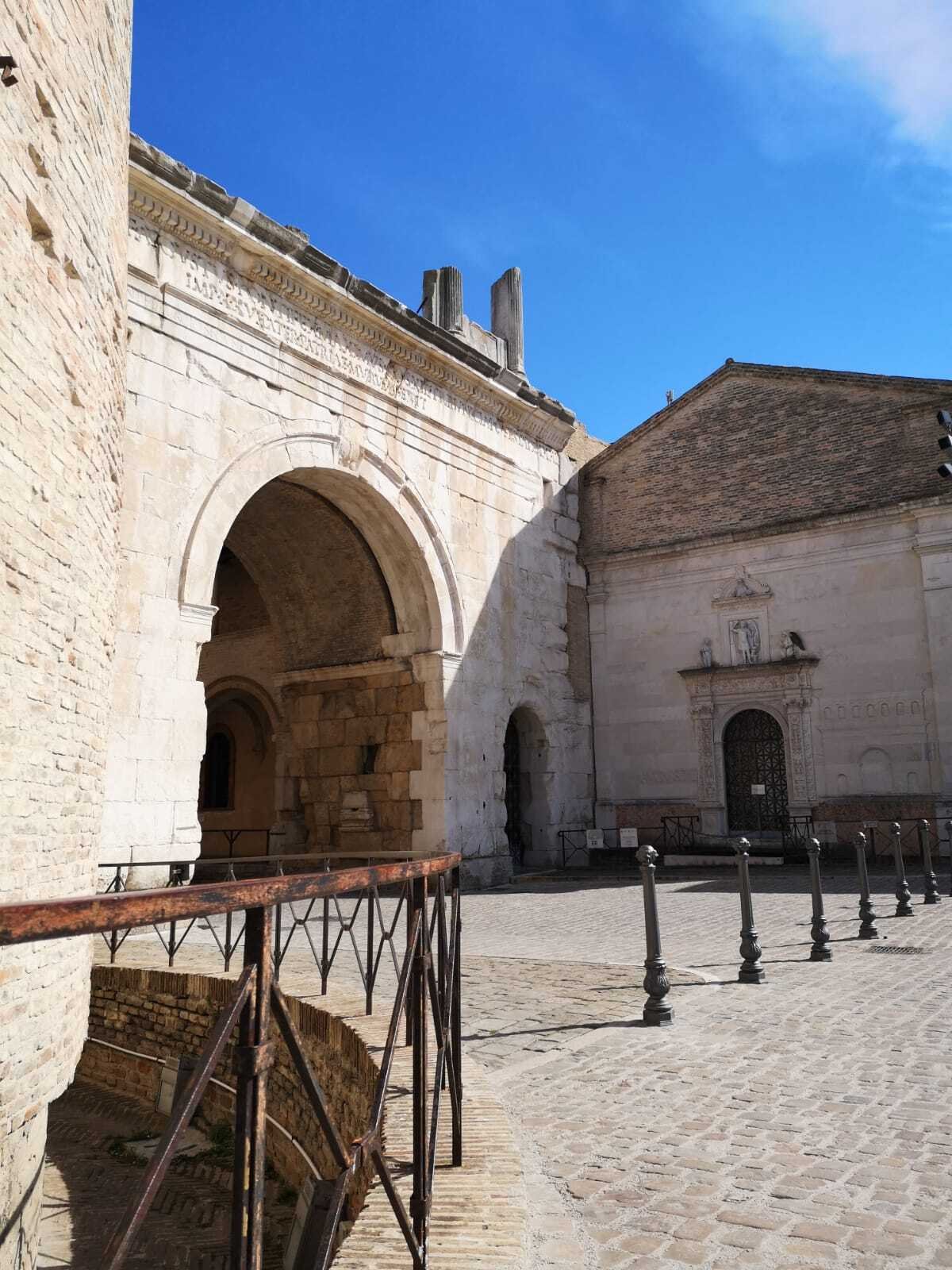
The Arch of Augustus in Fano is the original entrance to the Roman city of Fanum Fortunae, built in 9 AD in honor of Emperor Augustus. It remains in its original position, seamlessly integrated into the modern urban fabric along Via Arco d’Augusto, just steps from the historic center and seafront. Its massive structure, made of local travertine, features details such as statue brackets and composite capitals, offering an authentic historical experience accessible to all.
- Perfectly preserved Roman monument from 9 AD in its original structure
- Conveniently located in the historic center, freely accessible without queues
- Built from local travertine, the same stone used for the nearby Roman walls
- Ideal starting point to explore Fano’s historic center and its charming alleys
Introduction
Have you ever walked down an ordinary street and stumbled upon a piece of history that stops you in your tracks? In Fano, the Arch of Augustus does just that. It’s not an isolated monument in an archaeological park, but stands proudly amidst city traffic, at the intersection of Via Arco d’Augusto and Corso Matteotti. The first time I saw it, I was struck by the contrast: on one side, the white marble, worn by time yet still solemn; on the other, cars speeding by. It’s a Roman triumphal arch, one of the best preserved in the Marche region, yet it feels almost like a neighbor, an integral part of daily life. Its location, right where the northern entrance to the Roman city of *Fanum Fortunae* once stood, makes you feel like you’re stepping through a doorway in time. It’s not as majestic as other imperial arches, but it has an authenticity that wins you over. The local stone, travertine, has taken on those warm hues that only centuries can bestow.
Historical Background
This arch was not built to celebrate a military victory, but to thank Emperor Augustus. The date is precise:
9 AD. Augustus had funded the construction of Fano’s walls, and the citizens dedicated this arch to him as a sign of gratitude. Imagine: nearly two thousand years ago. The original inscription, unfortunately lost, commemorated this. The arch has witnessed everything: from Roman legions to invasions, from the Middle Ages to the present day. It has survived earthquakes, wars, and the expansion of the modern city. A curious fact? In the 18th century, they even built a house on top of it, later removed during restoration. Its structure is massive, with a single fornix (meaning a single arched opening), and the capitals of the side half-columns are in a composite style, a mix of Ionic and Corinthian. It’s not just a stone; it’s a silent witness to Fano’s history.
Timeline in a nutshell:
- 9 AD: construction of the arch in honor of Augustus.
- Roman era: marks the northern entrance to the city.
- Middle Ages: incorporated into the city’s defenses.
- 18th century: a house is built against the structure.
- 20th-century restorations: the house is removed, and the arch is brought back to light.
The Details That Speak
Come closer and look carefully. There are no narrative bas-reliefs like on the Arch of Constantine, but the beauty lies in the details. The protruding brackets up high, beneath the cornice, likely supported statues. Imagine them up there, watching over the Via Flaminia that passed right through here. Then observe the stone: it’s not uniform marble, but local travertine, full of veins and small fossils. If you visit in the early afternoon, with the sun beating on the facade, you’ll see these imperfections become poetry. Another detail I love: the arch isn’t perfectly symmetrical. The centuries have slightly bent it, but that’s precisely what makes it human. Under the vault, the passage is narrow, almost intimate. You walk through it and for a moment you’re away from the noise of the main street. It’s a small experience, but one that stays with you. You don’t need a guide to understand it; just stop for a minute and let the stone tell its story.
Fano beyond the arch
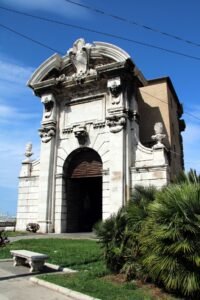
Visiting the Arch of Augustus also means discovering the context in which it lives. It’s not a relic in a display case, but the ideal starting point for exploring Fano’s historic center. From there, taking Corso Matteotti (the old Via Flaminia), you dive into a series of alleyways and small squares. Just a few steps away is the Church of San Michele, with its simple and powerful Romanesque facade. A little further on, Piazza XX Settembre, with the Fountain of Fortune, almost a modern counterpoint to the arch’s Roman heritage. As you walk, you understand why the arch was placed right there: it was the hinge of the city. Today, it’s as if it still holds everything together. Personal advice? After seeing the arch, deliberately lose your sense of direction in the alleys behind it. You’ll find artisan workshops, small cafes, and unexpected glimpses. The arch, from a distance, will always serve as a beacon to find your way back.
Why Visit It
For three concrete reasons. First: it’s extremely accessible. It’s located right in the city center, with no queues or tickets required. Just arrive and look up. Second: it’s a concentrated dose of history without rhetoric. It doesn’t bombard you with information, but invites you to reflect on the layering of time in a living city. Third: it’s perfect for a brief but intense stop during a tour of the Marche region. If you’re in Pesaro or Urbino and looking for a change of scenery, Fano with its arch is ideal. It’s not a full-day destination, but the kind of place that enriches a broader itinerary. And, last but not least, it’s a fantastic photographic subject, especially when the late afternoon light enhances its volumes.
When to Go
Avoid rush hour if you don’t want the roar of traffic as your soundtrack. My favorite time? Late afternoon in autumn, when the sun is low and the light turns golden. The slanting rays caress the stone, create long shadows, and highlight every carving, every mark of time. In summer, the early morning hours are excellent: the air is still cool and the light is clear. In winter, with a bit of haze, the arch takes on a melancholy and mysterious air, perfect. In any case, don’t seek absolute silence: part of the charm is hearing the hum of the city living around such an ancient monument.
In the Surroundings
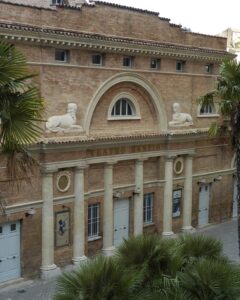
The visit to the arch pairs perfectly with two nearby experiences. The first is a stroll to the Rocca Malatestiana, the imposing fortress that overlooks Fano. The contrast between the Renaissance military architecture and the Roman simplicity of the arch is fascinating. The second, for lovers of antiquity, is the Archaeological Museum and Art Gallery of the Malatesta Palace. Here you can see artifacts from the very area of the arch and Roman Fano, providing a richer context to what you’ve seen outdoors. Both places are just a few minutes’ walk away, immersed in the same urban fabric.